 +91 72929 29159










Contractors are essential to industrial maintenance, construction and shutdown projects. However, bringing several contractors onto one site also introduces safety challenges, particularly when work activities overlap, responsibilities are unclear or critical controls are not properly verified.
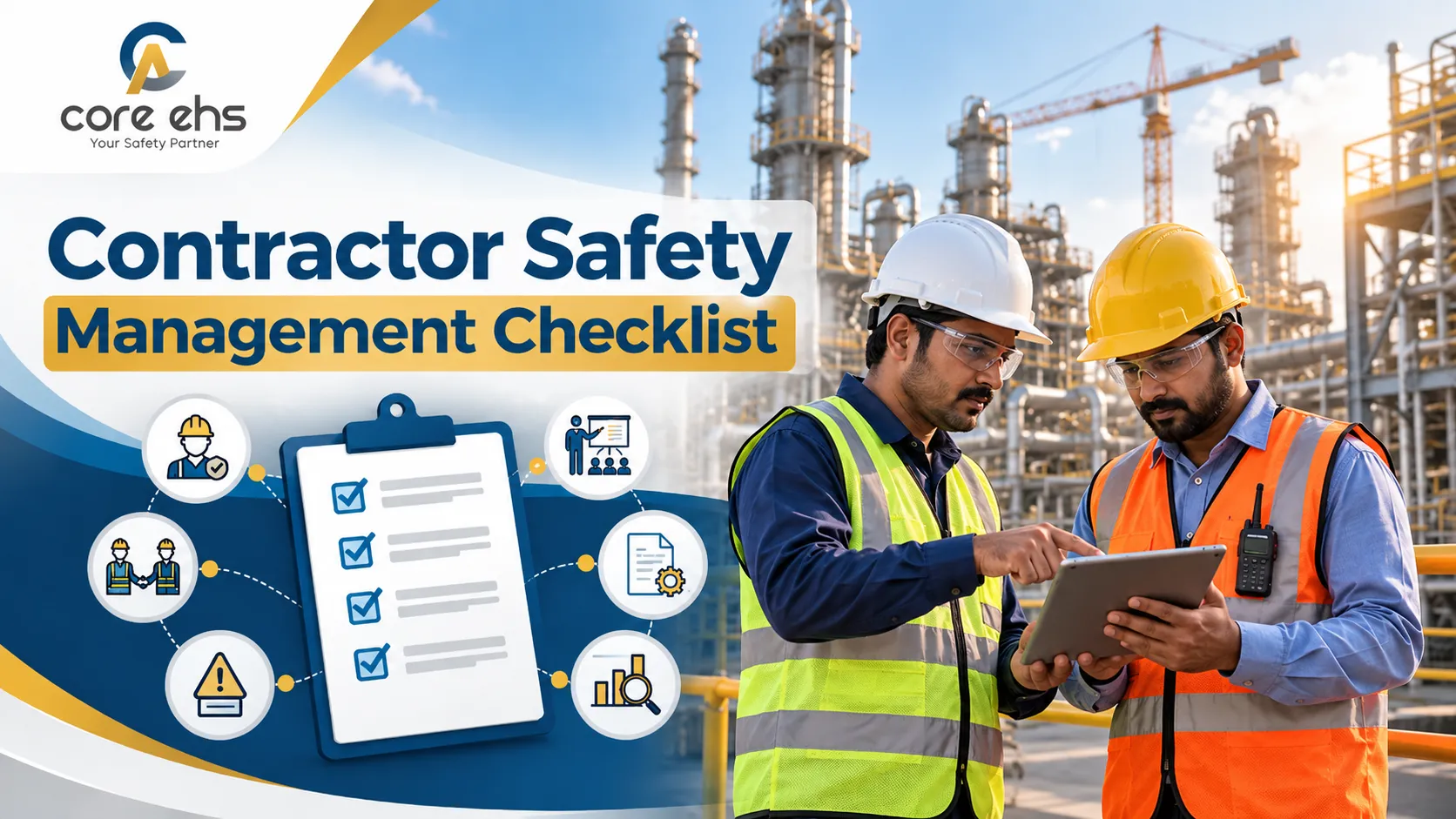
A contractor safety management checklist helps EHS teams assess contractor competency, identify worksite hazards, verify safety controls and monitor performance throughout a project.
Effective contractor safety management goes beyond checking documents before work begins. It requires coordination between the host organization and contractors, clear work authorization, regular site verification and safe project handover.
This guide explains the seven stages of contractor safety management and provides a practical checklist for industrial organizations.
What Is Contractor Safety Management?
Contractor safety management is a structured approach to selecting, evaluating, supervising and monitoring external contractors to ensure work is carried out under appropriate safety arrangements.
It covers contractor prequalification, risk assessment, worker induction, competency verification, permit-to-work requirements, field supervision, incident management and project closeout.
The main objective is to identify and control risks associated with contractor activities before and during work, rather than relying solely on prequalification documents.
For industrial organizations, this is particularly important during equipment maintenance, plant shutdowns, construction, electrical work, confined-space entry and other high-risk activities.
7 Key Stages of Contractor Safety Management

A contractor safety management process should cover the entire project lifecycle, from initial selection to final site handover.
1. Contractor Prequalification and Selection
Contractor safety begins before the contract is awarded. Organizations should evaluate whether a contractor has the technical capability, competent personnel and safety arrangements required for the proposed work.
A contractor suitable for routine housekeeping may not be qualified to undertake high-voltage electrical maintenance or confined-space activities.
Key verification points:
- Review applicable licences, registrations and work-specific qualifications.
- Assess relevant experience and previous safety performance.
- Verify worker competency and training requirements.
- Review safety management procedures and available resources.
- Confirm subcontractor arrangements and supervisory responsibilities.
Incident history can support the assessment, but it should not be the only selection criterion. Relevant technical competency and the ability to manage the actual work hazards are equally important.
Practical consideration: Contractor approval should be based on the specific work scope and associated risks, not a generic company safety declaration.
2. Pre-Mobilization Safety Planning
Once a contractor is selected, the host organization and contractor should jointly review the worksite and identify hazards that could affect workers or ongoing operations.
This stage is especially important in operating plants, where contractor activities may interact with machinery, hazardous substances, vehicle movements or other maintenance tasks.
Key verification points:
- Conduct a joint site hazard assessment.
- Review task-specific risk assessments and method statements.
- Identify simultaneous operations (SIMOPS) and work interfaces.
- Define responsibilities for implementing and verifying controls.
- Confirm emergency response and rescue arrangements.
- Inspect equipment and tools before mobilization.
For example, during a shutdown, welding near equipment maintenance can introduce additional fire or ignition hazards. Coordination is necessary to determine whether activities can proceed together or must be separated.
OSHA’s guidance on host-employer and contractor coordination emphasizes sharing information about work hazards and coordinating protective measures.
3. Contractor Induction and Competency Verification
Contractor induction ensures that workers understand site-specific hazards, operating procedures and emergency arrangements before starting work.
However, completing an induction does not automatically mean a worker is competent to perform a specialized task.
Key verification points:
- Confirm site-specific induction completion and understanding.
- Verify task-specific training, licences and authorizations.
- Communicate emergency procedures and reporting requirements.
- Confirm suitable personal protective equipment (PPE).
- Establish contractor supervision and communication arrangements.
For high-risk activities such as lifting operations, electrical work or confined-space entry, relevant competency and authorization must be verified separately.
Induction information should also be communicated in a language and format workers can understand.
4. Permit-to-Work and Critical Safety Controls
Contractor activities involving significant hazards may require formal work authorization and additional safeguards.
A Permit to Work (PTW) is a controlled authorization process used for specified hazardous or non-routine activities. It identifies the work, associated hazards, required precautions and responsible personnel.
Typical high-risk activities include:
| Activity | Essential safety verification |
| Work at height | Suitable access equipment, fall protection, inspections and rescue arrangements |
| Confined-space entry | Entry authorization, atmospheric assessment, isolation and rescue preparedness |
| Electrical maintenance | Competency, isolation and appropriate electrical safety precautions |
| Hot work | Ignition-source control, combustible material assessment and fire precautions |
| Lifting operations | Suitable lifting equipment, competent personnel and controlled lifting areas |
| Equipment maintenance | Hazardous-energy isolation and verification before work begins |
Permit requirements depend on the work and applicable regulations. A signed permit alone does not confirm that physical precautions are effective.
For equipment maintenance, hazardous-energy controls may include lockout/tagout (LOTO), stored-energy management and verification of isolation under the applicable procedure.
OSHA’s Control of Hazardous Energy guidance explains the importance of preventing unexpected equipment startup and hazardous-energy release during maintenance.
For further information, read CORE-EHS’s guide on Permit to Work in Safety.
5. Contractor Supervision and Daily Safety Monitoring
Safety controls must remain effective throughout the activity, not only when the work permit is issued.
Industrial worksites frequently change as equipment is dismantled, temporary access is installed or other contractors begin work nearby.
Regular supervision and risk-based verification help identify unsafe conditions before they develop into more serious problems.
Key verification points:
- Conduct pre-task safety briefings.
- Verify that the required safety controls are in place.
- Inspect work areas, tools, equipment and protective arrangements.
- Monitor interactions between contractors and operating departments.
- Reassess risks when work conditions or activities change.
- Record deficiencies and ensure corrective action.
Consider a plant shutdown where one contractor performs overhead lifting while another works beneath the lifting area. Even if both activities have separate approved plans, their interaction creates additional risks.
The project team must coordinate the work, establish suitable exclusion arrangements and determine whether the activities can safely occur simultaneously.
Monitoring should therefore focus on the actual effectiveness of controls, not simply the completion of inspection forms.
6. Incident Reporting and Corrective Action
Contractor workers should have a clear process for reporting incidents, near misses, hazardous conditions and failures in safety controls.
When problems occur, the host organization and contractor need to coordinate their response and identify the actions necessary to prevent recurrence.
Key verification points:
- Ensure incidents and near misses are reported promptly.
- Investigate events according to their actual and potential severity.
- Identify immediate and underlying causes.
- Assign corrective actions, owners and deadlines.
- Verify corrective-action completion.
- Review repeated or significant control failures.
For example, repeated findings of incomplete lifting-area barricading may indicate weaknesses in work planning, supervision or site coordination.
Simply reminding workers to follow the procedure may not address the underlying problem.
Safety inspections and management audits can provide complementary information about these weaknesses. Learn more in CORE-EHS’s article on the difference between safety audits and inspections.
7. Contractor Demobilization and Project Handover
Contractor safety management does not end when physical work is completed.
Before demobilization, the organization should verify that equipment, work areas and any remaining hazards have been properly addressed.
Key verification points:
- Remove temporary equipment, waste and surplus materials safely.
- Close work permits through the authorized process.
- Restore equipment and protective systems under approved procedures.
- Communicate incomplete work and residual hazards.
- Verify the condition of the worksite before handover.
- Review contractor performance and document lessons learned.
A project should not be treated as safely completed while unresolved hazards remain without appropriate controls and clear responsibility.
Formal handover helps ensure that operations and maintenance teams understand the condition of the equipment or area being returned to them.
Contractor Safety Management Checklist
The following checklist summarizes the essential verification points across the contractor lifecycle.
| Stage | Safety verification requirement | Suggested responsible person |
| Prequalification | Contractor qualifications, competency and safety arrangements verified | Contract manager / EHS |
| Prequalification | Work scope and supervisory responsibilities established | Project manager |
| Pre-mobilization | Site hazards and work interfaces assessed | EHS / contractor supervisor |
| Pre-mobilization | Risk assessments, work procedures and emergency arrangements reviewed | Project manager / EHS |
| Induction | Workers inducted and task-specific competency verified | Contractor supervisor / EHS |
| Work authorization | Applicable permits and critical safety controls verified | Permit issuer / work supervisor |
| Work authorization | Required isolation, fall protection and other high-risk controls established | Authorized personnel |
| Monitoring | Site conditions and contractor activities regularly assessed | Contractor supervisor / EHS |
| Corrective action | Unsafe conditions recorded, assigned and resolved | Action owner / EHS |
| Closeout | Work permits, equipment and site conditions safely handed over | Project manager / operations |
How to Use the Checklist
For each work package, assign the responsible person and document the verification status of each applicable requirement.
Use five statuses: Compliant, Non-compliant, Pending evidence, Not applicable and Not checked.
Maintain records of supporting evidence, deficiencies and corrective actions. Where a critical safety control is ineffective or cannot be verified, work should be restricted until the issue is resolved through an authorised process.
The checklist should be adapted to site risks, applicable laws, contractual requirements and established safety procedures.
Download the Contractor Safety Management Checklist
CORE-EHS has prepared an editable 47-point contractor safety management checklist covering prequalification, mobilisation, work authorisation, monitoring, corrective actions and project handover.
4 Most Common Contractor Safety Management Mistakes
Even organisations with established safety procedures can experience gaps in contractor control.
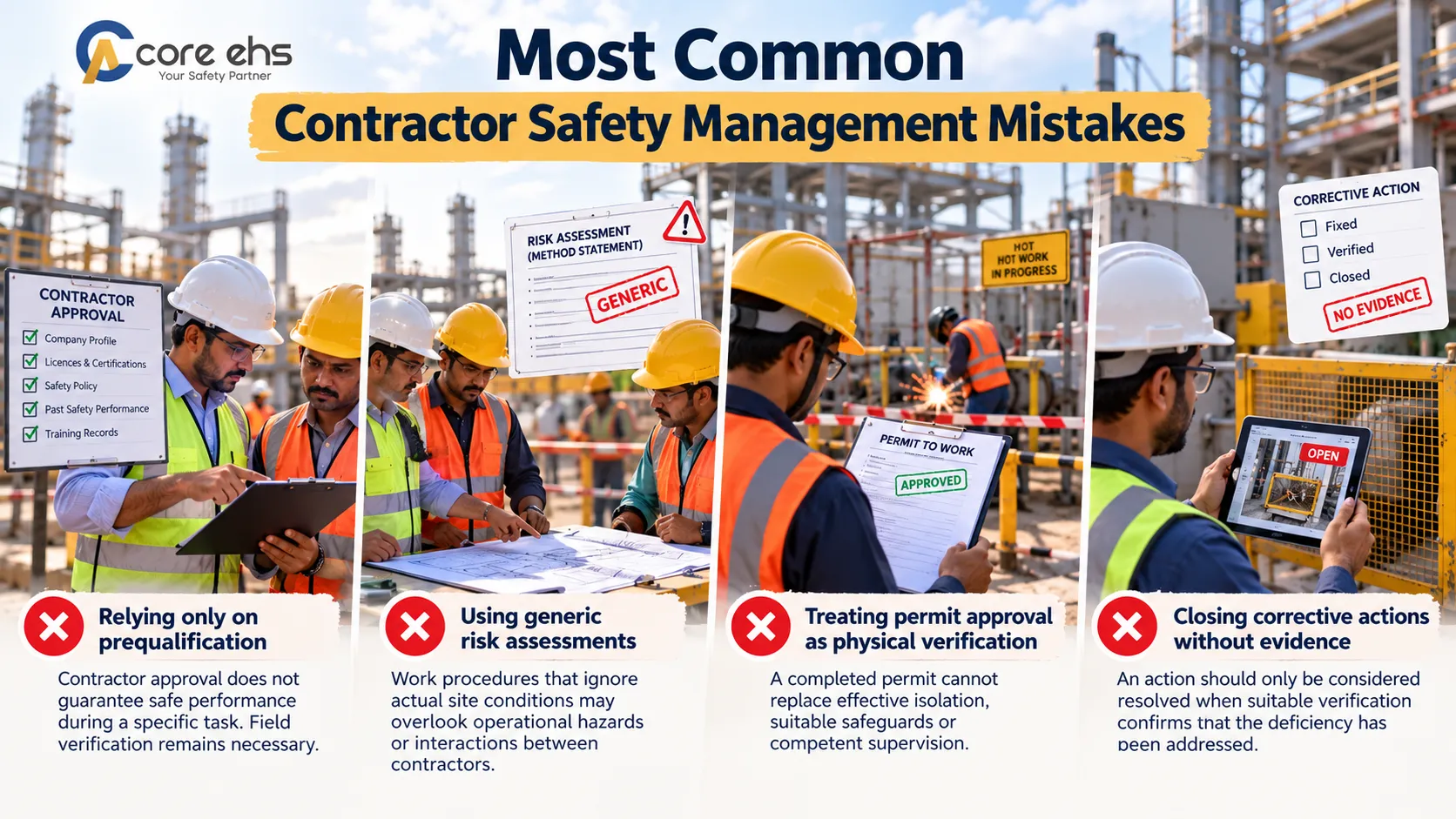
- Relying only on prequalification: Contractor approval does not guarantee safe performance during a specific task. Field verification remains necessary.
- Using generic risk assessments: Work procedures that ignore actual site conditions may overlook operational hazards or interactions between contractors.
- Treating permit approval as physical verification: A completed permit cannot replace effective isolation, suitable safeguards or competent supervision.
- Closing corrective actions without evidence: An action should only be considered resolved when suitable verification confirms that the deficiency has been addressed.
These problems are best managed through clear accountability, regular coordination and evidence-based verification.
How Digital Tools Support Contractor Safety Management
For organizations managing multiple contractors or industrial sites, digital systems can support work authorization, record management, inspection tracking and corrective-action monitoring.
Digital workflows can improve the traceability of approvals, documentation and outstanding issues. However, software does not replace physical safety controls or competent decision-making.
CORE-EHS offers digital Permit to Work software to support work authorization, safety reviews, permit monitoring and closure.
Organizations should establish effective safety processes and clearly defined responsibilities before digitizing them..
Conclusion
Effective contractor safety management requires more than collecting documents and approving contractors before mobilization.
By following a structured process, from prequalification and risk assessment to field monitoring and safe handover industrial organizations can strengthen contractor oversight, maintain critical controls and address safety deficiencies before work continues.
A practical contractor safety management checklist helps make these responsibilities visible, consistent and verifiable.