 +91 72929 29159














Workplace safety management has evolved significantly over the last decade. Organisations today are expected to track incidents, manage corrective actions, conduct audits, monitor compliance, analyse risks, and maintain accurate records across multiple sites and teams.
Yet many organisations still rely on spreadsheets to manage safety data.
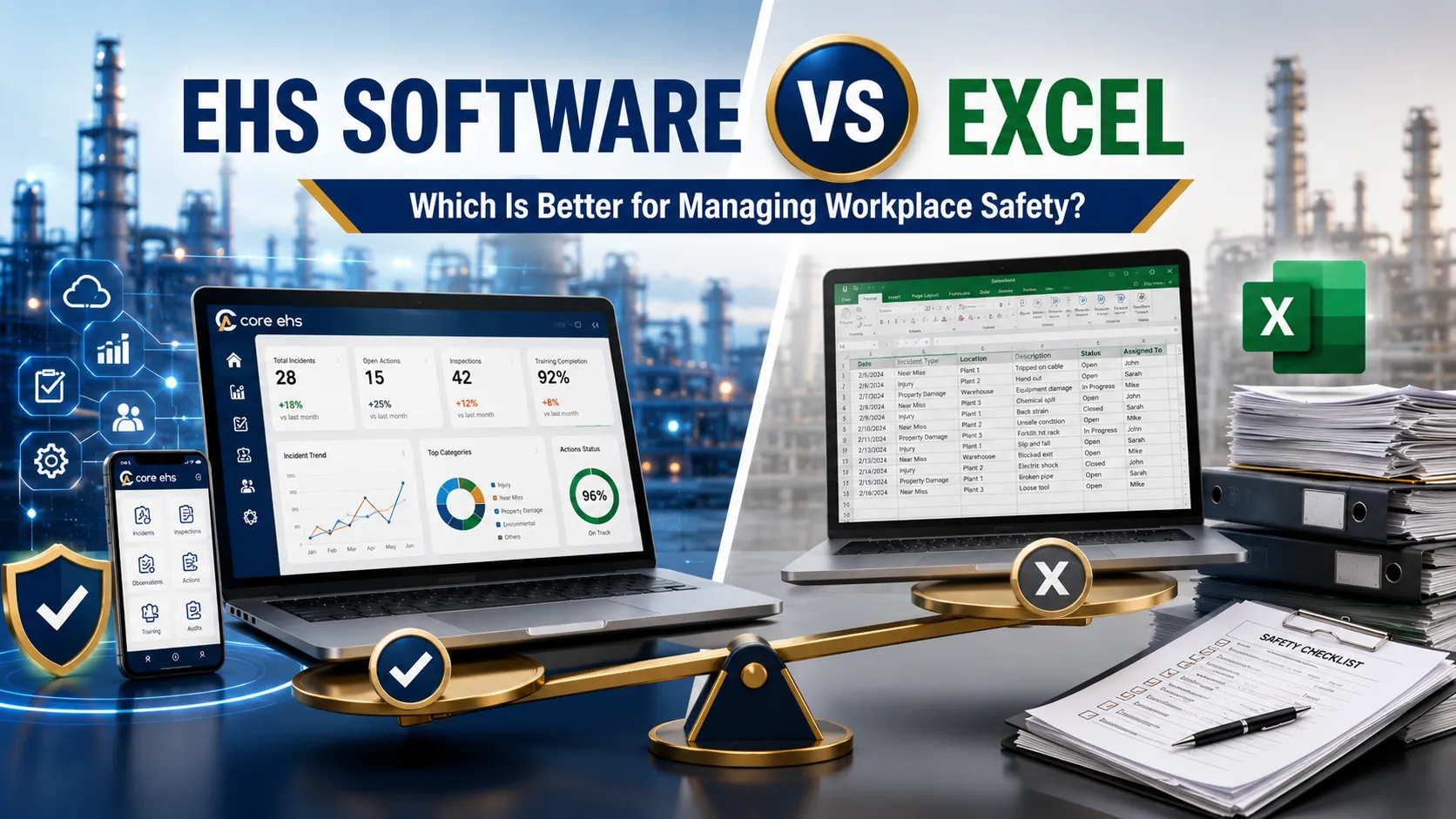
This raises an important question: EHS Software vs Excel: which is better for managing workplace safety?
While Excel remains a familiar and widely used tool, growing regulatory requirements, larger workforces, and increasing safety expectations are pushing organisations toward digital EHS platforms.
In this article, we’ll compare EHS Software vs Spreadsheets, examine their strengths and limitations, and help safety leaders determine the right approach for their organisation.
What Is EHS Software?
EHS Software (Environment, Health, and Safety Software) is a digital platform that helps organisations manage workplace safety, compliance, incidents, audits, inspections, risk assessments, corrective actions, and safety reporting from a centralised system.
Unlike spreadsheets, EHS software automates data collection, workflows, notifications, reporting, and analytics, helping organisations improve visibility and reduce administrative workload.
Common EHS software modules include:
- Incident management
- Hazard reporting
- Risk assessment
- Permit-to-work management
- Audit and inspection management
- Compliance tracking
- Training management
- Corrective and preventive action (CAPA) tracking
- Safety analytics and dashboards
Why Many Organizations Still Use Excel
Excel has been a workplace standard for decades.
Many safety professionals initially use spreadsheets because they are:
- Easy to access
- Familiar to employees
- Low cost
- Flexible for basic record keeping
- Useful for small teams
A safety manager can quickly create spreadsheets for:
- Incident logs
- Inspection checklists
- Training records
- Risk assessment registers
- Audit findings
For small organisations with limited compliance requirements, Excel may appear sufficient.
However, as operations grow, managing safety through spreadsheets becomes increasingly difficult.
Related Read: What Is the Best EHS Software for Modern Industries?
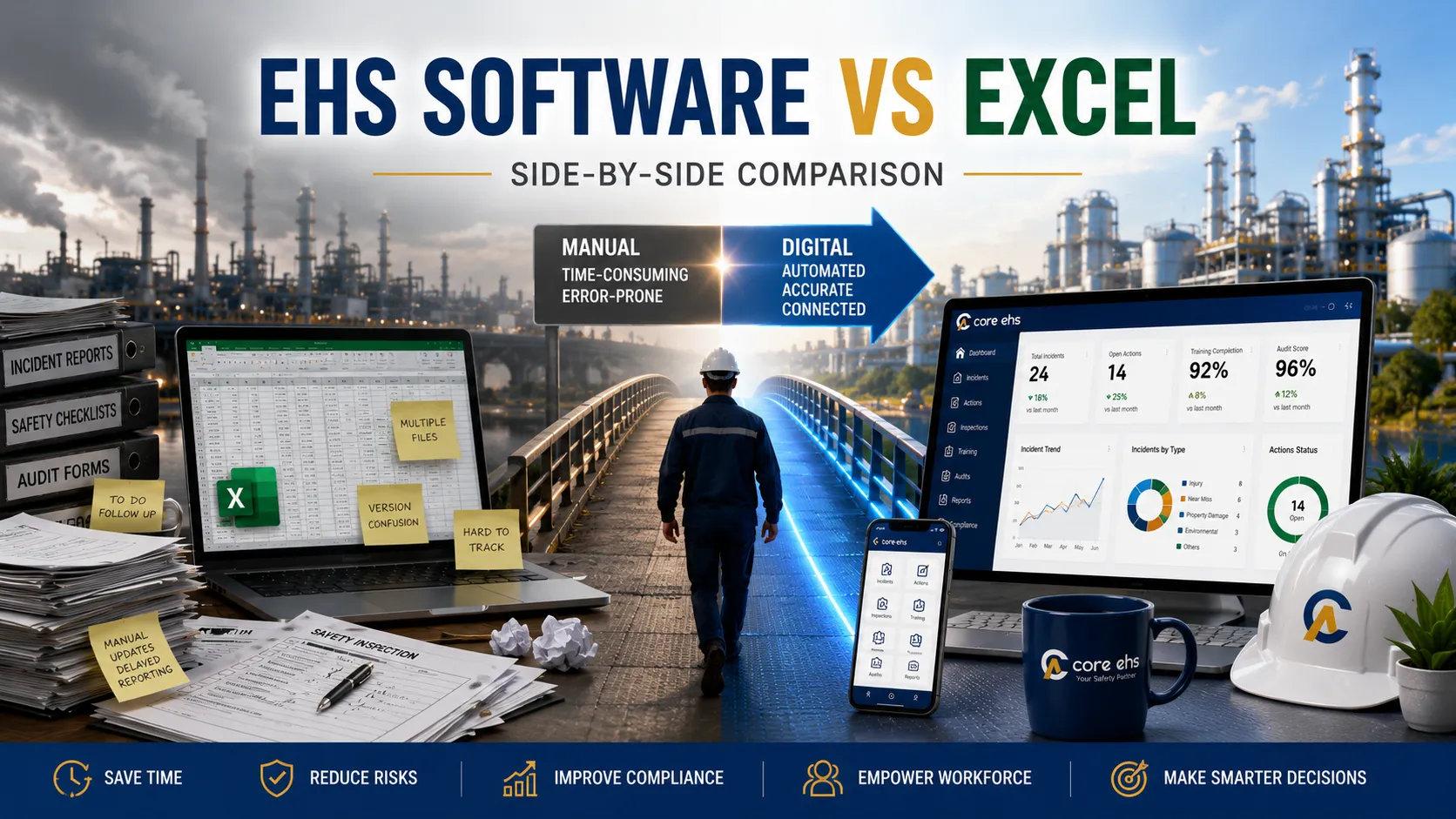
EHS Software vs Excel: Side-by-Side Comparison
| Feature | Excel/Spreadsheets | EHS Software |
| Data Entry | Manual | Automated and structured |
| Collaboration | Limited | Real-time multi-user access |
| Incident Reporting | Manual updates | Instant reporting workflows |
| Corrective Action Tracking | Manual follow-up | Automated reminders and escalations |
| Compliance Management | Difficult to monitor | Centralised compliance tracking |
| Mobile Access | Limited | Mobile-friendly applications |
| Audit Management | Manual documentation | Digital audits and inspections |
| Reporting | Time-consuming | Real-time dashboards |
| Data Accuracy | Higher risk of errors | Standardised data collection |
| Scalability | Limited | Designed for growth |
| Analytics | Basic charts | Advanced safety intelligence |
| Record Retention | File dependent | Secure centralized database |
The comparison clearly shows that both tools can manage data, but they differ significantly in efficiency, visibility, and scalability.
The Hidden Challenges of Managing Safety in Spreadsheet
Many organisations do not recognise spreadsheet limitations until safety processes become difficult to manage.
1. Version Control Problems
Multiple versions of the same spreadsheet often circulate across departments.
Safety teams may struggle to identify:
- The latest file
- Updated corrective actions
- Current audit status
- Approved risk assessments
This creates confusion and increases the risk of outdated information being used for decision-making.
2. Manual Data Entry Errors
Even experienced professionals make mistakes.
Common spreadsheet issues include:
- Incorrect formulas
- Missing data
- Duplicate entries
- Accidental deletions
When safety decisions rely on accurate information, these errors can have serious consequences.
3. Limited Visibility Across Locations
Consider a manufacturing company operating across five facilities.
If each site maintains separate spreadsheets:
- Incident trends become difficult to identify
- Management lacks real-time visibility
- Reporting becomes time-intensive
Consolidating data often requires significant manual effort.
4. Poor Follow-Up of Corrective Actions
A safety audit may identify 50 corrective actions.
Tracking them manually through spreadsheets often results in:
- Missed deadlines
- Delayed closures
- Inconsistent accountability
Without automated reminders, actions can remain open for months.
5. Difficulty During Compliance Audits
Regulatory inspections frequently require organisations to provide:
- Incident records
- Training records
- Risk assessments
- Inspection reports
- Action closure evidence
Finding these records across multiple spreadsheets can become stressful and time-consuming.
Where EHS Software Creates Value
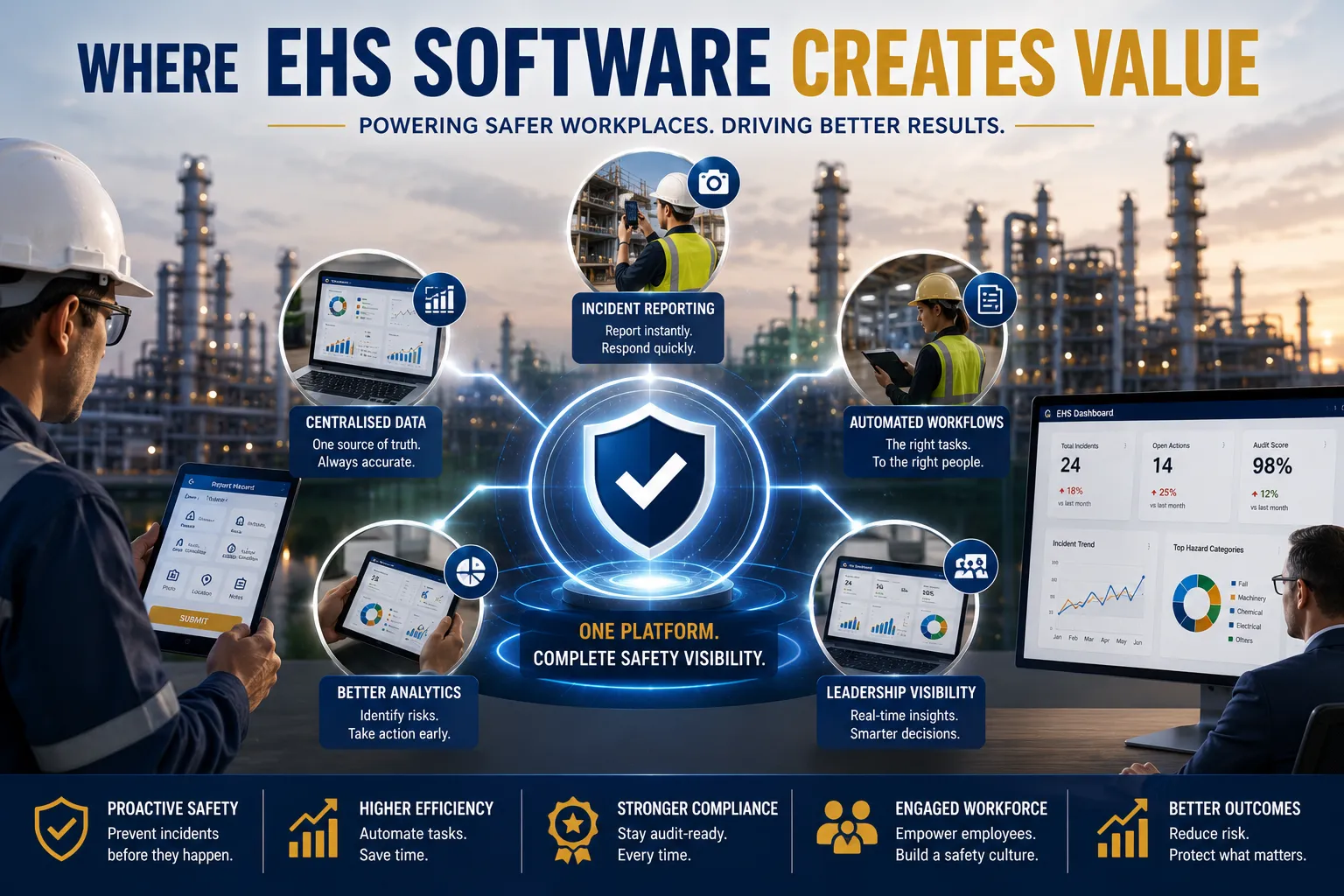
Organisations often move to EHS software when manual processes begin affecting efficiency and compliance performance.
Centralised Safety Data
All safety information is stored in a single system.
This creates:
- One source of truth
- Consistent reporting
- Improved data integrity
- Faster access to records
Safety managers no longer need to search through dozens of spreadsheets.
Faster Incident Reporting
Employees can report incidents, hazards, and near misses immediately.
For example:
A worker identifies an unsafe condition on a construction site.
Instead of filling out a spreadsheet later, they can submit:
- Photos
- Location details
- Hazard information
- Corrective action requests
This speeds up response times and improves the reporting culture.
Automated Workflows
Modern EHS systems automatically route tasks to responsible individuals.
Examples include:
- Incident investigations
- Corrective action assignments
- Audit findings
- Compliance reviews
Notifications and reminders help ensure actions are completed on time.
Better Analytics
Data becomes useful only when organisations can learn from it.
EHS software helps identify:
- Repeated incident causes
- Safety performance trends
- Leading indicators
- Compliance gaps
This enables proactive decision-making rather than reactive management.
Improved Leadership Visibility
Executives often need safety performance insights quickly.
Instead of manually compiling reports, dashboards can display:
- Open incidents
- Audit scores
- Hazard trends
- Training compliance
- Action closure rates
This supports informed leadership decisions.
Practical Example: Excel vs EHS Software
Imagine a construction company with 2,000 workers across multiple projects.
Using Excel
The safety team manages:
- Incident records in one spreadsheet
- Audit findings in another
- Training records separately
- Corrective actions through email
Monthly reporting requires several days of manual consolidation.
Finding trends is difficult.
Using EHS Software
The same organisation can:
- Capture incidents instantly
- Conduct digital inspections
- Assign corrective actions automatically
- Monitor compliance through dashboards
- Generate reports in minutes
The result is greater visibility, faster response times, and improved operational efficiency.

Checklist: Is It Time to Move Beyond Excel?
Use this checklist to evaluate your current safety management approach.
If you answer “Yes” to three or more questions, EHS software may provide significant value.
Safety Management Assessment Checklist
- Do you manage safety data across multiple spreadsheets?
- Do corrective actions frequently miss deadlines?
- Do you struggle to create safety reports quickly?
- Do you operate across multiple sites or locations?
- Do employees need mobile reporting capabilities?
- Do compliance audits require extensive document searches?
- Do you want better visibility into safety trends?
- Do you spend significant time consolidating data manually?
- Do you need real-time safety performance dashboards?
- Do you want stronger accountability for corrective actions?
The more boxes you check, the greater the benefits of digital safety management.
When Excel May Still Be Appropriate
Despite its limitations, Excel can still work effectively in certain situations.
Examples include:
- Small organizations with fewer employees
- Single-site operations
- Limited compliance requirements
- Basic incident tracking needs
- Organisations beginning their safety journey
For these businesses, spreadsheets may provide a practical starting point.
However, safety leaders should recognise that growth often increases complexity and reporting requirements.
The Future of Workplace Safety Management
Organisations worldwide are increasingly adopting digital solutions to improve safety performance.
Several factors are driving this shift:
- Growing regulatory expectations
- Larger distributed workforces
- Real-time reporting needs
- Data-driven decision-making
- Increased focus on proactive safety culture
The goal is not simply replacing spreadsheets.
The goal is to create systems that help organisations identify risks earlier, respond faster, and continuously improve workplace safety.
Conclusion: EHS Software vs Excel
When comparing EHS Software vs spreadsheet, the right choice depends on organisational size, complexity, and safety objectives.
Excel remains useful for basic record keeping and small-scale operations. However, as organisations grow, spreadsheet-based safety management often becomes difficult to maintain.
In the debate of EHS Software vs Spreadsheets, EHS software provides stronger visibility, automation, collaboration, accountability, and analytics. These capabilities help organisations manage safety more efficiently while supporting compliance and continuous improvement.
For safety leaders looking to move beyond manual processes, digital EHS platforms can provide the structure and insights needed to build a more proactive safety culture.
Ready to Digitise Your Safety Management Process?
CORE-EHS helps organisations transform workplace safety through integrated EHS software solutions for incident management, hazard reporting, audits, inspections, risk assessments, compliance tracking, and corrective action management.
Book a demo with CORE-EHS today and discover how digital safety management can help improve visibility, accountability, and safety performance across your organisation.