 +91 72929 29159














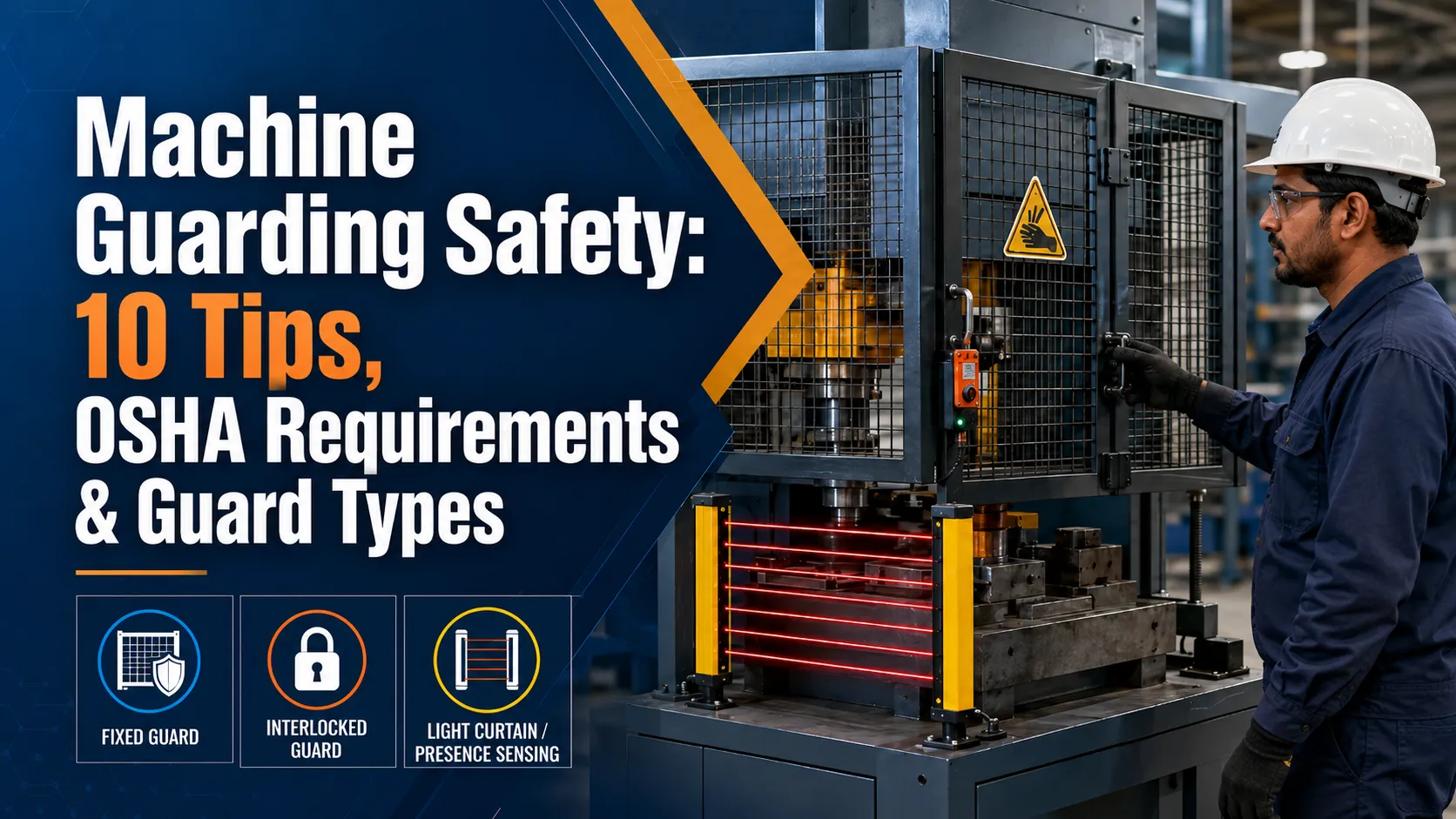
Machine guarding safety can fail in seconds when a damaged, missing, or bypassed safeguard exposes a worker to moving equipment. The risk is not limited to large machines. A rotating shaft, cutting blade, belt drive, or unexpected startup can cause a serious injury before an operator has time to react.
The issue also remains a major compliance concern. Machine guarding under 29 CFR 1910.212 ranked tenth on OSHA’s list of the most frequently cited standards for fiscal year 2025.
This guide explains OSHA requirements, common hazards, types of guards, and 10 practical steps organisations can use to strengthen machine guarding safety.
What Is Machine Guarding Safety?
Machine guarding safety is the use of physical barriers, protective devices, controls, and safe procedures to prevent workers from reaching dangerous machine areas. Effective safeguards protect operators, maintenance personnel, and other employees working near the equipment.
Machine hazards are commonly divided into three main zones:
- The point of operation, where cutting, shaping, punching, shearing, or forming takes place
- The power transmission apparatus, including belts, pulleys, gears, chains, couplings, and shafts
- Other moving parts, including rotating, reciprocating, feeding, and auxiliary components
Physical guards must be suitable for the equipment, securely installed, and maintained in working condition. Training, supervision, inspections, and safe work practices support the guard but do not replace it.
Machine guarding remains one of OSHA’s most frequently cited standards because missing, damaged, unsuitable, or bypassed safeguards can directly expose workers to hazardous machine motion.
OSHA Machine Guarding Requirements
The main OSHA machine guarding requirements for general industry appear in 29 CFR 1910.212, General Requirements for All Machines.
The standard requires one or more guarding methods to protect operators and other employees from hazards created by:
- Points of operation
- Ingoing nip points
- Rotating parts
- Flying chips
- Sparks
- Other hazardous machine movements
For effective machine guarding safety, safeguards should:
- Prevent workers from contacting hazardous moving parts
- Be securely attached wherever practical
- Avoid creating sharp edges, pinch points, or other new hazards
- Allow normal machine operation without encouraging removal or bypass
- Protect both the operator and other people in the machine area
OSHA also requires point-of-operation guards to prevent workers from placing any part of their body inside the danger zone during the machine’s operating cycle.
Employers should identify hazards through a machine-specific risk assessment or Job Safety Analysis, select suitable controls, train affected employees, and maintain inspection and repair records.
When guards must be removed for servicing, cleaning, adjustment, or jam clearing, hazardous energy must be controlled through an appropriate lockout/tagout procedure under 29 CFR 1910.147.
Refer to OSHA’s official general machine guarding requirements for the complete regulatory text.
What is a Machine Guarding Hazard?
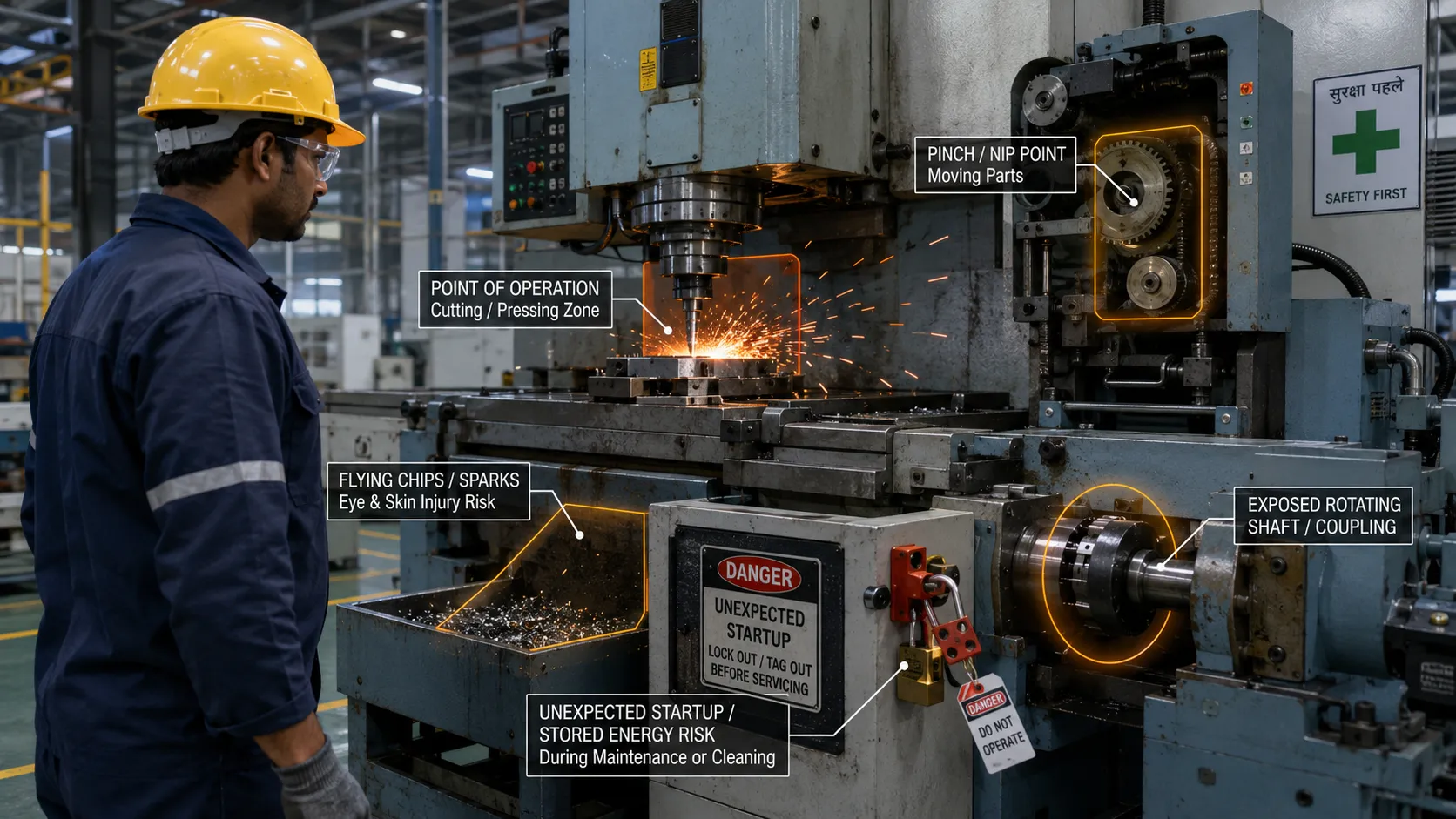
Common machine guarding hazards can appear during production, setup, cleaning, maintenance, and troubleshooting. Employers should assess at least the following exposures:
- Point-of-operation hazards: Cutting, punching, shearing, bending, or forming actions
- Pinch and nip points: Areas where moving parts trap or crush body parts
- Rotating parts: Shafts, couplings, flywheels, spindles, and chucks
- Flying material: Chips, sparks, fragments, broken tools, or workpieces
- Unexpected startup or stored energy: Movement during servicing, cleaning, or jam removal
These hazards should be reassessed whenever equipment, materials, operating speeds, tooling, layouts, or work methods change.
What Are the Different Types of Guards on Machines
Different machine safeguards are used according to the equipment, task, access needs, and level of risk.
| Guard or device | How it protects workers |
| Fixed guards | Permanently block access to hazardous parts and normally require tools for removal. |
| Interlocked guards | Stop or prevent machine operation when the guard is opened or removed. |
| Adjustable guards | Can be repositioned for different material sizes but must be correctly set before operation. |
| Self-adjusting guards | Move as material enters the machine while limiting access to the hazardous area. |
| Presence-sensing devices | Light curtains and similar devices detect entry into the danger zone and initiate a safe response. |
| Pullback or restraint devices | Limit hand movement so the operator cannot reach the hazard during the machine cycle. |
| Two-hand controls | Require both hands to activate the machine, keeping them away from the point of operation during the hazardous cycle. |
OSHA identifies barrier guards, two-hand tripping devices, and electronic safety devices as examples of acceptable safeguarding methods.
No single safeguard is suitable for every machine. A risk assessment should consider the severity of possible harm, frequency of access, stopping time, reach paths, maintenance needs, and reliability of the control before selecting the most appropriate option among the different types of machine guards.
10 Machine Guarding Safety Tips
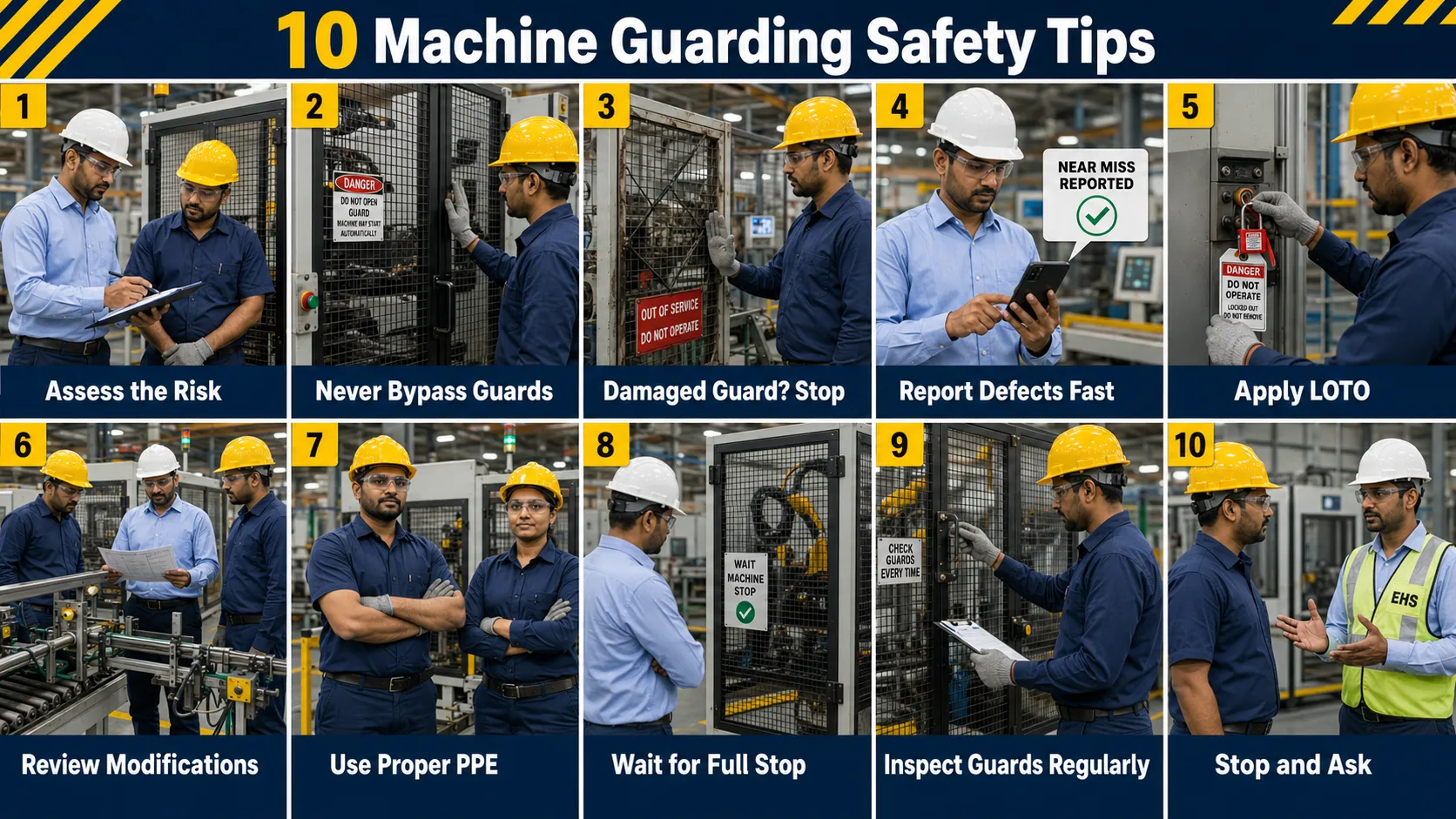
These machine guarding safety tips focus on practical actions that operators, supervisors, maintenance teams, and EHS professionals can apply during daily work.
1. Assess the Risk Before Choosing a Guard
Review every operating mode, including production, setup, cleaning, tool changes, fault finding, and maintenance. Select safeguards according to how workers may reach or enter the danger zone.
2. Never Remove or Bypass a Safeguard
Machine guarding safety depends on guards, interlocks, and sensing devices remaining effective. Stop the machine and report any safeguard that interferes with work instead of removing, altering, or defeating it.
3. Do Not Operate with a Damaged Guard
Cracked panels, loose fasteners, enlarged openings, misaligned interlocks, or unauthorized modifications can reduce protection. Isolate the affected equipment until a competent person confirms that it is safe to operate.
4. Report Defects and Near Misses Immediately
Report missing guards, exposed moving parts, unusual vibration, delayed stopping, or repeated interlock faults. Early near-miss reporting can prevent a minor equipment defect from becoming a serious incident.
CORE ART Hazard Reporting Software allows workers to report machine guarding hazards, near misses, unsafe acts, and unsafe conditions through mobile or web access. Safety teams can assign corrective actions, track closure, and monitor recurring machine safety issues through a centralized dashboard.
5. Apply LOTO Before Removing Guards
Shut down, isolate, lock, tag, release stored energy, and verify zero-energy conditions before maintenance, cleaning, adjustment, tool changes, or jam clearing begins.
6. Review Every Machine Modification
New tooling, conveyors, access platforms, sensors, guards, or production changes may create new pinch points and reach paths. Repeat the risk assessment before returning modified equipment to service.
7. Use Task-Appropriate PPE and Clothing
Wear required eye, face, hearing, foot, or other protection according to the risk assessment. Secure long hair and avoid loose clothing, jewellery, or gloves where entanglement with moving parts is possible.
OSHA warns that clothing, jewellery, long hair, and even gloves can become caught in moving machine components.
8. Wait Until All Motion Has Stopped
Do not reach into equipment simply because the power has been switched off. Flywheels, blades, rollers, rotating tools, and stored pressure may continue moving or release energy after shutdown.
9. Inspect Safeguards on a Schedule
A reliable machine guarding safety program checks guard condition, fasteners, openings, interlocks, sensors, emergency stops, and safe distances before failure occurs. Record findings and track corrective actions through closure.
10. Stop and Ask When Unsure
Never guess whether a guard, access method, or operating condition is safe. Stop work and escalate the concern to a supervisor, maintenance lead, competent person, or EHS representative.

Building a Machine Guarding Safety Culture
A strong machine safety culture goes beyond installing physical guards. Supervisors should reinforce safe behaviour, include safeguard checks in relevant toolbox talks, encourage near-miss reporting, and respond quickly when workers raise concerns.
Employees should understand that stopping an unsafe machine is a responsible action, not a production failure. Regular inspections, refresher training, clear accountability, and learning from repeated defects help make safe machine operation part of everyday work instead of a one-time compliance exercise.
CORE-EHS supports organisations in strengthening machine guarding safety through structured machine safety audits, risk assessments, workforce training, and practical recommendations. These services help identify guarding gaps, improve worker awareness, and build safer, more consistent machine-operating practices across the workplace.
Conclusion
Effective machine guarding safety combines suitable safeguards, hazard assessment, worker training, planned inspections, and energy-control procedures.
Strengthen your machine controls with a structured CORE-EHS machine safety audit and receive practical recommendations for reducing risks, closing compliance gaps, and protecting workers.