 +91 72929 29159













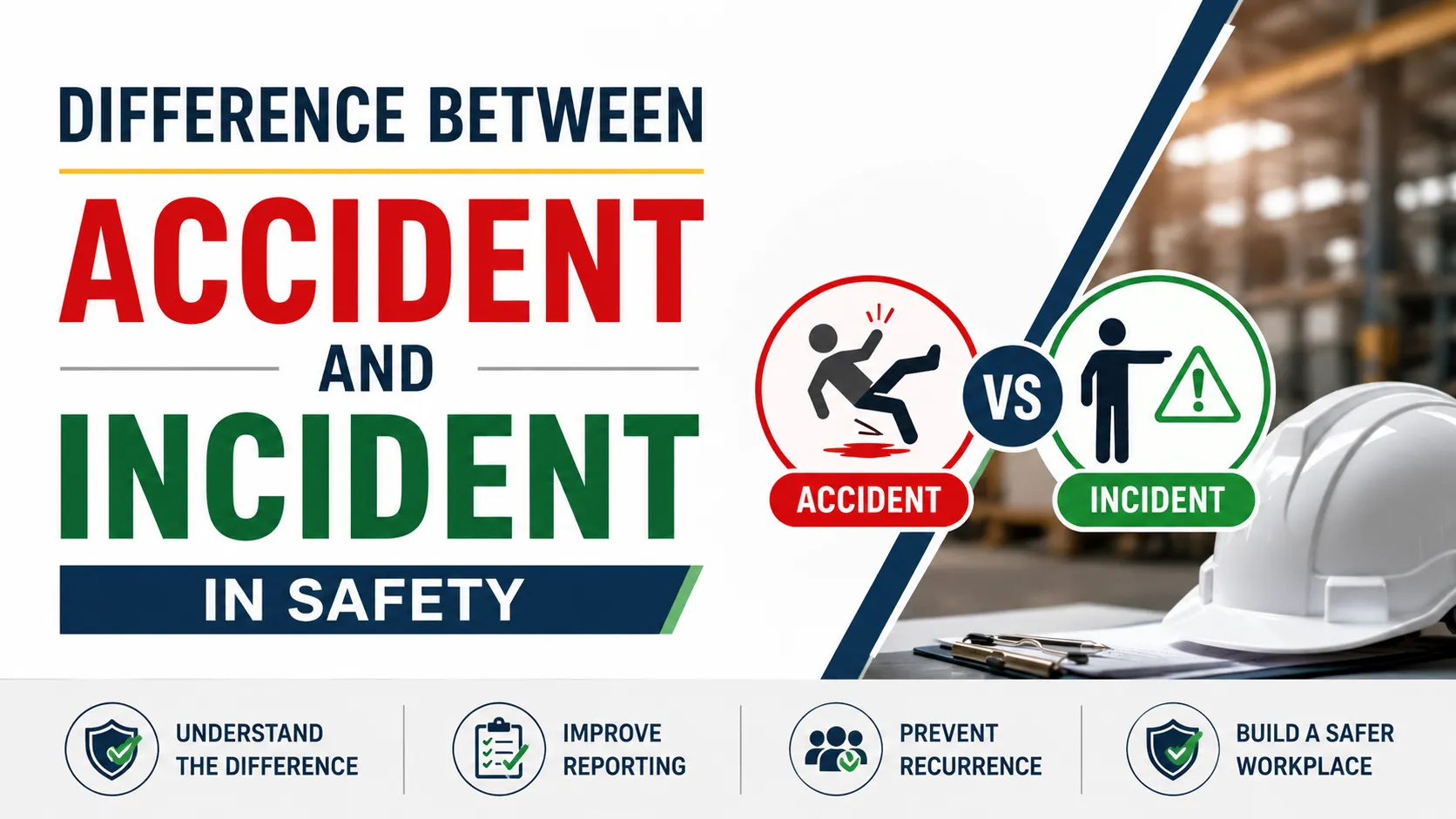
In workplace safety, the terms accident and incident are often used together, but they do not mean the same thing. Understanding the difference between accident and incident in safety helps organisations improve reporting, investigate risks correctly, and prevent serious workplace harm.
An accident is an unplanned event that results in injury, illness, property damage, equipment loss, or environmental impact. An incident is also an unplanned safety event, but it may or may not result in harm. In simple words, every accident can be considered an incident, but every incident is not always an accident.
This difference matters because many serious accidents are preceded by smaller incidents, unsafe acts, or near misses. When these early warning signs are reported and reviewed properly, safety teams can take corrective action before someone gets hurt.
For any workplace, clear accident and incident reporting is not just a compliance requirement. It is a practical way to build a stronger safety culture, reduce repeat events, and protect workers across daily operations.
Accident vs Incident in Safety (Quick Comparison)
Understanding the difference becomes easier when you compare both side by side. This quick table highlights the key distinctions used in workplace safety management.
| Parameter | Accident | Incident |
| Definition | Unplanned event that causes injury, damage, or loss | Unplanned event that may or may not cause harm |
| Injury/Damage | Always involves injury, illness, or damage | May not involve injury or damage |
| Severity | High impact event | Low to high potential risk |
| Reporting Urgency | Immediate and critical reporting required | Should be reported for prevention and analysis |
| Example | Worker injured due to machine malfunction | Object falls near worker but no injury |
This comparison helps safety teams quickly classify events and take the right action. Proper classification is important for accurate reporting, investigation, and future risk prevention.
What is an Accident in Workplace Safety?
An accident in workplace safety refers to an unplanned event that results in actual harm, such as injury, illness, property damage, or equipment loss. Accidents are typically visible, measurable, and require immediate attention because they directly impact people, operations, and business continuity.
In most industries, accidents are considered serious safety events because they lead to lost work time, medical treatment, or financial loss. This is why organisations have strict protocols for reporting, investigating, and preventing workplace accidents.
Common Characteristics of an Accident
- Involves physical injury or health impact
- Causes damage to equipment, property, or the environment
- Requires immediate reporting and investigation
- Leads to corrective and preventive actions
Accident Real-World Example
A worker slips from an elevated platform and suffers a fracture. This is classified as an accident because it resulted in actual injury and required medical attention.
Understanding what qualifies as an accident helps safety teams respond quickly, reduce severity, and prevent similar events in the future. A strong accident reporting system ensures that every event is properly documented and analysed for long-term safety improvement.
What is an Incident in Workplace Safety?
An incident in workplace safety refers to an unplanned event that does not always result in injury or damage, but has the potential to cause harm. Incidents are often early warning signs that something is wrong in the work environment.
In many cases, incidents include near misses, unsafe acts, or unsafe conditions that could have led to a serious accident if not addressed in time. This is why reporting incidents is just as important as reporting accidents.
Common Characteristics of an Incident
- May or may not result in injury or damage
- Indicates a potential risk or unsafe condition
- Often overlooked or underreported
- Provides opportunity for preventive action
Incident Real-World Example
A tool falls from a height but does not hit anyone. This is classified as an incident because there was no injury, but the situation had the potential to cause serious harm.
Identifying and reporting incidents helps organisations take proactive safety measures. By addressing these early signals, companies can prevent accidents before they occur and improve overall workplace safety performance.
Key Differences Between Accident and Incident
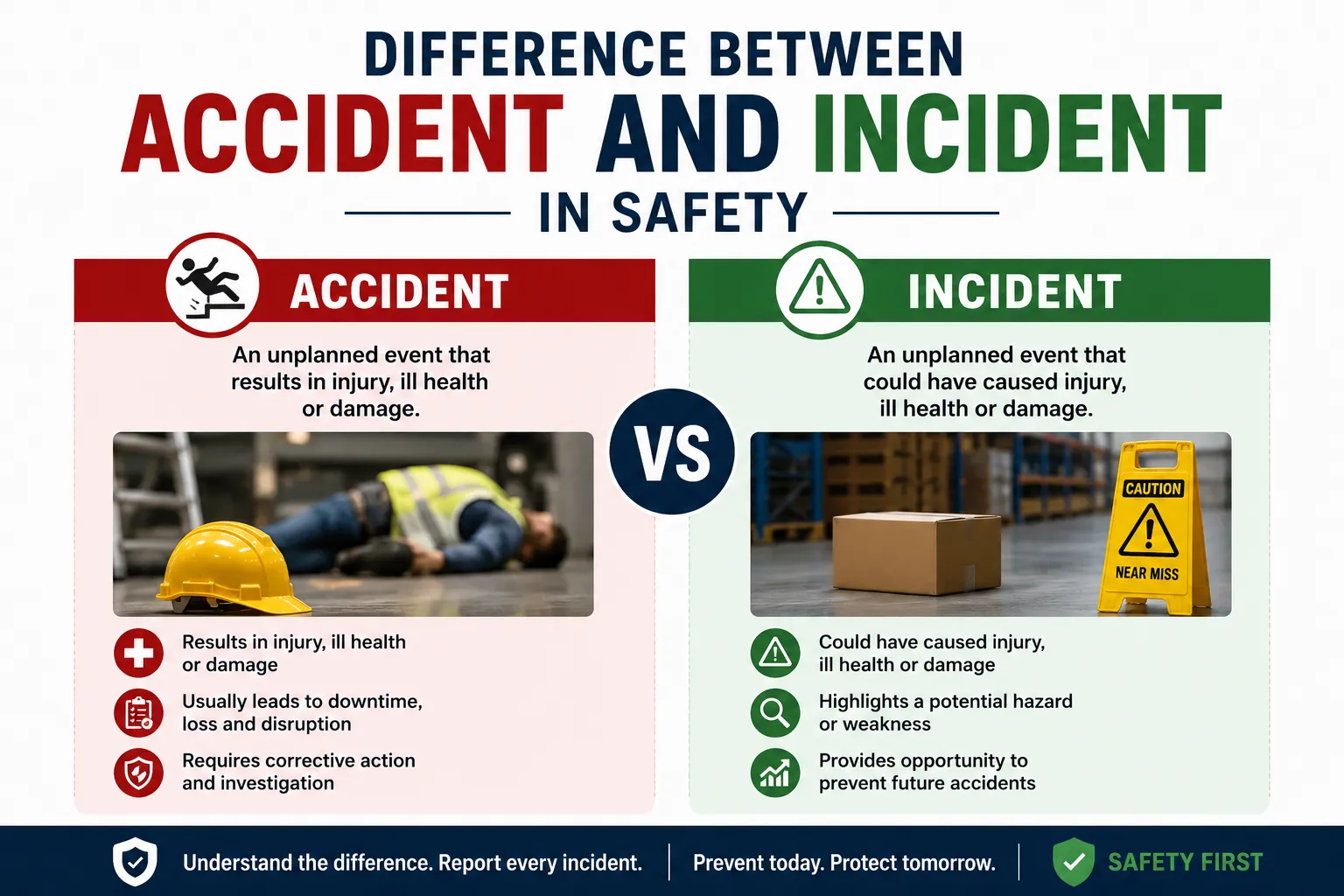
While both terms are related to workplace safety events, the difference between accident and incident lies mainly in the outcome and impact. Understanding these differences helps safety teams take the right corrective actions and improve reporting accuracy.
Major Differences: Accident vs Incident
Outcome:
- Accident results in actual injury, damage, or loss
- Incident may not cause harm but has the potential to do so
Severity:
- Accident is a high-impact event
- Incident is a lower-impact event but can indicate serious hidden risks
Reporting Focus:
- Accidents are reported for investigation and compliance
- Incidents are reported for prevention and early risk identification
Safety Approach:
- Accident management is reactive
- Incident management is proactive
Business Impact:
- Accidents lead to downtime, cost, and legal implications
- Incidents help prevent those losses if addressed on time
In simple terms, accidents show what has already gone wrong, while incidents highlight what could go wrong. Organisations that focus on incident reporting can significantly reduce the chances of future accidents and build a safer work environment.
Why Understanding the Difference is Important in Safety Management
Understanding the difference between accident and incident in safety is not just about terminology. It plays a critical role in how organisations manage risks, improve reporting, and prevent serious workplace events.
When safety teams clearly classify events, they can take the right level of action. Accidents require immediate response and investigation, while incidents provide an opportunity to identify risks before they escalate.
Key Benefits for Organisations
- Improves safety reporting culture: Employees are more likely to report events when they understand what qualifies as an incident
- Helps prevent future accidents: Early identification of incidents allows corrective action before harm occurs
- Supports compliance and audits: Proper classification ensures accurate documentation for safety standards
- Enhances risk management: Data from incidents helps identify patterns and recurring hazards
Organisations that actively track both accidents and incidents are able to move from a reactive approach to a proactive safety strategy.
Want to strengthen your safety management system? Start by improving how you capture and analyse incidents across your workplace.
What Is Near Miss in Safety: Why It Matters
You have already seen the difference between accident and incident above. Here, the focus is on near miss, which are the most important signal for prevention.
A near miss is an unplanned event where no injury or damage occurs, but the situation had a high potential to cause harm. It is a critical early warning sign that something in the workplace is unsafe.
Why Near Miss is Important
- Identifies hidden hazards before they cause accidents
- Helps take corrective action at the right time
- Improves proactive safety management
- Strengthens reporting culture across teams
Near Miss Example
A worker slips but regains balance and avoids falling. This is a near miss because no injury occurred, but the risk was real.
Many organisations ignore near misses because there is no immediate damage. However, most serious accidents are often preceded by multiple near misses. Capturing and analyzing these events helps prevent future incidents and accidents.
Encouraging employees to report near misses can significantly improve workplace safety and reduce high-risk situations.
How Digital Safety Systems Improve Incident Reporting
Traditional reporting methods like paper forms or manual logs often lead to delays, incomplete data, and underreporting. This is where digital safety systems play a critical role in improving how accidents and incidents are captured, tracked, and managed.
Modern incident reporting software enables organisations to move from reactive reporting to a real-time, data-driven safety approach. Solutions like the CORE-EHS Incident Reporting Software are designed to simplify reporting, improve visibility, and ensure faster action across sites.
Key Benefits of Digital Safety Systems
- Real-time reporting: Employees can report incidents instantly using mobile devices from the worksite
- Centralised data: All accident and incident records are stored in one system for easy access and analysis
- Improved accuracy: Structured forms ensure complete and standardized reporting
- Faster corrective actions: Automated workflows help assign and track actions quickly
- Data-driven insights: Analytics help identify trends, high-risk areas, and recurring issues
By using digital tools, organisations can ensure that no incident goes unnoticed and every safety event contributes to continuous improvement.
Looking to enhance your safety reporting process? Explore the CORE-EHS Incident Reporting Software to streamline reporting and build a proactive safety culture.

Conclusion
Understanding the difference between accident and incident in safety is essential for building a strong and proactive workplace safety system. While accidents result in actual harm, incidents act as early warning signs that help prevent serious events in the future.
Organisations that focus on reporting and analysing both accidents and incidents can reduce risks, improve safety culture, and ensure better compliance. The key is not just to react after an accident, but to learn from every incident before it escalates.
Improve your workplace safety with CORE-EHS by strengthening your reporting process and using digital tools to capture, track, and act on every safety event.