 +91 72929 29159














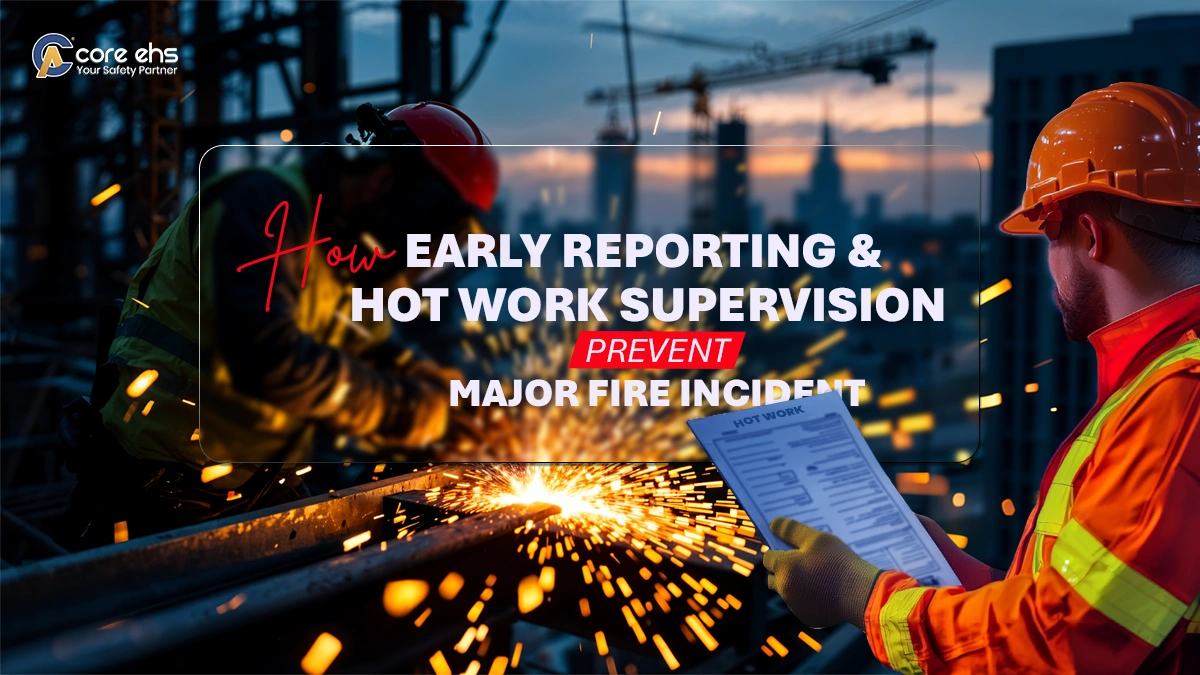
The spark landed, but nothing happened.
At least, that’s what everyone thought.
Welding had just started. A few sparks fell near a stack of material. One worker noticed it. Another brushed it off.
“No issue. It’s fine.”
Work continued.
Hours later, smoke was seen in the same area. By then, the fire had already developed.
This is how many major fire incidents begin – not with a sudden explosion, but with a small, ignored moment.
In industrial environments, fires are rarely unpredictable. They are often preceded by near misses – small warning signs that go unreported, unnoticed, or underestimated.
This blog explores how early reporting and effective hot work supervision play a critical role in fire safety, and how organizations can prevent incidents by strengthening behaviour, systems, and response culture.
Why Most Fire Incidents Give Warning Signs First
Before a fire becomes visible, it usually leaves signals behind.
A spark that travels further than expected.
A smell that seems unusual.
A material that feels warmer than it should.
These are not incidents yet. They are warnings.
In many cases, these early indicators are dismissed because:
- They do not cause immediate damage
- They are seen as part of routine work
- There is no structured reporting culture
However, these small signals are exactly what strong fire safety and training systems are designed to capture.
Ignoring them creates the conditions for escalation.
Understanding Near Misses in Fire Safety
A near miss is an event that could have led to a fire but did not – either by chance or timely interruption.
In hot work environments, near misses are common:
- Sparks landing near combustible materials
- Temporary heat buildup in equipment
- Minor gas leaks
- Uncontrolled work areas
These situations may not result in immediate incidents, but they reveal underlying risks.
Organizations that actively track near misses gain critical insights into:
- Unsafe conditions
- Behavioural gaps
- System failures
This is why near-miss reporting is a key part of fire and life safety practices.
The Behavioural Gap: Why Near Misses Go Unreported
Even when workers notice risks, they often do not report them.
This is rarely due to negligence. It is usually due to behaviour and culture.
Common reasons include:
- “It didn’t cause any harm”
- “It happens all the time”
- “Not worth reporting”
- “Work will get delayed”
Over time, this creates a normalization of risk.
What should be treated as a warning becomes accepted as routine.
Without strong behavioural reinforcement, even the best fire safety tips remain ineffective.
Hot Work: Where Small Risks Become Major Fires
Hot work activities such as welding, cutting, and grinding are among the most common ignition sources in industrial settings.
These operations generate:
- High temperatures
- Flying sparks
- Molten particles
When combined with nearby fuel sources, the risk increases significantly.
The challenge is not just the activity itself – it is the environment in which it is performed.
A small lapse in supervision can allow:
- Sparks to reach combustible materials
- Fire watch to be absent
- Safety controls to be bypassed
This is where most failures occur – not in planning, but in execution.
Related Read: The difference between hazard and risk.
The Role of Supervision in Fire Prevention
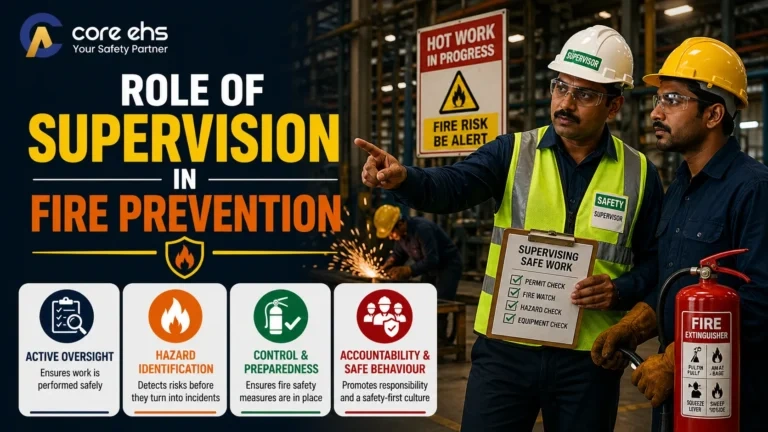
Hot work supervision is not just about oversight. It is about active risk control.
Effective supervision ensures that:
- The work area is properly prepared
- Fire hazards are identified and removed
- Fire and safety equipment is available and accessible
- Workers follow safe practices
More importantly, supervision provides real-time intervention.
When conditions change, supervisors can act immediately – preventing escalation.
This is why supervision is a critical layer in fire safety services and operational control.
Why Permit Systems Alone Are Not Enough
Many organizations rely on Permit to Work (PTW) systems to manage hot work risks.
While permits are essential, they often focus on documentation rather than real-time control.
A permit may confirm that:
- Safety checks were completed
- Equipment was available
- Risks were assessed
But it cannot ensure that:
- Conditions remain safe during work
- Hazards are not introduced later
- Workers respond correctly to changes
This gap between documentation and execution is where incidents occur.
Strong fire safety inspections and supervision are required to bridge this gap.
How Early Reporting Prevents Escalation
When near misses are reported early, organizations can act before risks become incidents.
Early reporting helps:
- Identify recurring hazards
- Improve safety procedures
- Strengthen supervision practices
More importantly, it creates a culture where:
- Risks are taken seriously
- Workers feel responsible for safety
- Small issues are addressed immediately
This proactive approach is a key part of effective fire prevention safety tips and safety culture development.
Building a Culture of Reporting and Accountability
Fire safety is not just about systems – it is about people.
Organizations that succeed in prevention create environments where:
- Reporting is encouraged
- No blame is attached to near misses
- Learning is prioritized over punishment
Workers must feel that reporting a risk is not a delay – it is a contribution to safety.
This cultural shift strengthens both behaviour and system effectiveness.
Strengthening Fire Safety Through Training and Systems
To improve fire prevention, organizations must combine:
- Practical fire safety training
- Strong supervision practices
- Effective reporting systems
- Continuous safety monitoring
Training should focus not only on procedures, but also on:
- Risk recognition
- Decision-making
- Behaviour under pressure
When training is aligned with real work conditions, response improves significantly.
Conclusion
Most fire incidents are preceded by warning signs.
The question is, are they being reported and acted upon?
At CORE-EHS, we help organisations strengthen fire safety and training systems through:
- Behaviour-based safety programs
- Hot work supervision frameworks
- Fire risk assessments
- Comprehensive fire and safety services
Move beyond reactive safety.
Build systems that detect and act before incidents occur.
Connect with us to strengthen your fire prevention strategy.