 +91 72929 29159














Every confined space incident starts the same way.
A worker enters a tank, vessel, pit, silo, manhole, or enclosed space believing the area is safe.
Sometimes it is.
Sometimes it isn’t.
The challenge is that many confined space hazards are invisible. Oxygen deficiency cannot be seen. Toxic gases may not have a warning odour. Atmospheric conditions can change without notice.
That’s why confined space safety should never rely on assumptions.
Before anyone enters a confined space, workers must verify that hazards have been identified, controls have been implemented, and emergency arrangements are in place.
This is where a confined space safety checklist becomes essential.
A well-planned checklist helps teams confirm that critical precautions have been taken before entry begins. It reduces the likelihood of missed steps, strengthens compliance, and helps create a safer working environment for everyone involved.
In this guide, we’ll walk through the essential confined space safety precautions organizations should verify before entry and provide a practical checklist that can support safer confined space operations.
Why a Confined Space Safety Checklist Matters
A permit-to-work system is an important part of confined space safety. So are gas testing, communication procedures, rescue arrangements, and employee training.
The problem is that even the best safety procedures can fail if a critical step is overlooked. In many confined space incidents, the issue isn’t the absence of a safety procedure. It’s the assumption that someone else has already completed it.
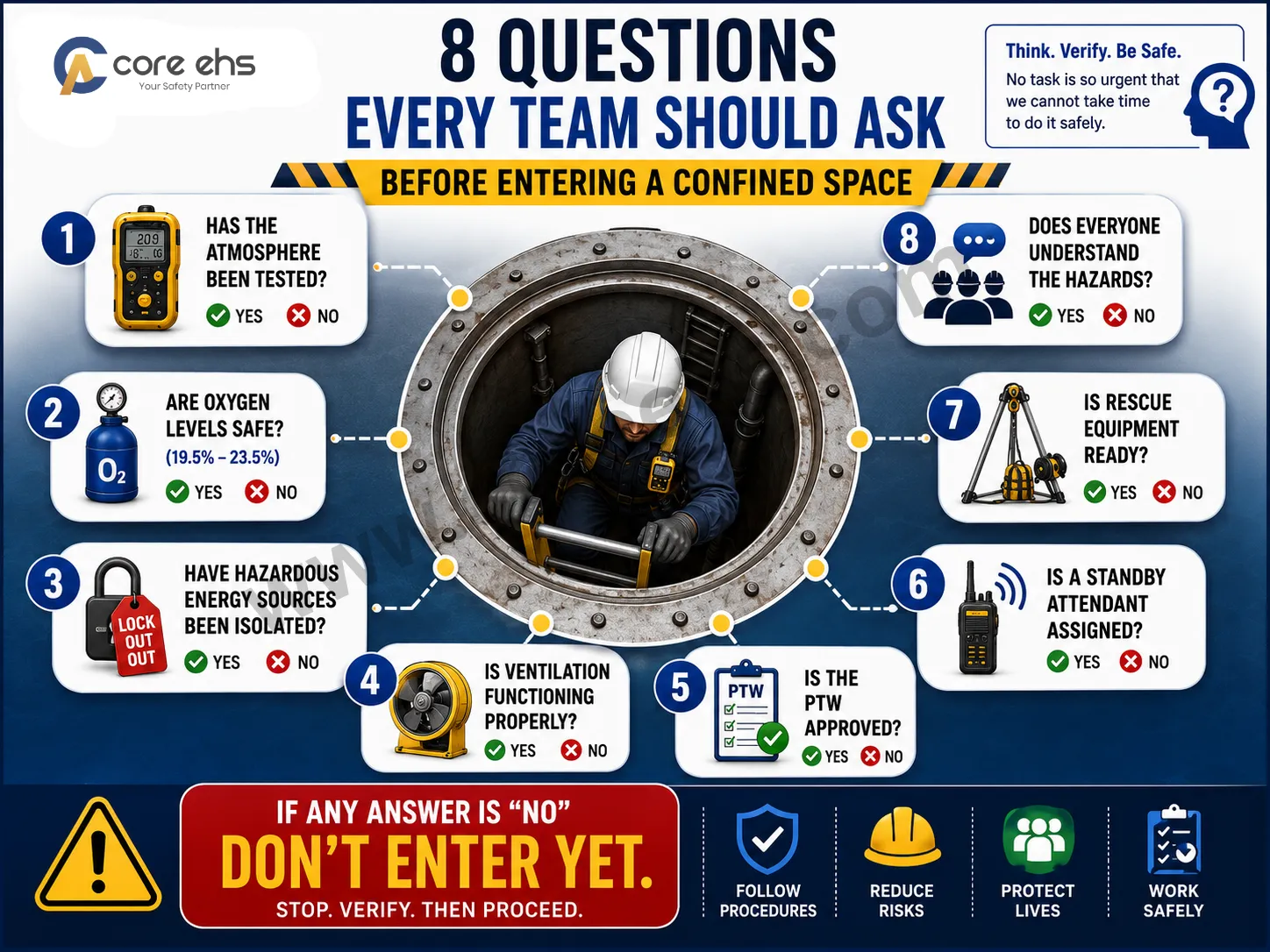
Was the atmosphere tested?
Is ventilation running?
Has the space been isolated?
Is rescue equipment ready?
Has everyone involved understood their responsibilities?
A confined space safety checklist helps eliminate uncertainty by ensuring these questions are answered before entry begins. It creates a simple verification process that helps teams confirm hazards have been assessed, controls are in place, and emergency arrangements are ready if something goes wrong.
More importantly, a checklist encourages consistency. Whether the work is being performed today, next week, or six months from now, the same critical precautions are reviewed before every entry. Because in confined space operations, missing a single step can have serious consequences.
A checklist helps ensure that essential safety precautions don’t depend on memory, assumptions, or routine.
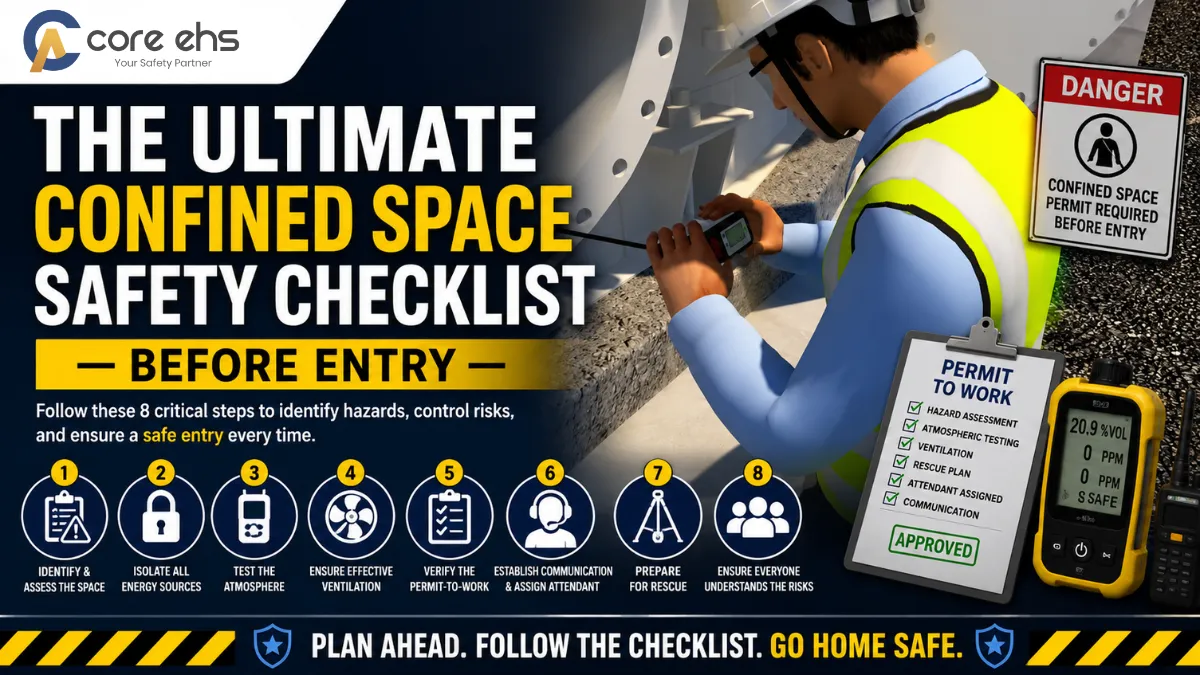
The Ultimate Confined Space Safety Checklist Before Entry
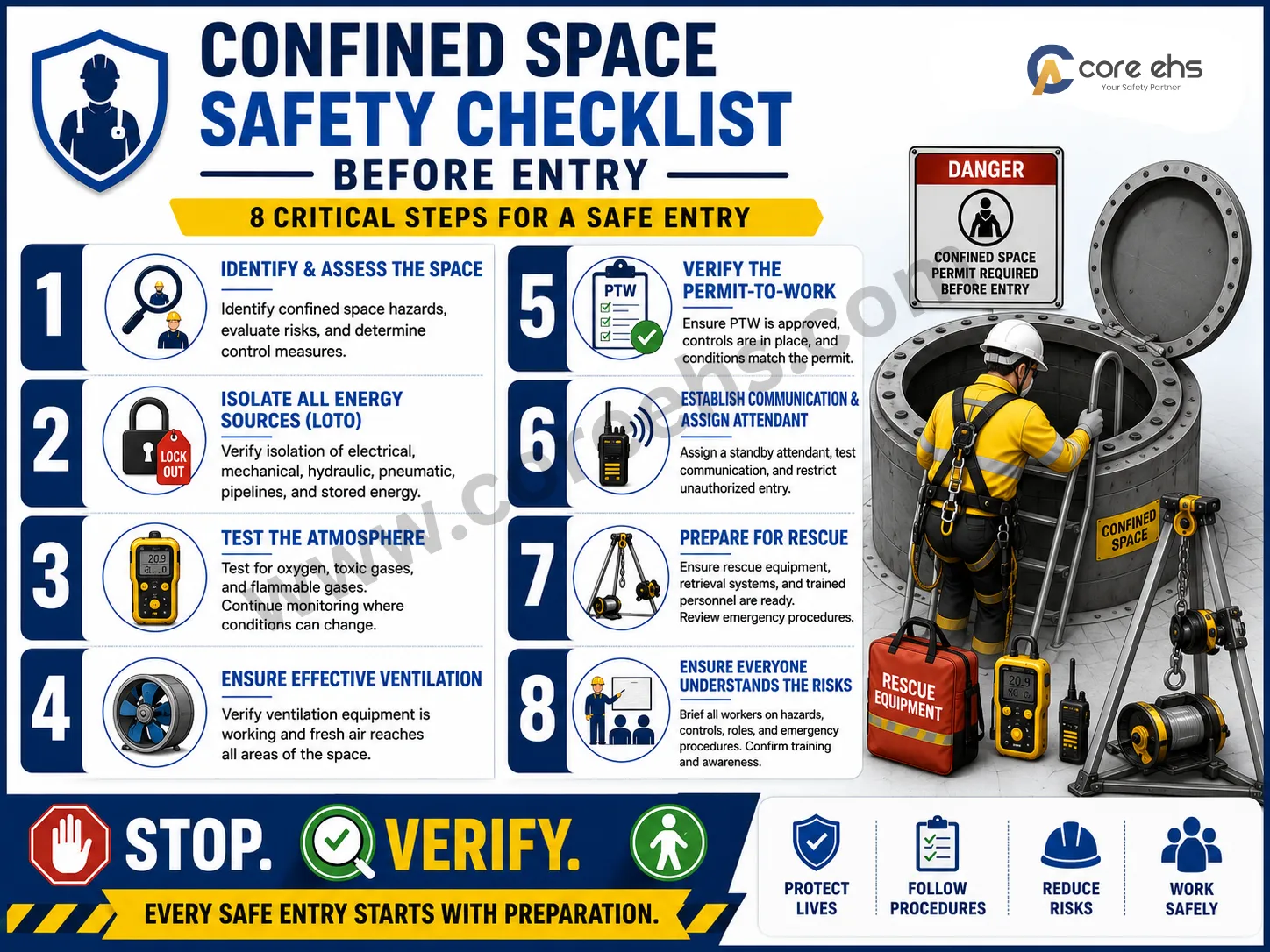
1. Identify and Assess the Confined Space
Before any work begins, confirm that the space has been properly identified as a confined space and assessed for potential hazards.
Every confined space is different. A storage tank, vessel, pit, manhole, silo, or sewer may present unique risks depending on its design, contents, location, and the work being performed.
Before entry, ask:
- What hazards are present inside the space?
- Could oxygen levels become unsafe?
- Are toxic gases, vapors, or fumes likely to be present?
- Is there a risk of engulfment, mechanical hazards, or energy sources?
- Could the work itself create additional hazasrds?
A thorough risk assessment helps ensure that hazards are identified before workers are exposed to them.
Quick Verification Checklist
- Confined space identified and classified
- Risk assessment completed
- Potential hazards documented
- Entry conditions reviewed
- Control measures identified
Why this step matters
Many confined space incidents occur because teams focus on the job they need to complete rather than the hazards they may encounter.
A proper assessment creates the foundation for every other safety precaution that follows.
2. Verify Isolation of All Energy Sources
Before anyone enters a confined space, ensure that all hazardous energy sources have been properly isolated.
Many confined spaces contain equipment, pipelines, agitators, electrical systems, hydraulic systems, pneumatic systems, or stored energy that can unexpectedly activate during work.
A confined space may appear safe, but if an energy source remains connected, workers could face serious injury within seconds.
This is why isolation and Lockout/Tagout (LOTO) procedures should always be verified before entry.
Before entry, confirm:
- Electrical power has been isolated
- Mechanical equipment has been shut down and secured
- Hydraulic and pneumatic systems have been isolated
- Pipelines have been disconnected, blanked, or blinded where required
- Stored energy has been released or controlled
- Lockout/Tagout devices have been applied and verified
Isolation should never be assumed.
Physically verify that the equipment cannot start, move, energize, release pressure, or introduce hazardous substances into the confined space.
Quick Verification Checklist
- Electrical isolation completed
- Mechanical isolation completed
- Hydraulic/pneumatic systems isolated
- Pipelines blanked or disconnected
- Stored energy released
- Lockout/Tagout applied
- Isolation verified before entry
Why this step matters
A worker may successfully enter a confined space only to be exposed to a hazard that originates outside the space itself.
Unexpected equipment startup, product flow, electrical energization, or pressure release can quickly turn a routine task into a life-threatening situation.
Proper isolation ensures the confined space remains under control before work begins.
3. Test the Atmosphere Before Entry
A confined space may look safe from the outside.
That doesn’t mean the atmosphere inside is safe to breathe.
Some of the most dangerous confined space hazards cannot be seen, smelled, or heard. Oxygen deficiency, toxic gases, and flammable atmospheres can exist even when there are no visible warning signs.
This is why atmospheric testing should always take place before entry.
Using a calibrated gas detector, test the atmosphere for:
- Oxygen levels
- Toxic gases
- Flammable gases and vapours
Where conditions can change during the task, continue monitoring throughout the operation.
Never rely on previous test results, assumptions, or successful entries from earlier shifts. Conditions inside a confined space can change quickly due to cleaning activities, welding, chemical reactions, nearby processes, or poor ventilation.
When in doubt, test again.
Quick Verification Checklist
- Gas detector calibrated and functional
- Oxygen levels tested
- Toxic gases tested
- Flammable gases tested
- Results recorded and reviewed
- Continuous monitoring arranged where required
Why this step matters
Many confined space incidents occur because workers assume the atmosphere is safe.
Atmospheric testing replaces assumptions with facts.
A few minutes spent testing before entry can prevent exposure to invisible hazards that could otherwise have life-threatening consequences.
4. Ensure Ventilation Is Effective
Passing a gas test before entry does not guarantee conditions will remain safe throughout the job.
As work progresses, oxygen levels can change, gases can accumulate, and contaminants can build up inside the space. Activities such as welding, cleaning, chemical application, or maintenance work can significantly affect atmospheric conditions.
This is why effective ventilation plays a critical role in confined space safety.
Before entry, verify that:
- Ventilation equipment is available and functioning properly
- Fresh air can reach all areas of the confined space
- Airflow is not obstructed
- Ventilation remains operational throughout the task where required
Remember, the atmosphere at the entrance may be very different from the atmosphere deeper inside the confined space.
Good ventilation helps maintain safe oxygen levels, reduce contaminant buildup, and create a safer working environment for entrants.
Quick Verification Checklist
- Ventilation requirements assessed
- Ventilation equipment inspected
- Airflow reaches all work areas
- No blocked ducts or obstructions
- Continuous ventilation provided where required
- Atmospheric conditions rechecked after ventilation
Why this step matters
Atmospheric testing tells you whether conditions are safe right now.
Ventilation helps keep them safe during the job.
Together, testing and ventilation form one of the most important layers of protection in any confined space entry operation.
5. Verify the Permit-to-Work (PTW) Before Entry
A permit should never be treated as a formality.
It serves as a final verification that hazards have been identified, controls have been implemented, and the confined space is ready for safe entry.
A properly completed permit helps ensure that everyone involved understands:
- The scope of work
- The hazards present
- The control measures required
- Emergency arrangements
- Individual responsibilities
Before entry, confirm that the permit has been reviewed, approved, and communicated to all relevant personnel.
Most importantly, verify that the conditions stated on the permit match the actual conditions at the worksite.
If conditions change, stop work and reassess before continuing.
Quick Verification Checklist
- Permit issued and approved
- Scope of work clearly defined
- Hazards identified and documented
- Control measures verified
- Atmospheric test results recorded
- Emergency arrangements confirmed
- Permit communicated to all involved personnel
- Permit displayed at the entry point
Why this step matters
A permit-to-work system brings all critical safety checks together before entry begins.
It helps ensure that confined space entry does not depend on memory, assumptions, or routine. Instead, it depends on verification, communication, and accountability.
When used correctly, a permit becomes one of the most effective tools for preventing confined space incidents.
6. Establish Clear Communication and Assign a Standby Attendant
Confined space entry is never a one-person activity.
Workers inside the space and personnel outside the space should be able to communicate at all times. If communication breaks down, response times increase and emergency situations become much harder to manage.
Before entry, assign a competent standby attendant who remains outside the confined space for the duration of the work.
The attendant should:
- Maintain communication with entrants
- Monitor conditions and activities
- Restrict unauthorized entry
- Initiate emergency procedures when required
- Summon rescue assistance if needed
The standby attendant should never leave their position unless properly relieved by another trained person.
Quick Verification Checklist
- Standby attendant assigned
- Roles and responsibilities communicated
- Communication method tested and verified
- Emergency contact information available
- Unauthorized entry controls in place
- Attendant remains outside the space throughout the job
Why this step matters
Many confined space incidents become worse because workers inside the space cannot communicate their situation quickly enough.
A trained standby attendant acts as the first layer of emergency response and provides continuous oversight throughout the operation.
When workers stay connected, teams can identify problems faster, respond sooner, and prevent minor issues from becoming major emergencies.
7. Prepare for Rescue Before Entry Begins
Hope is not a rescue plan.
One of the most common mistakes organizations make is focusing heavily on entry procedures while giving less attention to what happens if an emergency occurs.
Before anyone enters a confined space, verify that rescue arrangements are already in place and ready to be activated.
This includes:
- Rescue equipment available and inspected
- Tripods, winches, and retrieval systems ready for use
- Rescue personnel identified and available
- Emergency procedures reviewed and understood
- Communication channels established
Most importantly, avoid relying on unplanned rescue attempts.
In many confined space incidents, co-workers instinctively enter the space to help a colleague in distress. Unfortunately, these well-intentioned actions often result in multiple casualties.
Every rescue should follow a planned procedure, not an emotional reaction.
Quick Verification Checklist
- Rescue plan reviewed and approved
- Rescue equipment inspected
- Retrieval systems available where required
- Rescue team identified
- Emergency contacts verified
- Communication channels tested
- Workers briefed on emergency procedures
Why this step matters
The first few minutes of a confined space emergency are often the most critical.
When rescue equipment, procedures, and personnel are ready before entry begins, teams can respond faster, more effectively, and with less risk to additional workers.
A confined space entry should never begin until the team is confident, they can safely rescue a worker if the need arises.
8. Ensure Everyone Understands the Risks Before Entry
A confined space can have all the right equipment, permits, and procedures in place.
But if workers don’t fully understand the hazards, the risk remains.
Before entry, take time to ensure everyone involved understands:
- The hazards inside the space
- The control measures in place
- Emergency procedures
- Communication requirements
- Their individual responsibilities
Organizations are increasingly using technology-driven learning tools to strengthen confined space awareness.
3D animated safety videos help workers visualize atmospheric hazards, emergency scenarios, and entry procedures that are often difficult to explain through presentations alone.
For high-risk tasks, VR-based training allows workers to experience realistic confined space scenarios and practice decision-making in a safe environment before entering an actual confined space.
To reinforce learning over time, eLearning modules provide self-paced refresher training that workers can access whenever needed, helping them retain critical safety knowledge.
Many organizations also use IoT-enabled monitoring systems that continuously track atmospheric conditions and generate alerts when conditions become unsafe, helping teams respond faster to developing risks.
Quick Verification Checklist
- Workers briefed before entry
- Hazards and controls explained
- Emergency procedures reviewed
- Roles and responsibilities understood
- Refresher training completed where required
- Monitoring systems functional and verified
Why this step matters
Procedures protect workers only when workers understand them.
The more clearly people understand the hazards before entry, the more likely they are to recognize risks, follow controls, and make safe decisions throughout the job.
Conclusion
Confined space safety begins long before a worker enters a tank, vessel, pit, silo, or manhole.
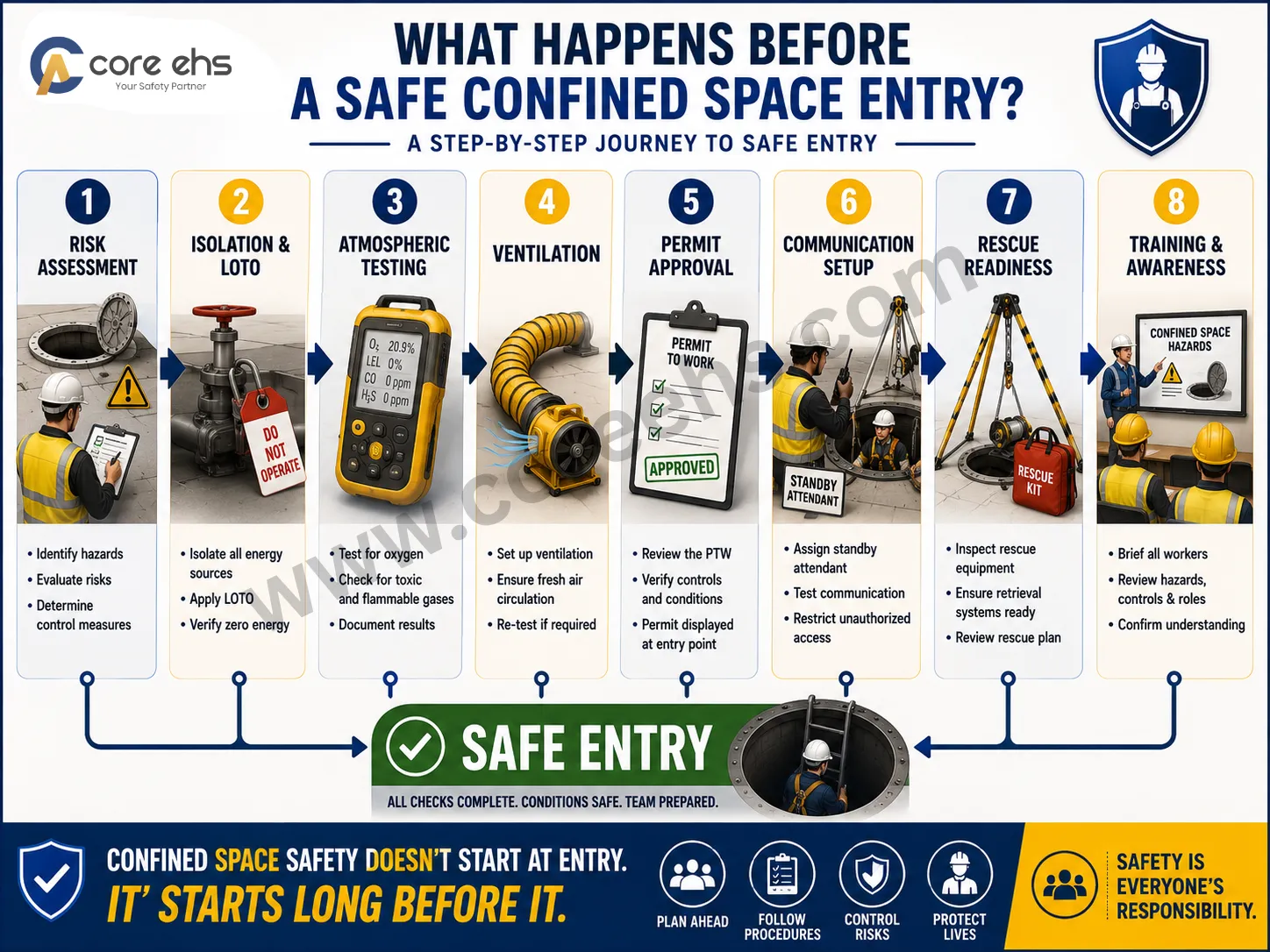
It begins with preparation.
Every atmospheric test conducted, every energy source isolated, every permit verified, every communication channel established, and every rescue plan reviewed adds another layer of protection for the people performing the work.
The reality is that most confined space incidents don’t occur because organizations lack procedures. They occur when critical steps are skipped, assumptions replace verification, or hazards go unnoticed until it’s too late.
That’s why a confined space safety checklist remains one of the most effective tools for preventing incidents. It helps teams slow down, verify conditions, and ensure that no critical precaution is overlooked before entry begins.
Remember, confined space safety is not about completing paperwork.
It’s about making sure every worker who enters a confined space has the best possible chance of returning safely.
Because in confined space operations, what happens before entry often determines what happens after entry.
Strengthen Your Confined Space Safety Program with CORE-EHS
Creating safer confined space operations requires more than a checklist.
It requires awareness, competency, communication, training, and the right technologies working together.
At CORE-EHS, we help organizations strengthen confined space safety through:
- Confined Space Safety Training Programs
- 3D Animated Safety Videos
- VR-Based Safety Simulations
- eLearning & Refresher Training Modules
- IoT-Based Safety Monitoring Solutions
- Hazard Reporting & Incident Management Systems
- Safety Audits, Assessments & Advisory Services
Whether you’re looking to improve workforce awareness, strengthen permit-to-work compliance, enhance emergency preparedness, or build a more proactive safety culture, our team can help.
Before the next confined space entry begins, ask yourself:
Has every critical precaution been verified?
Connect with CORE-EHS today and take the next step toward safer confined space operations.