 +91 72929 29159













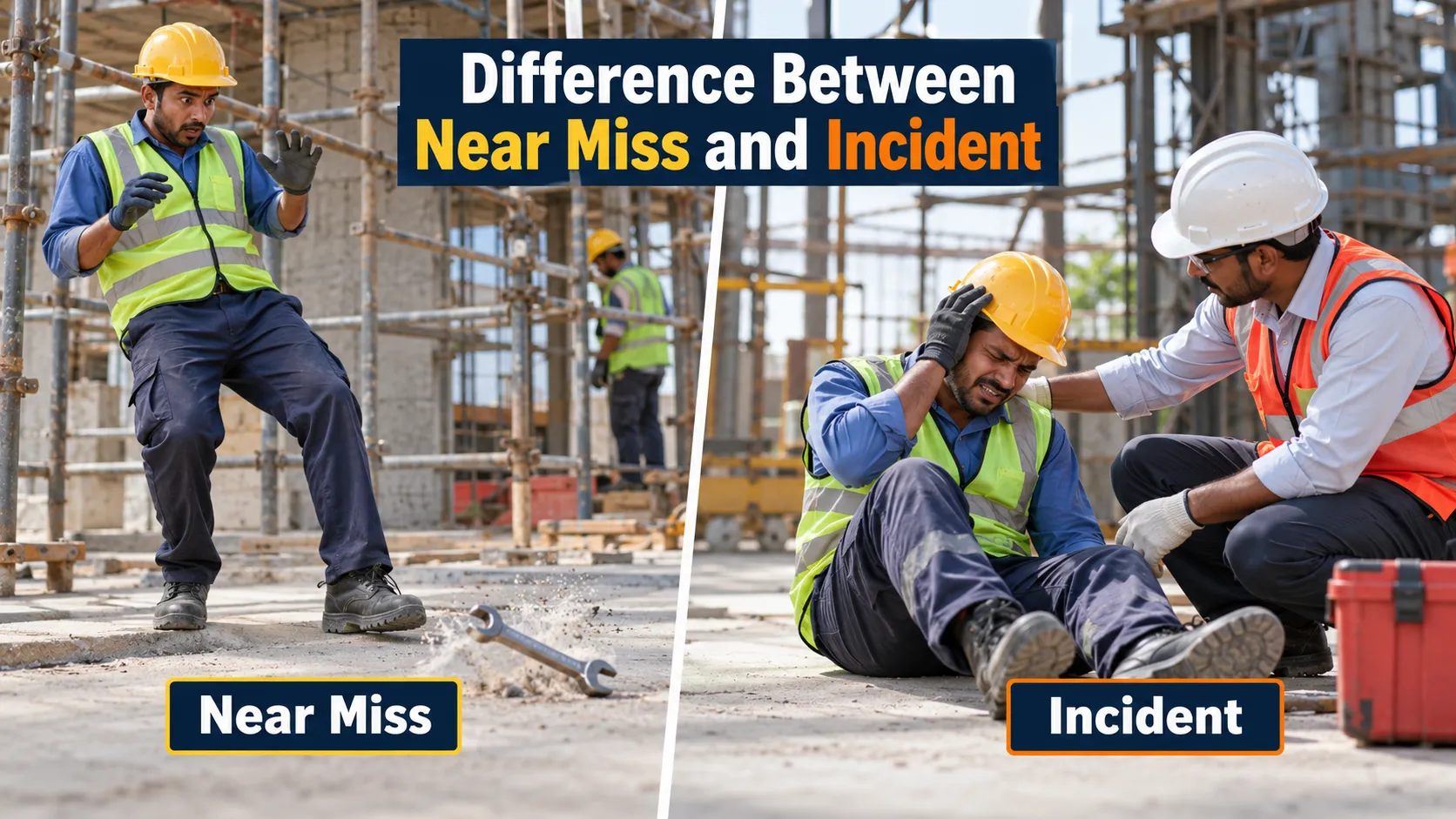
A near miss is an unplanned workplace event where an injury, illness, property damage, or other loss could have occurred but did not. An incident is the broader term used for work-related events that result in, or have the potential to result in, harm.
So, the main difference between near miss and incident is the outcome and classification of the event. A near miss involves potential harm without an actual harmful consequence, while an incident may include injuries, damage, environmental impact, or even near-miss events, depending on the organization’s reporting framework.
In simple terms, every near miss can be treated as an incident, but not every incident is a near miss.
Quick Answer
Near miss: Something happened, but no one was injured and no actual loss occurred.
Incident: A broader workplace event that either caused harm or had the potential to cause harm.
This distinction matters because both near misses and incidents can reveal weaknesses in workplace controls that should be reported, investigated, and corrected before a more serious event occurs.
Near Miss vs Incident
The easiest way to understand near miss vs incident is to compare what actually happened and what the outcome was.
| Factor | Near Miss | Incident |
| Did an unplanned event occur? | Yes | Yes |
| Injury or illness | No | May occur |
| Property or environmental damage | Typically no | May occur |
| Potential for harm | Yes | Yes |
| Reporting needed | Should be reported | Should be reported as per procedure |
| Investigation | Often required based on risk | Usually required based on severity |
| Corrective action | Yes, where a control gap exists | Yes, where causes or control failures are identified |
| Example | A falling tool narrowly misses a worker | A falling tool strikes and injures a worker |
The key difference between near miss and incident is that a near miss has the potential to cause harm but does not result in an actual harmful outcome. An incident is the broader term and may include events that result in injury, damage, environmental impact, or other consequences.
A useful way to remember it is:
Near miss = event occurred, harm was avoided.
Incident = event occurred, with or without an actual consequence depending on the reporting framework.
This distinction is important because a near miss should not be dismissed simply because no one was injured. It can still expose a weakness in workplace controls that may lead to a more serious event if left uncorrected.
What Is a Near Miss?

A near miss is an unplanned event that could have caused an injury, illness, property damage, environmental harm, or operational loss, but the harmful outcome did not occur.
The important point is that a near miss is more than just an unsafe condition. An actual event has already happened, but the person, equipment, or environment escaped harm.
For example, if a tool falls from an elevated work area and lands close to a worker without striking them, that event is a near miss. The worker was not injured, but the potential for serious harm clearly existed.
Near misses are sometimes described as close calls or narrow escapes. They should still be reported because they can reveal failed controls, unsafe practices, or hazardous conditions before those weaknesses contribute to a more serious workplace incident.
Example of a Near Miss
A worker is standing below a scaffolding area when a hammer falls from above and lands beside them.
No one is injured and no damage occurs, but the event had the potential to cause a serious injury.
Event occurred + potential for harm existed + no actual harm occurred = near miss.
What Is an Incident?

An incident is a work-related event that results in, or has the potential to result in, injury, illness, property damage, environmental impact, operational disruption, or another unwanted consequence.
In safety management, the term incident is often used as a broad category. Depending on the organization’s reporting framework, it may include events involving actual harm as well as near misses where no injury or damage occurred.
This is why an incident should not automatically be understood as an event where someone was injured. The classification depends on the outcome, severity, and the organization’s incident-reporting criteria.
Example of an Incident
Consider the same workplace situation used in the near-miss example.
A hammer falls from scaffolding, strikes a worker below, and causes an injury.
In this case, an actual harmful consequence occurred, so the event would be classified as an incident involving injury.
Same hazard → same event mechanism → different outcome.
That difference in outcome is what separates this event from the earlier near miss.

What Is the Main Difference Between a Near Miss and an Incident?
The main difference between near miss and incident is not whether something happened. In both cases, an unplanned event occurred. The difference is mainly in the outcome and how the event is classified.
A simple way to identify the event is to ask two questions:
- Did an unplanned workplace event occur?
If no event occurred and only a dangerous condition was identified, it may be a hazard or unsafe condition, not a near miss. - Did the event result in injury, illness, damage, or another actual consequence?
If no harm occurred, but harm was possible, the event is a near miss. If actual harm or loss occurred, it is an incident with a consequence.
The important point is that a near miss does not mean “nothing happened.” The event happened; only the harmful consequence was avoided.
For example, if a suspended load falls but misses a worker, it is a near miss. If the same load strikes the worker or damages equipment, the event becomes an incident with an actual consequence.
This distinction helps safety teams classify events more consistently and decide the level of reporting, investigation, and corrective action required.
Near Miss vs Incident vs Accident: Key Differences with Workplace Examples
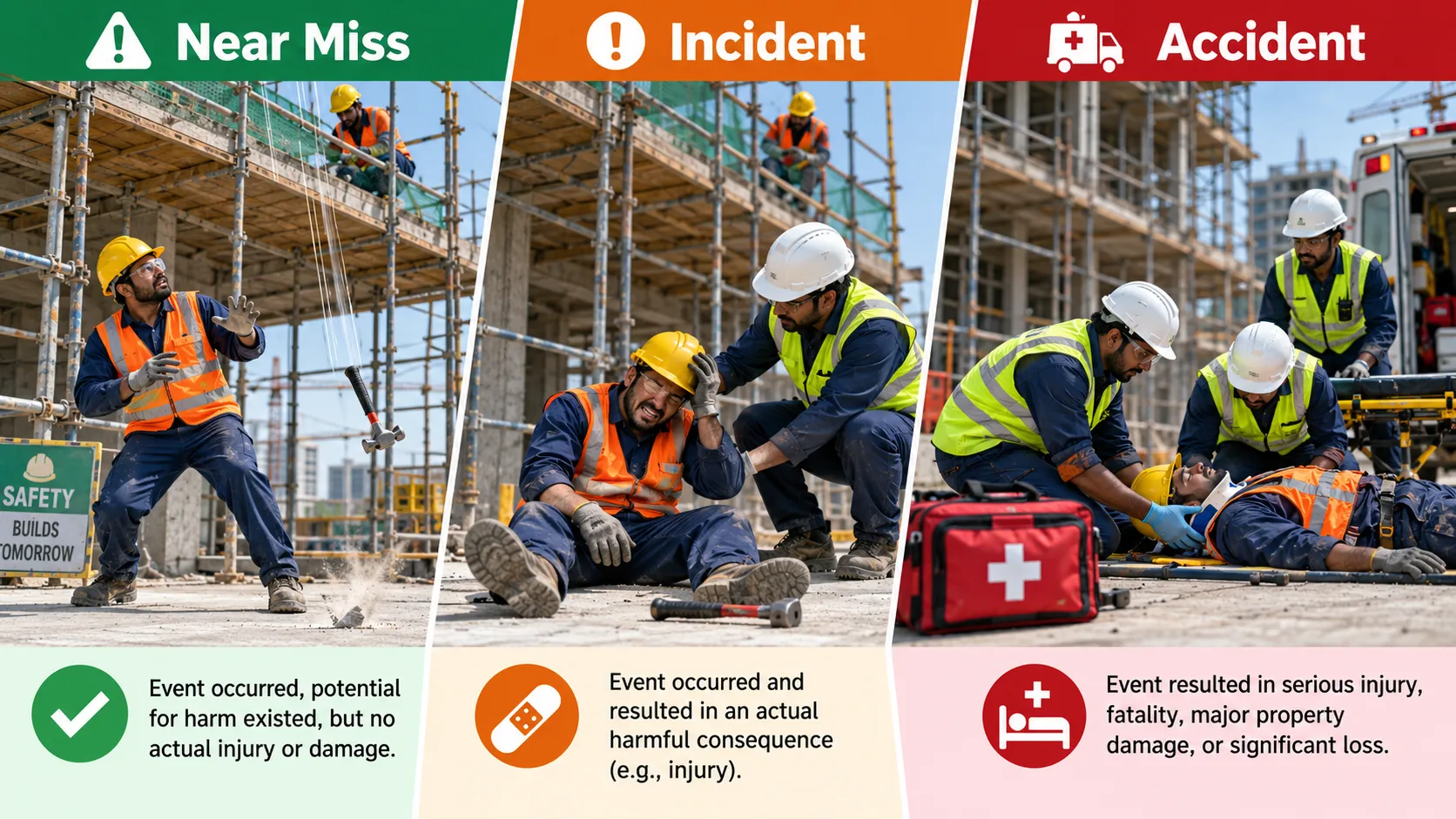
The terms near miss, incident, accident, and hazard are closely connected, but they describe different stages or outcomes of a workplace safety event. The easiest way to understand the difference between accident, incident and near miss is to look at two things: did an event occur, and what was the outcome?
| Workplace Scenario | Classification | Why |
| Oil is noticed on a walkway before anyone steps on it | Hazard / Unsafe Condition | A source of potential harm exists, but no event has occurred |
| A worker slips on the oil but regains balance without injury | Near Miss | An event occurred and injury was possible, but no harm resulted |
| A worker slips, falls, and fractures a wrist | Incident / Accident | The event resulted in an actual injury |
| A heavy suspended load falls and lands close to a worker | High-Potential Near Miss | No injury occurred, but the potential consequence was severe |
| A chemical release exposes an employee and causes health effects | Incident | The event resulted in an actual harmful consequence |
A simple way to understand the relationship is:
Hazard → Event → Outcome
A hazard is a condition or source with the potential to cause harm. A near miss occurs when an event happens, but injury, damage, or loss is avoided. An accident generally refers to an event that results in actual injury, damage, or loss. An incident is the broader safety term and may include accidents, near misses, and other unwanted work-related events.
For example, oil on a walkway is a hazard. If a worker slips but recovers without injury, it becomes a near miss. If the worker slips, falls, and is injured, the event becomes an incident with an actual consequence and may also be described as an accident.
This is why safety teams should not classify events based only on whether someone was injured. They should also consider what happened, the actual outcome, and the potential severity of the event.
What Is a High-Potential Near Miss?
Not all near misses carry the same level of risk. A high-potential near miss is an event where no actual injury or damage occurred, but the possible consequence could have been severe or even fatal.
For example, a worker nearly tripping over a loose cable and a 500 kg suspended load falling within inches of a worker can both be classified as near misses. However, the second event has a much higher potential severity.
This is where the difference between a high potential incident and near miss becomes important. A near miss describes the actual outcome, while high-potential classification focuses on what could reasonably have happened if circumstances had been slightly different.
Safety teams should therefore assess near misses based not only on the actual outcome, but also on factors such as:
- potential injury severity
- number of people exposed
- energy involved
- failure of critical controls
- likelihood of recurrence
A high-potential near miss should usually receive a deeper level of investigation because it can reveal serious weaknesses before they result in a major incident.
Why Near Miss Data Is Valuable for Safety Teams
A single near miss may look minor, but a pattern of similar near misses can reveal a much bigger problem.
For example, if workers repeatedly report dropped tools in the same work area, the issue may not be individual carelessness. The pattern could point to weak tool-retention practices, poor housekeeping, inadequate exclusion zones, or ineffective supervision.
This is where near-miss data becomes useful beyond individual event reporting. When organisations review trends over time, they can identify:
- repeated hazards in the same location
- activities with frequent control failures
- departments generating high-risk events
- recurring root causes
- corrective actions that are not preventing recurrence
The real value is in moving from isolated events to patterns.
That makes near miss information useful for prioritising inspections, improving controls, and focusing safety resources where the risk is actually developing.
How Should Organisations Manage Near Misses and Incidents?
Once a near miss or incident is identified, the challenge is not just recording it. The organization needs a clear system to ensure the event is investigated, corrective actions are assigned, responsibilities are defined, and closure is verified.
A practical incident-management process should include:
1. Record the event clearly
Capture what happened, where it occurred, who was involved, and supporting evidence such as photos, witness details, or equipment information.
2. Classify and prioritise the event
Assess both the actual outcome and potential severity so that high-risk events receive appropriate attention.
3. Investigate the cause
Identify immediate, contributing, and underlying causes instead of stopping at the visible event.
4. Assign corrective actions
Define action owners, target dates, and responsibilities so corrective measures do not remain open indefinitely.
5. Track and verify closure
Confirm that corrective actions have actually been implemented and are effective before the event is considered closed.
For organizations managing multiple sites, departments, or large volumes of safety events, CORE-EHS Incident Management Software (IRIS) helps digitize this complete workflow. The platform supports incident and near-miss reporting, investigation and root cause analysis, corrective-action tracking, automated alerts, dashboards, mobile-ready access, and audit-ready digital records.
This allows EHS teams to move beyond scattered spreadsheets and manual follow-up and manage incidents through a more structured, visible, and accountable process.
By bringing near-miss and incident data into one centralized system, CORE-EHS helps safety teams identify recurring patterns, monitor corrective actions, and improve visibility across sites before repeated issues develop into more serious events.