 +91 72929 29159













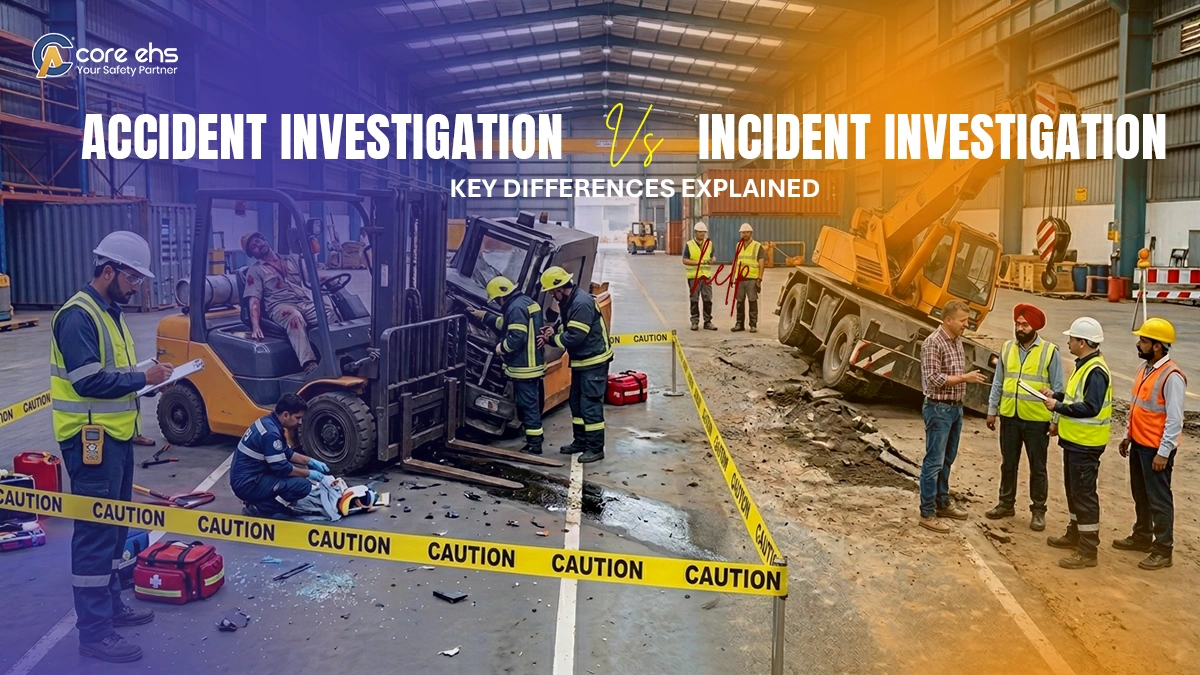
“Was it an accident, or was it an incident?”
That question comes up more often in workplaces than many people realize. A worker slips but is not injured. A machine sparks but does not cause damage. A forklift narrowly misses a pedestrian. Something happened, but no one is sure what to call it, or what kind of investigation it requires.
This confusion is more common than it should be. In many organizations, the terms accident investigation and incident investigation are used interchangeably, even though they do not always mean the same thing. That misunderstanding can affect how events are reported, how root causes are identified, and how future risks are controlled.
In workplace safety, the difference between an accident and an incident is not just about language. It shapes how a company responds, what gets documented, and whether lessons are learned before a more serious event happens. An effective incident investigation process helps organizations understand unsafe conditions, system failures, and human factors before they lead to injuries, damage, or operational disruption. A strong workplace accident investigation does the same after harm has already occurred.
This blog explains the difference between accident investigation vs incident investigation, why the distinction matters, and how both fit into a stronger safety management system. We will also look at the accident investigation process, the incident investigation process, and the role of near miss investigation, incident reporting and investigation, and root cause analysis in safety in preventing repeat events.
What Is an Accident and What Is an Incident?
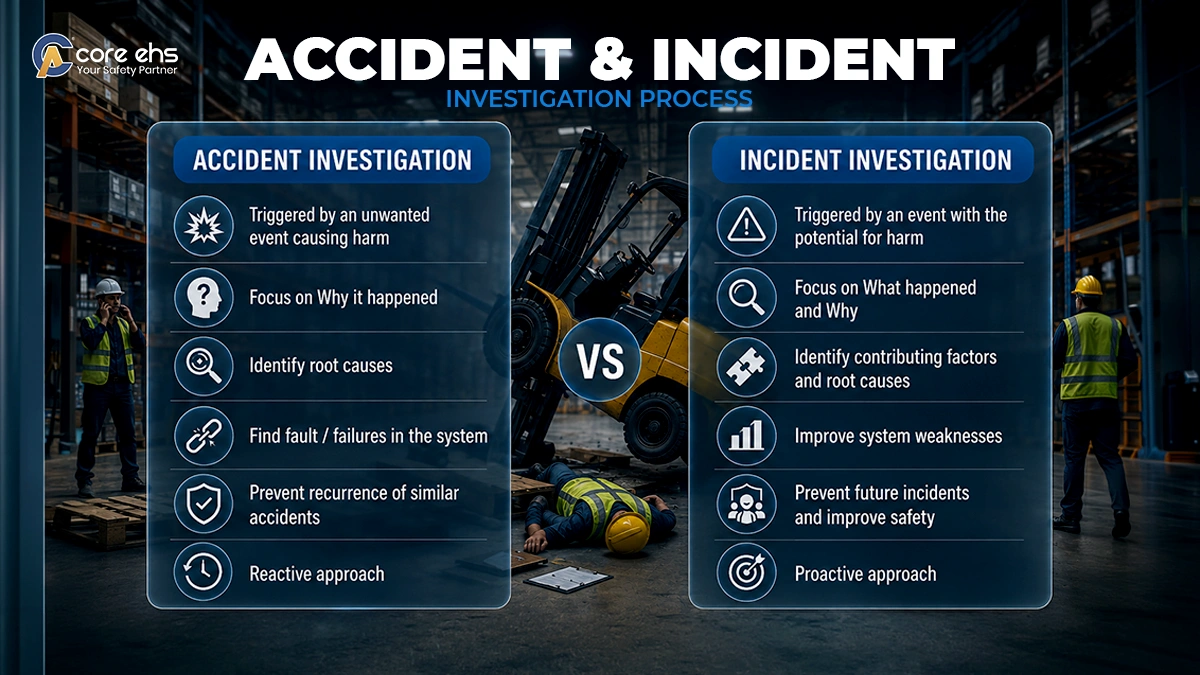
What is Accident Investigation?
In workplace safety, an accident is usually understood as an unplanned event that results in harm, damage, or loss. That harm may involve injury to a worker, damage to equipment, interruption of operations, or impact on the environment.
If someone slips and fractures an arm, if a forklift collision damages stock, or if a fire causes equipment loss, these are typically treated as accidents because the event has already caused a negative outcome.
What is Incident Investigation?
An incident, on the other hand, is a broader term. It refers to any unplanned event that disrupts normal operations or has the potential to cause harm, whether or not actual injury or damage occurs.
This means an incident may include accidents, but it also includes near misses and unsafe events that could have ended much worse. For example, if a load falls but misses a worker, or if a chemical leak is contained before anyone is harmed, it is still an incident because it exposed a failure or risk in the system.
The easiest way to understand the difference between accident and incident is this: every accident is an incident, but not every incident is an accident. That distinction matters because organizations that investigate only accidents often miss the opportunity to learn from smaller warning signs. A strong incident reporting and investigation process captures both harmful events and near misses, while a structured workplace accident investigation focuses closely on events where damage or injury has already occurred.
This is also where near miss investigation becomes so important. Near misses may not create immediate loss, but they reveal the same underlying weaknesses that often sit behind serious accidents, unsafe behaviour, poor supervision, equipment failure, communication gaps, or missing controls. In practical terms, accident investigation is usually reactive because it follows harm, while incident investigation is more preventive because it can identify risk before the next event becomes more serious.
That is why safety leaders should not treat these terms as simple wording differences. The way an event is classified influences the urgency of response, the level of documentation, the depth of root cause analysis in safety, and the actions taken to prevent recurrence. A mature safety system understands both definitions clearly and uses them to strengthen prevention, not just reporting.
Difference Between Accident Investigation vs Incident Investigation
Although the two terms are often used as if they mean the same thing, accident and incident investigation are not identical. The difference lies in the outcome of the event and the purpose of the review that follows. An accident investigation usually begins after an event has already caused injury, damage, loss, or business disruption. Its purpose is to understand what happened, identify immediate and root causes, and prevent the same type of event from happening again. An incident investigation is broader. It includes accidents, but it also covers near misses, unsafe occurrences, and events that had the potential to cause harm even if no actual loss occurred.
This distinction is important because organizations that focus only on accidents are usually learning too late. By the time an accident occurs, someone may already be injured, equipment may be damaged, or operations may be affected. A strong incident investigation process helps identify risk earlier, often at the near-miss stage, which gives safety teams a chance to take corrective action before the next event becomes more severe. In that sense, incident reporting and investigation strengthens prevention, while workplace accident investigation helps control recurrence after harm has already occurred.
To make the difference clearer, here is a practical comparison table you can include in the blog:
Accident Investigation vs Incident Investigation: Key Differences
| Aspect | Accident Investigation | Incident Investigation |
| Definition | Investigation of an unplanned event that caused injury, damage, or loss | Investigation of an unplanned event that caused or could have caused harm |
| When it starts | After actual harm or damage has occurred | After any unsafe event, near miss, accident, or abnormal occurrence |
| Main purpose | Determine causes of loss and prevent recurrence | Identify causes of risk and prevent future accidents |
| Outcome involved | Injury, damage, downtime, or measurable loss | May involve no injury or damage, but still reveals exposure to risk |
| Scope | Narrower, focused on events with consequences | Broader, includes accidents, near misses, and unsafe events |
| Urgency | High because harm has already occurred | High because it can prevent escalation into a serious event |
| Examples | Worker injury, equipment damage, fire loss, property damage | Near miss, unsafe act, small leak, dropped load, spark without injury |
| Corrective action focus | Recovery, compliance, accountability, and prevention of repeat events | Early intervention, hazard correction, and system improvement |
| Role in safety management | Reactive but necessary | Preventive and proactive |
| Link to root cause analysis | Used to determine why actual loss happened | Used to determine why risk was present before major loss occurred |
A simple way to explain the difference between accident and incident is this: an accident investigation looks back after loss, while an incident investigation looks deeper at risk, whether or not loss has already occurred. Both are essential, but they serve different purposes within a mature safety system. The strongest organizations do not wait for injuries before they start investigating. They use near miss investigation, routine reporting, and root cause analysis in safety to capture weak signals early and turn them into prevention opportunities.
This is why the best safety cultures do not ask only, “Was anyone hurt?” They also ask, “What did this event reveal about our system?” That shift in thinking is what moves a workplace from reactive compliance to active risk control.
Why the incident and accident investigation IsMatters in Workplace Safety
The difference between incident and accident investigation matters because it shapes how an organization sees risk. If a company investigates only accidents, it is waiting until harm has already happened before it starts learning. By that point, someone may be injured, production may be disrupted, equipment may be damaged, and the cost of failure is already real. A broader incident investigation process helps organizations recognize unsafe conditions earlier, often before they lead to loss. This is one of the most important differences between a reactive safety culture and a preventive one.
In workplace safety, language influences action. When an event is dismissed as “minor” simply because no one was hurt, the organization may fail to document it properly, investigate its causes, or apply corrective measures. That is where many systems break down. A near miss, a dropped object, a small leak, or a brief electrical fault may seem insignificant in isolation, but these events often reveal the same weaknesses that later sit behind serious accidents. Strong incident reporting and investigation practices ensure that these warning signs are not ignored just because the outcome was less severe this time.
This distinction also matters because it affects how root cause analysis in safety is carried out. A workplace accident investigation usually looks at what directly led to injury or damage, but a broader incident investigation allows teams to identify patterns in unsafe behaviour, supervision gaps, maintenance failures, communication issues, or missing controls before those weaknesses escalate. In other words, accident investigations are essential for understanding loss, but incident investigations are critical for preventing future loss.
For safety leaders, this difference has practical consequences. It influences what gets reported, how quickly action is taken, how corrective actions are prioritized, and whether learning happens consistently across the organization. Companies with mature safety systems do not separate events only by outcome; they assess what each event reveals about exposure, system weakness, and future risk. That is why near miss investigation is so valuable. It allows organizations to learn from what almost happened, rather than waiting for harm to make the lesson more visible.
Ultimately, the difference matters because safety performance improves when organizations stop asking only whether damage occurred and start asking what the event exposed. That mindset strengthens prevention, improves accountability, and makes both the accident investigation process and the incident investigation process more meaningful. In workplace safety, the goal is not simply to record harm after it occurs. The goal is to detect signals early enough to stop the next event from becoming worse.
Investigation Process: Step by Step for Both
Whether the event is classified as an accident or an incident, the purpose of the investigation remains the same: to understand what happened, why it happened, and what needs to change to prevent it from happening again. The difference is usually in the severity of the outcome, not in the need for a disciplined process. A strong accident investigation process and an equally strong incident investigation process both depend on timely reporting, fact-based review, and meaningful corrective action.
1. Immediate response and scene control.
If the event involves injury, fire, equipment damage, or ongoing risk, the priority is to protect people, stabilize the area, and prevent further harm. Emergency response must come before documentation. In the case of a near miss or minor incident, the area may still need to be isolated, so evidence is not disturbed and hazards are not overlooked. This early stage is critical because rushed cleanup or unverified assumptions can weaken the entire investigation.
2. Reporting and initial classification.
The event needs to be reported as quickly as possible through the organization’s reporting system. At this stage, teams identify whether the event is an accident, an incident, or a near miss, and they record the basic facts: what happened, where it happened, who was involved, and what immediate consequences occurred. This step is where many organizations lose valuable learning opportunities. If people only report events that cause visible loss, the system misses the weak signals that a broader incident reporting and investigation process is meant to capture.
3. Evidence collection.
Investigators gather photographs, equipment condition records, permit documents, witness statements, maintenance history, training records, CCTV footage where available, and environmental details such as lighting, housekeeping, weather, or noise conditions. The goal here is not to confirm a theory but to collect facts before memories fade and conditions change. In both workplace accident investigation and near miss investigation, good evidence is what separates real learning from guesswork.
4. Fact finding and event reconstruction.
Investigators then piece together the timeline. What was happening before the event? What changed? What action, condition, or system weakness allowed the event to occur? This stage helps teams move beyond surface explanations. For example, saying “the worker made a mistake” is not enough. The investigation should ask what training was provided, what supervision was present, whether procedures were practical, whether equipment was fit for use, and whether the work environment encouraged shortcuts or unsafe decisions.
5. Root cause analysis in safety.
This is where the investigation becomes truly valuable. Immediate causes such as a slip, a spark, a dropped load, or a missed signal are only part of the story. Root cause analysis looks deeper into why the system allowed that event to happen. It may reveal inadequate training, poor communication, missing inspections, weak permit control, maintenance gaps, design flaws, or a culture where small warnings are ignored. This applies equally to the accident investigation process and the incident investigation process, because both should aim to fix system weaknesses, not just describe what went wrong.
6. Corrective and preventive action.
Once causes are identified, the organization must decide what changes are required. These actions may include procedure changes, retraining, supervision improvements, engineering controls, equipment replacement, updated permit systems, stronger inspections, or clearer reporting channels. Corrective action addresses the issue that was found, while preventive action reduces the chance of similar events appearing elsewhere in the operation.
7. Communication and follow-through.
An investigation is incomplete if the findings stay in a file. Lessons must be shared with relevant teams, supervisors, contractors, and leadership so the event becomes a learning opportunity across the organization. This is especially important in safety incident investigation, where smaller events often reveal patterns that can prevent more serious accidents later. Follow-through also means verifying that corrective actions were actually completed and that they worked in practice.
In simple terms, accident investigation begins after harm has already occurred, while incident investigation often begins before the worst outcome happens. But the process for both should be structured, evidence-based, and focused on prevention. The organizations that improve fastest are the ones that investigate not only what caused harm, but also what almost caused it.
Common Mistakes Organizations Make
One of the most common mistakes organizations make is treating investigation as a paperwork exercise instead of a safety improvement process. Reports are completed, forms are filed, and corrective actions are listed, but the deeper purpose of the investigation is lost. When this happens, the organization may appear compliant on paper while the same risks continue to exist in practice. Both the accident investigation process and the incident investigation process lose value when the focus shifts from learning to documentation.
Another major mistake is investigating only events that cause injury or visible loss. This is one of the biggest barriers to prevention. When companies ignore near misses, unsafe occurrences, or low-severity incidents, they also ignore the early warning signs that could prevent serious harm later. A strong incident reporting and investigation system should capture what almost happened, not just what already caused damage. Organizations that overlook near miss investigation usually end up learning only after the consequences become more severe.
Many investigations also stop at the immediate cause instead of going deeper into the system. It is easy to write that a worker was distracted, a procedure was not followed, or an object was left in the wrong place. But these are surface-level findings, not the full explanation. Effective root cause analysis in safety asks harder questions. Was the worker properly trained? Was supervision present? Was the procedure practical? Were time pressures, poor communication, equipment condition, or cultural issues influencing behaviour? Without this deeper review, the investigation may blame individuals while leaving the real weaknesses untouched.
A further mistake is delaying the investigation itself. When evidence is not collected quickly, memories fade, conditions change, and assumptions begin to replace facts. Witnesses may forget critical details, the scene may be cleaned up, and the organization loses the chance to understand the event accurately. In both workplace accident investigation and safety incident investigation, speed matters, not to rush conclusions, but to preserve evidence and build a clearer picture of what actually happened.
Organizations also make the mistake of failing to connect findings to meaningful corrective action. Sometimes recommendations are too generic, such as “be more careful” or “follow procedures.” These statements do little to reduce future risk. Corrective actions should be specific, measurable, and linked to the actual causes identified during the investigation. If an event revealed poor supervision, inadequate permit control, weak communication, or missing inspections, the response should address those exact issues. Otherwise, the investigation closes on paper while the hazard remains active.
Another common failure is poor communication after the investigation is complete. Findings are often shared only with a limited group or filed away without broader learning. This prevents the organization from using one event to improve performance across multiple teams, locations, or contractors. A mature safety culture treats every investigation as an opportunity to strengthen awareness, improve systems, and prevent recurrence elsewhere.
Ultimately, the biggest mistake is assuming that an accident or incident is an isolated event. In most cases, it is not. It is a signal that something in the system, behaviour, communication, training, maintenance, supervision, design, or reporting, needs attention. Organizations that understand this use investigations to strengthen prevention. Those that do not often repeat the same patterns until the next event forces them to look again.
Role of Near Miss Reporting
Near miss reporting plays one of the most important roles in workplace safety because it captures risk before harm makes it visible. In many organizations, serious attention begins only after an accident occurs. But by then, the lesson has already come at a cost. A strong near miss investigation process helps safety teams learn earlier, when the signal is still small and the consequences are still avoidable. That is what makes near miss reporting such a powerful behavioural tool.
The biggest value of near miss reporting is that it changes how people think about safety. It teaches workers, supervisors, and managers to pay attention not only to injuries and damage, but also to warning signs, unsafe conditions, and events that almost became serious. A spark that landed near combustible material, a dropped object that missed someone, a forklift that stopped just in time, or a permit condition that was not followed but caused no immediate loss, these are not minor details. They are indicators of exposure. When people report them consistently, the organization begins to see risk patterns much earlier.
This is where behaviour becomes critical. In many workplaces, near misses go unreported not because workers do not notice them, but because they do not believe reporting matters. Some think the event was too small. Others do not want to interrupt work, create paperwork, or invite blame. Over time, this creates a dangerous habit: people become more comfortable with warning signs than they should be. Unsafe conditions start to feel normal. That normalization of risk is one of the strongest predictors of future accidents.
A strong reporting culture works against that mindset. It encourages workers to speak up early, supervisors to take small events seriously, and managers to treat reporting as a strength rather than a disruption. This is not only good for the incident investigation process. It also improves the quality of the accident investigation process, because organizations with healthy reporting systems usually have better data, stronger awareness, and more accurate understanding of how risk develops over time. In this sense, near miss reporting supports both prevention and better decision-making.
Near miss reporting also strengthens root cause analysis in safety. When an organization investigates only harmful events, it sees only the final stage of failure. But when it investigates near misses as well, it begins to understand the full chain, unsafe behaviours, supervision gaps, equipment issues, communication failures, maintenance weaknesses, or unrealistic procedures that exist before harm occurs. This creates a more complete picture of system performance and helps teams correct problems before they become incidents with serious consequences.
Ultimately, near miss reporting is not just an administrative practice. It is a behavioural indicator of safety maturity. Workplaces that report near misses openly are usually workplaces where people are engaged, supervisors are alert, and leadership is serious about prevention. They do not wait for injury to prove that a risk was real. They recognize that in safety, the event that almost happened may be the most valuable lesson of all.
How Digital Systems Improve Investigation
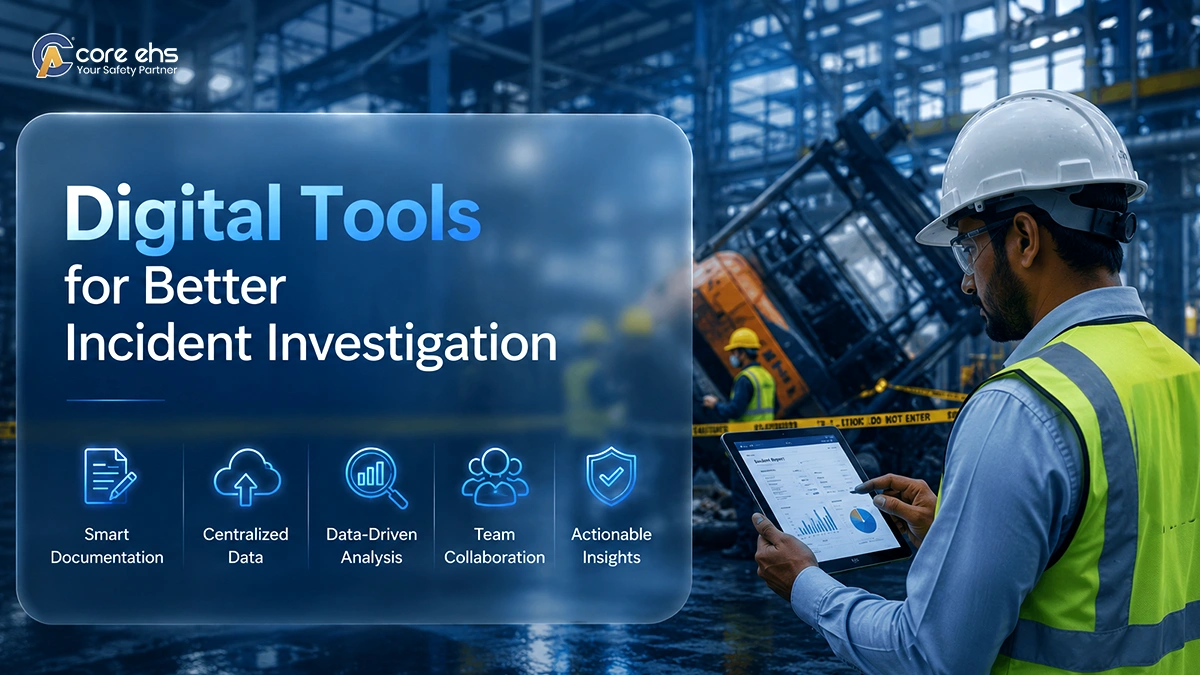
A strong investigation process depends on one thing above all else: the ability to capture what really happened, preserve evidence clearly, and turn that learning into action. This is where digital systems make a major difference. Traditional investigations often rely on handwritten reports, delayed documentation, incomplete witness accounts, and fragmented follow-up. By the time the investigation is reviewed, important details may already be lost. Digital systems improve this process by making reporting faster, evidence more structured, and learning easier to apply across the organization.
One of the most valuable ways digital systems improve investigation is through incident recreation in animation. In many cases, written reports and static photographs do not fully explain how an event unfolded. Sequence, timing, movement, blind spots, and unsafe actions can be difficult to understand from text alone. Recreating incidents through animation helps organizations visualize the chain of events more clearly. It supports investigation by showing how conditions developed, where controls failed, and what decisions led to the outcome. Just as importantly, it turns real incidents into learning opportunities. Instead of keeping a report buried in files, organizations can use recreated scenarios for fire safety training, safety briefings, toolbox talks, and behavioural learning programs. This makes lessons easier to understand, remember, and discuss.
Digital investigation also becomes stronger when near misses and unsafe acts are recorded systematically through reporting software such as ART hazard reporting software. One of the biggest weaknesses in many workplaces is that near misses are observed but not documented in a way that supports trend analysis or corrective action. A digital reporting platform makes it easier for workers and supervisors to record unsafe acts, unsafe conditions, and near misses in real time. That improves the quality of incident reporting and investigation because smaller warning signs are no longer lost between departments, notebooks, or verbal updates. When these reports are centralized, organizations can identify recurring patterns, high-risk areas, repeated unsafe behaviour, and system weaknesses much earlier.
Over time, that data becomes far more valuable than a single investigation report. It helps safety teams move beyond reacting to individual events and begin understanding the bigger behavioural picture. If the same type of unsafe act is reported repeatedly, or the same location produces repeated near misses, the problem is no longer isolated. It becomes a signal of system weakness. This is where digital reporting supports stronger root cause analysis in safety. Instead of asking only why one event occurred, organizations can ask why the same risk keeps appearing. That leads to more meaningful corrective action and better prevention.
Digital systems also support a more mature safety culture when they are tied to broader culture-building efforts such as SMCS. Investigation should not end with identifying a cause. It should feed into continuous improvement, leadership awareness, safer behaviours, and stronger accountability. When investigation data, near miss reporting, unsafe act observations, and corrective actions are all connected to a structured safety culture model, organizations are better able to turn information into long-term change. This is where systems stop being just tools and start becoming part of how people think and act. A reporting platform may capture the signal, animation may explain the event, but culture is what determines whether people learn from it and respond differently next time.
That is why digital investigation should not be seen only as a reporting upgrade. It is a way to improve visibility, strengthen learning, and connect individual events to organizational safety performance. When incident recreation, hazard reporting software, and structured culture-building efforts work together, investigations become more than reactive exercises. They become part of a preventive system, one that captures risk early, explains it clearly, and uses it to build safer behaviour across the workplace.
Conclusion
The difference between accident investigation and incident investigation is not just a technical distinction. It reflects how seriously an organization takes prevention. If investigations begin only after injury, damage, or loss has already occurred, the business is always learning late. But when near misses, unsafe acts, and early warning signs are captured and investigated properly, organizations gain the opportunity to act before risk turns into consequence.
That is why effective investigation should never stop at forms, findings, or blame. It should lead to better reporting, clearer visibility, stronger supervision, and more practical learning. From incident recreation in animation that helps teams understand what actually happened, to digital reporting through ART hazard reporting software that captures near misses and unsafe acts in real time, to culture-building approaches that strengthen behaviour and accountability, digital systems can turn isolated events into long-term safety improvement.
At CORE-EHS, we help organizations move beyond reactive investigation and build stronger systems for learning and prevention. Through safety training, digital reporting solutions, investigation support, and safety culture strengthening through SMCS, the goal is not just to document what went wrong, but to reduce the chance of it happening again. Because in a mature safety system, every event should become a learning opportunity, not just a closed report.