Introduction
In workplace safety, the difference between hazard and risk is one of the most commonly misunderstood concepts. Whether it is during safety training sessions, site inductions, toolbox talks, or professional exams, people often use these two terms interchangeably. This confusion can lead to poor safety decisions, ineffective controls, and increased chances of incidents.
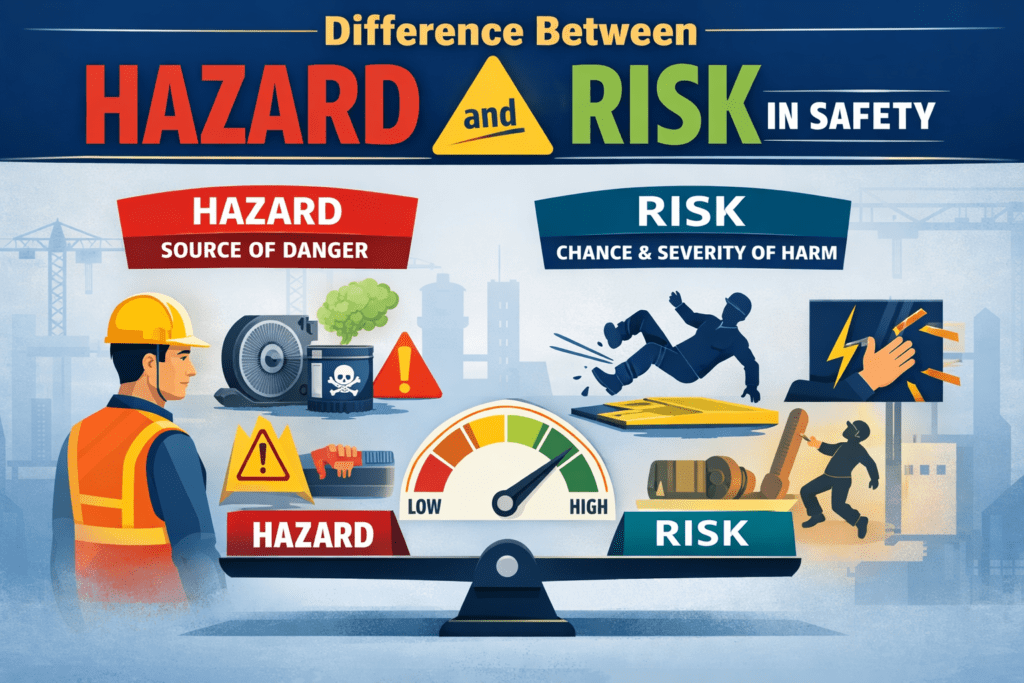
In simple terms, a hazard refers to something that has the potential to cause harm, while risk relates to how likely that harm is to occur and how severe the consequences could be. Understanding hazard vs risk is not just a theoretical exercise. It plays a critical role in preventing workplace accidents, improving compliance, and building a proactive safety culture.
For safety officers, supervisors, engineers, and even workers, clarity on this topic helps in identifying dangers early and managing them effectively. This guide explains the concepts in clear language, supported by practical workplace examples, so that anyone can understand and apply them correctly in real-life safety situations.
What Is a Hazard?
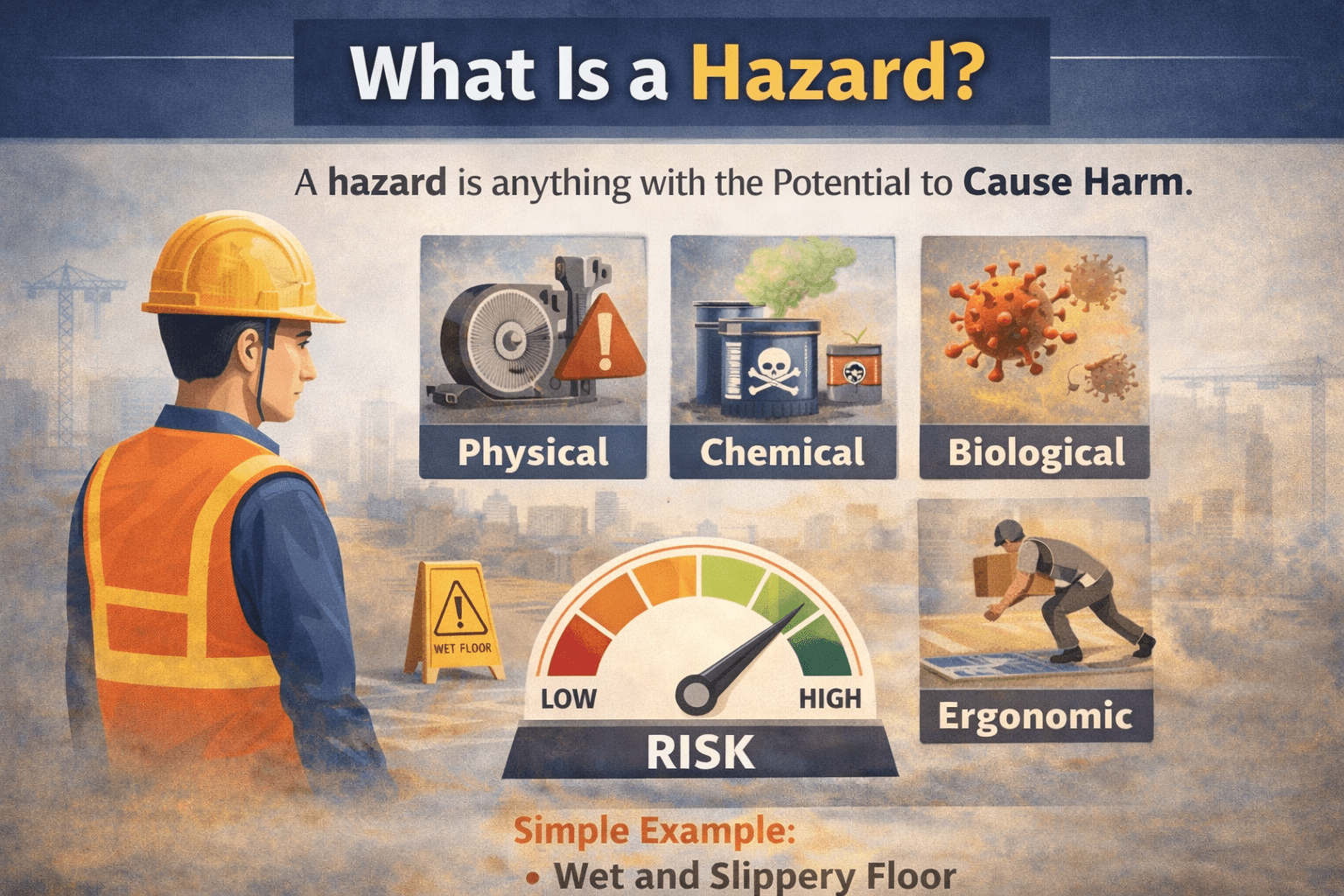
A hazard is anything that has the potential to cause injury, illness, damage, or harm to people, property, or the environment. In simple words, a hazard is the source of danger. Understanding what is hazard in safety is the first step toward preventing accidents at the workplace.
A hazard may exist even if no one is currently exposed to it. For example, an unguarded machine part is a workplace hazard even if no worker is operating that machine at the moment. The presence of the hazard does not automatically mean an accident will occur, but it creates the possibility for harm if proper controls are not in place.
Common Types of Workplace Hazards
Most workplace hazards fall into the following categories:
- Physical hazards: Noise, vibration, heat, radiation, slips, trips, and working at height
- Chemical hazards: Toxic gases, fumes, solvents, acids, and flammable substances
- Biological hazards: Bacteria, viruses, mould, and bloodborne pathogens
- Ergonomic hazards: Poor posture, repetitive movements, manual handling, and improper workstation design
- Psychosocial hazards: Work stress, fatigue, long working hours, and workplace violence
Each of these can become a serious workplace hazard if not identified and controlled at the right time.
Simple Example of a Hazard
Example: Wet Floor at Workplace
Consider a wet floor in a factory, warehouse, or office corridor. The wet surface itself is the hazard because it has the potential to cause harm. If a worker walks across this area, the hazard may lead to a slip or fall.
At this stage, we are only identifying the source of danger. We are not judging how often someone passes through the area or how serious the injury could be. That evaluation comes later when risk is assessed.
In simple terms:
- Hazard: Wet and slippery floor
- Potential harm: Slipping, falling, and injury
Recognising hazards early helps organisations take preventive action before anyone gets hurt. This is why hazard identification is always the starting point of effective safety management.
What Is a Risk?
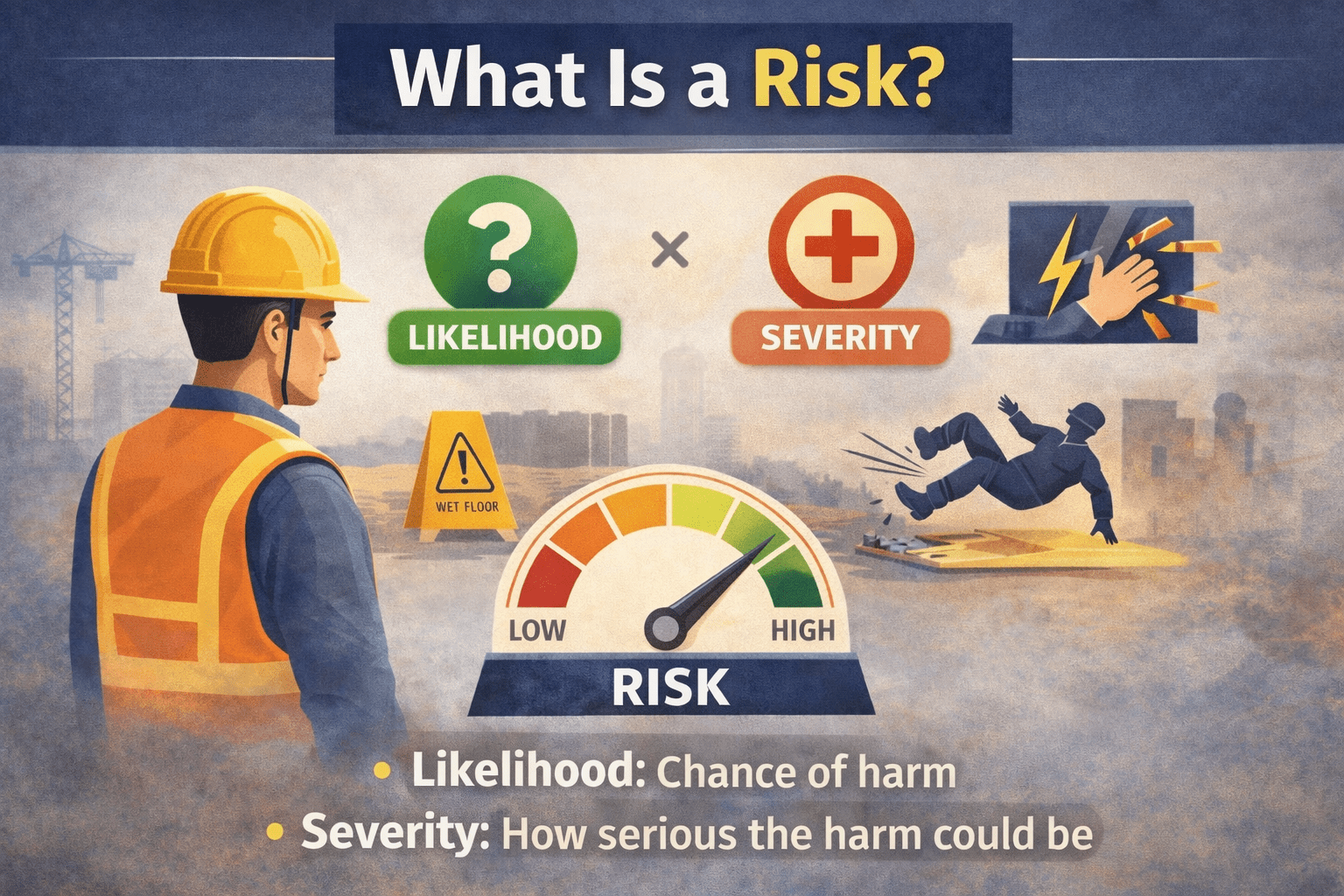
Risk refers to the likelihood that a hazard will actually cause harm, along with the severity of that harm. In workplace safety, understanding what is risk in safety means looking beyond the source of danger and evaluating how probable an incident is and how serious the consequences could be.
Unlike a hazard, risk is not fixed. The level of risk can change depending on who is exposed, how often the exposure occurs, and what safety controls are in place. For example, the same hazard may present a low risk in one situation and a high risk in another.
In simple safety terms, risk is often understood as a combination of two factors:
- Likelihood: How likely it is that the hazard will cause harm
- Severity: How serious the injury, illness, or damage could be if it occurs
This evaluation is a key part of risk assessment, which helps organisations decide where to focus their safety efforts.
Simple Example of Risk at Workplace
Continuing with the wet floor example, the risk depends on the situation. If the wet floor is in a rarely used area with warning signs placed, the likelihood of someone slipping is low, and so is the risk. However, if the same wet floor is located in a busy walkway with no warning signs, the risk increases significantly because more people are exposed and the chance of a fall is higher.
In this case:
- Hazard: Wet and slippery floor
- Risk: Possibility of a worker slipping and getting injured
This shows how risk changes based on exposure, controls, and working conditions. Managing workplace safety effectively requires not only identifying hazards but also assessing and reducing the associated risks through proper controls and safe work practices.
Difference Between Hazard and Risk
Understanding the difference between hazard and risk is critical for effective workplace safety management. While both terms are closely related, they do not mean the same thing and should never be used interchangeably.
A hazard identifies what can cause harm, whereas risk evaluates how likely that harm is to occur and how severe it could be. The table below clearly explains the hazard and risk difference in a simple, exam-ready, and workplace-friendly format.
Hazard vs Risk Comparison Table
Basis of Comparison | Hazard | Risk |
Meaning | A hazard is a source or situation with the potential to cause harm | Risk is the likelihood and severity of harm caused by a hazard |
Nature | Always exists when a source of danger is present | Changes based on exposure, controls, and conditions |
Focus | Identifies what can go wrong | Evaluates how serious the outcome could be |
Can it be eliminated? | Can often be removed or substituted | Can be reduced but not always eliminated |
Example | Working at height | Falling from height and getting injured |
Safety approach | Hazard identification | Risk assessment and control |
When organisations clearly understand the difference between hazard and risk, safety decisions become more structured, effective, and compliant with recognised safety management practices.
Real-Life Examples of Hazard and Risk at Workplace
Understanding concepts becomes much easier when we look at real situations. The following hazard and risk examples show how the same hazard can lead to different levels of risk depending on exposure, environment, and controls in place. These examples reflect common conditions found across industries and everyday workplaces.
Wet Floor in a Factory
- Hazard: Slip & trip Hazard due to wet and slippery floor surface
- Risk: Workers may slip, fall, and suffer injuries such as sprains or fractures
- Control: Warning signage, immediate cleaning, and anti-slip flooring
Working at Height on a Construction Site
- Hazard: Fall from height due to unprotected edges
- Risk: Serious injury or fatality caused due to fall
- Control: Guardrails, safety harnesses, and proper supervision
Exposed Electrical Wiring
- Hazard: Exposure to live electrical cables or damaged insulation
- Risk: Electric shocks, burns, or fire incidents due to exposed wires
- Control: Proper insulation, lockout procedures, and regular inspections
Manual Handling of Heavy Loads
- Hazard: Improper/incorrect lifting or carrying heavy materials causing musculoskeletal Injuries
- Risk: Musculoskeletal injuries such as back strain
- Control: Mechanical lifting aids and ergonomic training
Chemical Storage Area
- Hazard: Hazardous chemicals stored improperly
- Risk: Chemical burns, inhalation injuries, or environmental damage
- Control: Proper labelling, ventilation, and safe storage practices
These workplace hazard and risk examples highlight an important lesson. Hazards are often unavoidable, but risks can be reduced significantly through proper planning, training, and control measures. Effective workplace safety depends on recognising this difference and acting on it consistently.
Can a Hazard Exist Without Risk?
Yes, a hazard can exist without risk in certain situations. This is an important concept in workplace safety and helps clarify the real meaning of hazard vs risk.
A hazard represents a potential source of harm, but risk depends on exposure. If no one is exposed to the hazard, or if strong safety controls are in place, the level of risk may be very low or even negligible.
For example, a chemical stored securely in a sealed container inside a locked cabinet is still a hazard because it has the potential to cause harm. However, if workers do not have access to it and proper safety controls are maintained, the risk of injury or exposure is minimal.
This distinction is crucial for workplace safety planning. It helps organisations focus their efforts on managing exposure and strengthening controls, rather than trying to eliminate every hazard, which is not always practical in real working environments.
Why Understanding Hazard vs Risk Is Important for Workplace Safety
Understanding the difference between risk and a hazard is essential for improving workplace safety. When these concepts are mixed up, safety controls are often misapplied, leaving workers exposed to avoidable dangers.
Identifying hazards helps teams understand what can cause harm, while assessing risk helps decide what needs urgent action. By focusing on high-risk activities first, organisations can prevent accidents more effectively.
This clarity also strengthens safety management by supporting better risk assessments, compliance, and audits. When workers understand the difference between risk and a hazard, they recognise risky situations early and follow controls more consistently, helping build a safer and more proactive work environment.
Role of Hazard Identification and Risk Assessment (HIRA)
Hazard Identification and Risk Assessment, commonly called HIRA, is a simple but powerful way to prevent workplace accidents. It follows a clear sequence. First, hazards are identified by observing tasks, equipment, and work areas. This helps teams understand what could cause harm.
Next, risk assessment is carried out to judge how likely the hazard is to cause injury and how serious the impact could be. This step helps prioritise which risks need immediate control and which can be managed through routine safety measures.
When HIRA is done regularly, it supports safer work planning, better use of controls, and informed decision-making before starting any task. It also helps organisations move from reactive safety to proactive prevention.
Common Mistakes Organizations Make While Managing Hazards and Risks
Even organisations with safety systems in place often make avoidable mistakes while managing hazards and risks. Identifying these gaps early helps improve safety outcomes.
Treating Hazard and Risk as the Same Thing
Hazard and risk are confused, leading to incorrect controls and poor prioritisation.
Ignoring Exposure Levels
Hazards are identified, but how often workers are exposed is overlooked, increasing risk.
One-Time Risk Assessments
Risk assessments are not reviewed when work conditions change.
Lack of Worker Involvement
Worker inputs are missed, resulting in incomplete understanding of real hazard and risk conditions.
Poor Use of Safety Data
Incident and hazard data is collected but not analysed for improvement.
Avoiding these mistakes helps organisations manage risks more effectively and prevent incidents.
How CORE-EHS Helps Organizations Manage Hazards and Risks
CORE-EHS supports organisations in managing hazards and risks through a practical, system-driven approach. Instead of relying only on manual registers, teams can use Hazard Reporting Software to capture unsafe conditions, near misses, and hazards directly from the field.
Once hazards are reported, Incident Management Software helps investigate incidents, analyse trends, and track corrective actions to closure. This ensures that identified risks are not ignored and lessons are applied across sites.
By combining technology with training, audits, and on-ground safety support, CORE-EHS helps organisations prioritise high-risk activities, improve compliance, and strengthen day-to-day safety decision-making.
Frequently Asked Questions on Hazard and Risk
What is the difference between hazard and risk in safety?
A hazard is anything with the potential to cause harm, while risk explains how likely that harm is to happen and how severe the outcome could be under specific working conditions.
What is the difference between risk and a hazard?
The difference between risk and a hazard is that a hazard is the source of danger, whereas risk depends on exposure, likelihood, and the seriousness of possible injury or damage.
Is hazard the same as risk in workplace safety?
No, hazard and risk are not the same. A hazard identifies what can cause harm, while risk evaluates how dangerous that hazard is in a real work situation.
Can a hazard exist without risk?
Yes, a hazard can exist without risk if there is no exposure or if strong safety controls are in place that prevent the hazard from causing harm.
What is a simple example of hazard and risk at workplace?
A wet floor is a hazard. The risk is a worker slipping and getting injured, which becomes higher if the area is busy and not properly marked.
Why is risk assessment important after hazard identification?
Risk assessment helps prioritise hazards by evaluating likelihood and severity, ensuring that safety controls are applied first where the risk is highest.
Who is responsible for identifying hazards and risks at work?
Employers are responsible for providing a safe workplace, but workers, supervisors, and safety teams all share responsibility for identifying hazards and managing risks.
Why do safety professionals differentiate between hazard and risk?
Safety professionals differentiate between hazard and risk to apply the right controls, prevent incidents, improve compliance, and make better safety decisions on site.
Conclusion
Understanding the difference between hazard and risk helps organisations make better safety decisions. Hazards identify what can cause harm, while risks show how serious and likely that harm is. When this difference is clearly understood and managed systematically, workplaces become safer, more compliant, and more proactive.