 +91 72929 29159













Walk into any modern industrial facility in 2026 and you will see something interesting.
Introduction
Workers are wearing smart helmets. Supervisors are checking dashboards instead of clipboards. Hazard reports are submitted through mobile apps. Yet, despite all this technology, the most important question remains unchanged:
Are people truly safe while doing their work?
Occupational Health and Safety, often shortened to OHS, is no longer just about helmets, warning signs, and compliance checklists. It has evolved into a strategic discipline that combines people, processes, technology, and leadership to prevent harm before it happens.
In modern industries, OHS is not a department. It is a system.
Let us break down what that really means in 2026.
What Is Occupational Health & Safety?
Occupational Health and Safety refer to the policies, systems, and practices designed to protect workers from injury, illness, and unsafe working conditions.
According to the International Labour Organization, more than 2.78 million people die each year due to work-related injuries and diseases globally. These numbers highlight why OHS is essential.
Traditionally, OHS focused on:
- Preventing workplace injuries
- Ensuring regulatory compliance
- Conducting safety training
- Investigating incidents after they occur
In 2026, the scope is much broader.
Modern Occupational Health and Safety include:
- Proactive hazard identification
- Digital reporting and analytics
- Real-time risk monitoring
- Behaviour-based safety programs
- Mental health and wellbeing
- Contractor and multi-site safety integration
- Predictive risk management using data
OHS today is about prevention, visibility, and measurable improvement.
How Occupational Health & Safety Has Evolved
1. Shifting from Reactive to Proactive Safety Management
Historically, safety systems were built around responding to incidents. An accident occurred, it was investigated, and corrective measures were introduced. While this improved compliance, it did not always prevent recurrence.
Modern Occupational Health & Safety emphasizes leading indicators instead of relying only on injury statistics.
Today, organizations track:
- Near-miss reports
- Hazard observations
- Unsafe act and unsafe condition trends
- Safety training participation
- Corrective action closure timelines
Regulatory guidance, such as OSHA’s focus on leading indicators, highlights the importance of monitoring early warning signals. When organizations measure what happens before an incident, they improve their ability to prevent escalation.
The shift from reactive to proactive safety management represents one of the most significant changes in industrial OHS.
2. Switching from Paper-Based Systems to Digital EHS Platforms
Traditional safety management relied heavily on manual logs, spreadsheets, and paper inspection forms. While these systems met compliance requirements, they often created delays and limited cross-site visibility.
Digital EHS systems now allow organizations to:
- Centralize hazard and incident reporting
- Automate audit scheduling and documentation
- Track compliance obligations
- Monitor leading indicators in real time
- Assign and verify corrective actions
The benefit is not just convenience. It is visibility and accountability.
When hazard reporting becomes instant and corrective actions are tracked digitally, response times improve and trends become measurable. This digital transformation supports consulting-led safety improvement by ensuring that well-designed frameworks are implemented consistently.
3. Building a Culture-Driven Safety Management System
Compliance defines minimum standards. Culture defines daily behaviour.
Modern industries recognize that sustainable safety performance depends on more than policies. It requires:
- Visible leadership commitment
- Worker participation in reporting
- Transparent corrective action systems
- Psychological safety in raising concerns
- Continuous reinforcement through training
A culture-driven Occupational Health & Safety approach connects safety performance directly to operational excellence.
Organizations that prioritize safety culture experience improvements not only in incident reduction but also in productivity, workforce morale, and reputational strength.
The Core Pillars of Modern OHS in 2026
Modern Occupational Health & Safety systems are built on structured foundations. In 2026, effective OHS is not defined by isolated policies but by interconnected pillars that reinforce prevention, visibility, and continuous improvement.
Below are the four core pillars that define modern OHS in industrial environments.
1. Hazard Identification and Risk Assessment
Every effective safety system begins with identifying what can go wrong before it does.
Hazard identification is no longer informal or reactive. It is systematic and data supported. Modern organizations use structured methodologies to evaluate risk across operations, processes, and environments.
Common tools include:
- Job Safety Analysis to break tasks into risk-prone steps
- HAZOP studies for complex process industries
- Digital inspections for real-time documentation
- AI-supported analytics to detect patterns across large datasets
Early identification reduces exposure risk and provides the first opportunity for prevention. When hazards are captured consistently and categorized correctly, organizations can move from assumption-based safety to evidence-based risk control.
2. Technology Integration in Safety Management
Technology has become an enabling layer in modern OHS, expanding visibility beyond what manual systems can achieve.
Today’s safety ecosystems often include:
- Digital EHS software for centralized reporting and compliance tracking
- IoT sensors and smart wearables for real-time environmental and worker monitoring
- AI-based video analytics to detect unsafe conditions and behaviours
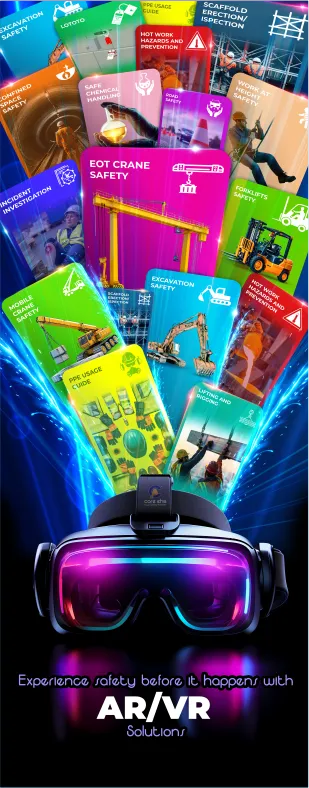
- VR and simulation training for high-risk task rehearsal
- eLearning and gamified modules for scalable skill reinforcement
Technology enhances visibility and consistency across sites. It reduces reporting delays, strengthens accountability, and improves response times.
However, technology does not replace leadership or supervision. It strengthens them by providing accurate, timely information that supports informed decisions.
3. Continuous Learning and Skill Reinforcement
Industrial environments are dynamic. Processes evolve, equipment changes, and workforce composition shifts. In such settings, one-time safety training is insufficient.
Modern OHS integrates learning as a continuous process rather than a single event.
This includes:
- Visual and simulation-based training to improve understanding
- Periodic refresher modules to strengthen retention
- Skill validation and competency assessments
- Data-driven learning interventions based on observed gaps
When training is integrated into the safety system, it reinforces daily behaviour instead of remaining theoretical. Continuous learning supports consistency across shifts, departments, and locations.
4. Data-Driven Decision Making
In 2026, industrial safety decisions are increasingly guided by structured data rather than anecdotal experience.
Modern safety leaders rely on:
- Real-time dashboards displaying key safety metrics
- Trend analysis of hazards and near misses
- Predictive insights derived from historical patterns
- Leading indicator tracking for early warning signals
Data enables prioritization. Instead of reacting to isolated events, organizations can identify recurring risks, allocate resources strategically, and intervene before incidents escalate.
Data-driven decision-making transforms Occupational Health & Safety from a compliance activity into a performance-driven system.
Why Occupational Health & Safety Matters More Than Ever
Occupational Health & Safety has always been important. In 2026, it has become critical.
Industrial environments are more advanced, more interconnected, and more operationally demanding than ever before. The margin for error has reduced, while stakeholder expectations have increased.
Modern industries now operate within a landscape shaped by:
- Complex machinery and automation systems
- High-speed production cycles and tight deadlines
- Multi-site coordination across regions and countries
- Contract labour and dynamic workforce structures
- Increasing regulatory scrutiny
- Heightened reputation and ESG expectations
In such environments, safety risks are not isolated. They are systemic.
The Cost of Weak Safety Systems
A weak Occupational Health & Safety system does not only result in injuries. It creates ripple effects across the organization.
Operational consequences may include:
- Production downtime due to incidents
- Increased insurance premiums and compensation claims
- Regulatory penalties and compliance investigations
- Disruption in supply chains
- Loss of workforce morale
- Damage to brand credibility and stakeholder trust
In competitive industries, safety failures are no longer just internal events. They are visible and reputationally significant.
The Strategic Value of a Strong OHS Framework
A strong Occupational Health & Safety framework delivers measurable organizational benefits.
It supports:
- Worker wellbeing and long-term health protection
- Operational continuity with fewer disruptions
- Reduced incident frequency and severity
- Stronger compliance performance
- Better contractor and multi-site safety coordination
- Organizational resilience during high-risk or emergency conditions
Safety performance is increasingly recognized as a leading indicator of operational discipline. Organizations that manage risk well in safety often manage risk well across other functions.
OHS as a Business Enabler
Modern OHS is not simply about avoiding penalties or meeting minimum standards. It enables stable growth, predictable operations, and workforce confidence.
In 2026, investors, regulators, employees, and clients all evaluate organizations based on how responsibly they manage workplace risk.
Occupational Health & Safety has moved from the periphery of operations to the centre of sustainable industrial performance.
The Role of Consulting and Digital EHS in Modern OHS
In 2026, building an effective Occupational Health & Safety system is no longer about drafting policies and conducting periodic audits. It requires structured design and disciplined execution.
Structure without execution creates documentation.
Execution without structure creates inconsistency.
Modern OHS requires both.
This is where safety consulting and digital enablement converge.
Structured Safety Through Expert Consulting
A strong Occupational Health & Safety framework begins with clarity.
Safety consulting plays a foundational role in ensuring that:
- Risk assessments are systematic and aligned with operational realities
- Regulatory obligations are clearly understood and embedded into processes
- Gaps in controls, supervision, or training are identified objectively
- Leadership alignment is established across functions and sites
Consulting brings method. It ensures that safety systems are not reactive collections of policies, but structured frameworks tailored to specific industrial risks.
It also ensures that safety management integrates elements such as behavioural observations, contractor controls, process safety reviews, and structured training programs.
Digital EHS: Turning Frameworks into Measurable Systems
Even the most well-designed safety framework can weaken without visibility and accountability.
Digital EHS platforms strengthen execution by ensuring that:
- Hazards are reported and visible in real time
- Corrective actions are assigned, tracked, and verified
- Audit findings are documented and monitored centrally
- Leading indicators are measured consistently
- Compliance records are transparent and accessible
Beyond reporting, modern digital ecosystems often include:
- Mobile-based hazard reporting tools
- Real-time dashboards for leadership visibility
- IoT-enabled monitoring for critical risk areas
- AI-supported analytics for trend identification
- VR and simulation-based training for high-risk task readiness
- eLearning modules to reinforce learning across multiple locations
These tools do not replace leadership or supervision. They extend visibility, improve consistency, and support timely decision-making.
Sustainable and Scalable Safety Improvement
When structured consulting frameworks are supported by digital systems, safety improvement becomes sustainable.
Risks are identified earlier.
Actions are traceable.
Learning is continuous.
Performance is measurable.
This integration enables organizations to move beyond compliance-driven safety and toward proactive, data-informed risk management.
In modern industries, Occupational Health & Safety is strongest when expertise and technology work together, creating systems that are not only compliant, but resilient and scalable across operations.
Conclusion: OHS as a Strategic System
Occupational Health & Safety in modern industries is no longer limited to inspections and incident reports. It is a structured, measurable, and technology-enabled system designed to prevent harm before it occurs.
In 2026, organizations that treat OHS as a strategic priority, supported by consulting expertise and digital tools, are better positioned to build proactive safety cultures and resilient operations.
The future of safety is not reactive.
It is visible, predictive, and continuously improving.
Frequently Asked Questions
What is the main objective of Occupational Health & Safety?
The primary objective of Occupational Health & Safety is to prevent workplace injuries and illnesses by identifying hazards, implementing controls, and continuously improving safety systems.
How is modern Occupational Health & Safety different from traditional safety programs?
Modern OHS focuses on proactive hazard identification, leading indicator tracking, digital monitoring, and safety culture development rather than relying only on post-incident investigations.
Why are digital EHS systems important in 2026?
Digital EHS systems centralize safety data, improve transparency, enable real-time monitoring, and support data-driven decision making across multiple sites.