FAQs

Frequently Asked Questions

All the things you need to know

  • Not Given by coreehs

  • Not Given by coreehs

  • Not Given by coreehs

  • Not Given by coreehs

  • Not Given by coreehs

  • Not Given by coreehs

  • Not Given by coreehs

  • Not Given by coreehs

SMCS stands for Safety Management Consulting Services. It is a structured consulting approach designed to improve workplace safety systems, reduce risks, and drive long-term safety culture transformation across organisations.

The primary objective of SMCS is to transform organisational safety culture by identifying gaps, strengthening systems, improving behaviours, and ensuring consistent compliance with safety standards.

SMCS consists of 10 integrated safety elements, including safety maturity assessment, behaviour-based safety, incident management, contractor safety, process safety, competency development, and rail & road safety management.

A Safety Maturity Survey evaluates an organisation’s current safety culture, employee perception, and leadership commitment, helping identify gaps and improvement opportunities for better safety performance.

The survey is conducted using structured tools, data analysis, and stakeholder feedback to assess multiple safety parameters and provide actionable insights for improvement.

A Behavioural Intervention Programme focuses on changing unsafe behaviours through observations, feedback, coaching, and mentoring, helping employees adopt safer work practices consistently.

Behaviour-based safety helps reduce accidents by addressing human factors, encouraging positive safety behaviours, and building employee ownership of safety at all levels.

IRIS is an Incident Reporting and Investigation System that helps organisations report, analyse, and learn from incidents and near-misses to prevent future occurrences.

Contractor Safety Management ensures real-time risk control by monitoring contractor activities, enforcing safety compliance, and integrating contractors into the organisation’s safety systems.

It involves identifying high-risk scenarios, evaluating existing controls, and strengthening safety measures to reduce risks to ALARP (As Low As Reasonably Practicable) levels.

Upgrading a safety management system helps organisations close compliance gaps, improve operational safety, standardise processes, and strengthen overall risk control mechanisms.

Capability and competency development focuses on building skills, knowledge, and safety leadership across the organisation through structured training, assessments, and continuous learning programs.

Implementation includes training need analysis, competency matrices, customised training modules, train-the-trainer programs, coaching, and performance dashboards.

Rail and road safety management is a systematic approach to reduce transportation-related risks through engineering controls, administrative measures, and compliance with safety standards.

Process Safety Management is a structured framework that prevents major accidents and hazardous releases by managing process risks through defined systems, procedures, and audits.

A Personal Safety Action Plan encourages employees to take ownership of safety, promoting safe behaviours and influencing leadership commitment toward safer workplaces.

These sectors involve high-risk activities where continuous safety oversight is essential. Dedicated safety staffing helps prevent incidents, protect workers, and keep projects compliant and on schedule.

Companies can request customised staffing by sharing project scope, locations, timelines, and risk levels. Safety manpower plans are then tailored to support large-scale and multi-site operations effectively.

Organisations can hire safety officers, safety engineers, EHS coordinators, safety supervisors, auditors, and EHS managers, depending on project complexity and regulatory needs.

CORE-EHS continuously upskills its safety professionals through structured training, exposure to digital safety tools, and alignment with evolving global best practices, ensuring high on-site performance.

Outsourcing reduces hiring time, administrative effort, and training costs. It also gives companies access to experienced safety professionals who can be scaled up or down based on project requirements.

Qualified safety professionals ensure on-site implementation of safety procedures, audits, and reporting aligned with OSHA, ISO 45001, and other global standards, helping organizations maintain consistent compliance.

The process includes screening qualifications, verifying certifications, assessing experience, and providing project-specific orientation. For international projects, additional compliance and documentation requirements are addressed before deployment.

Industries such as construction, oil and gas, manufacturing, power, infrastructure, chemicals, logistics, and mining commonly require dedicated safety manpower due to high operational risks and regulatory obligations.

Companies can engage safety staffing partners who maintain a ready pool of certified safety officers and EHS professionals. This allows flexible hiring for shutdowns, expansions, or long-duration projects without recruitment delays.

Reliable safety staffing services combine global reach, industry expertise, and strong compliance knowledge. Providers with proven experience across industrial projects can ensure the right safety professionals are available wherever projects are executed.

Manpower outsourcing services allow companies to source skilled professionals through a specialized partner instead of hiring directly. In safety and EHS, this enables quick deployment of trained safety personnel without long-term hiring commitments.

EHS documentation refers to written procedures, policies, manuals, registers, and records that help organisations manage Environment, Health, and Safety risks and comply with statutory and regulatory requirements.

EHS documentation is critical to ensure legal compliance, reduce accidents, standardise safe work practices, and demonstrate due diligence during audits and inspections.

Mandatory EHS documents typically include safety policies, SOPs, risk assessments, emergency response plans, statutory registers, permits, and compliance records, depending on applicable laws and industry.

Yes. CORE-EHS develops customised EHS documentation based on your industry, processes, risk profile, applicable laws, and operational requirements—rather than generic templates.

EHS documentation is required across industries such as manufacturing, construction, oil & gas, power plants, chemicals, pharmaceuticals, logistics, and infrastructure projects.

Well-structured EHS documentation ensures quick access to records, clear compliance evidence, and reduced non-conformities during internal audits, third-party audits, and government inspections.

EHS documentation services typically include policy drafting, SOPs, risk assessments, emergency plans, statutory registers, compliance checklists, manuals, and periodic updates as per legal changes.

Yes. Clear and practical documentation helps employees understand hazards, follow safe procedures, and respond effectively to emergencies, leading to improved safety performance.

EHS documents should be reviewed annually or whenever there is a change in process, equipment, legislation, or incident trends to remain accurate and compliant.

Absolutely. EHS documentation forms the foundation for ISO 45001, ISO 14001, and integrated management systems, supporting certification and ongoing compliance.

Yes. EHS documentation can be digitised and integrated with EHS software systems for easier access, version control, reporting, and audit readiness.

While ownership usually lies with the EHS department, effective documentation requires involvement from operations, engineering, HR, and management to ensure accuracy and implementation.

Lack of proper EHS documentation can result in legal penalties, audit failures, increased accident risk, operational disruptions, and reputational damage.

CORE-EHS follows a risk-based, law-aligned, and industry-specific approach, ensuring documents are practical, compliant, easy to understand, and audit-ready.

The timeline depends on site complexity, industry, number of processes, and statutory requirements, but most projects are delivered in a structured and phased manner.

Yes. SMEs are equally required to comply with EHS laws, and proper documentation helps them manage risks, avoid penalties, and operate safely.

Organisations can begin by conducting a gap assessment, identifying legal requirements, and engaging an experienced EHS consultant to develop compliant documentation.

Yes. Consistent, well-communicated documentation supports standardised behaviours, accountability, and a proactive safety culture across the organisation.

Yes. Documentation can be aligned with client safety standards, project-specific requirements, and contractor safety expectations.

CORE-EHS combines regulatory expertise, industry experience, and practical implementation knowledge to deliver documentation that works on the ground—not just on paper.

EHS safety training equips employees with the knowledge, skills, and awareness required to identify workplace hazards, follow safe work practices, respond to emergencies, and comply with applicable Environment, Health, and Safety regulations.

EHS safety training is essential to prevent accidents, reduce unsafe acts, protect employees, and ensure legal compliance. It also strengthens safety culture and improves overall operational performance.

Yes. CORE-EHS provides customised on-site EHS safety training based on your industry, site conditions, hazard profile, job roles, and regulatory requirements, ensuring practical relevance and immediate applicability.

EHS safety training is required across industries such as manufacturing, construction, oil & gas, power plants, chemicals, pharmaceuticals, logistics, infrastructure, and project sites.

Training topics include work at height, confined space, electrical safety, fire safety, rigging and lifting, behaviour-based safety, accident investigation, contractor safety, and emergency response, among others.

CORE-EHS training programs are aligned with applicable Indian safety laws, statutory requirements, and regulatory guidelines, supporting compliance and audit readiness.

CORE-EHS supports organisations through internationally recognised safety frameworks and best practices and can guide learners towards globally accepted certifications such as NEBOSH through structured learning pathways.

Pre and post assessments help measure knowledge gaps, evaluate learning effectiveness, and ensure competency development, enabling organisations to track real improvement rather than just attendance.

Training sessions are conducted by experienced EHS professionals and industry practitioners with hands-on exposure to industrial operations, audits, and safety implementation.

Yes. EHS training directly supports the ‘Social’ pillar of ESG by improving worker safety, competence, and wellbeing, contributing to responsible and sustainable business practices.

Yes. CORE-EHS training includes real accident case studies, incident learnings, and industry examples to help participants understand root causes, consequences, and preventive measures.

Yes. Where applicable, CORE-EHS includes field-based and practical demonstrations, allowing participants to apply safety concepts in real work environments.

Safety training should be conducted during induction, periodically as refresher training, after incidents, and whenever processes, equipment, or regulations change.

Yes. Training programs are customised to address site-specific hazards, operational risks, and client safety standards, ensuring relevance to actual working conditions.

Interactive training improves engagement, retention, participation, and behaviour change, making safety learning more effective compared to lecture-based sessions.

EHS training ensures employees are aware of legal requirements, safe procedures, and responsibilities, helping organisations meet statutory obligations and reduce compliance risks.

Yes. Companies can request industry-specific and site-specific safety animation videos that reflect their actual processes, hazards, and compliance requirements, ensuring relevance and higher training impact.

Animated safety videos combine storytelling, visuals, and real-world scenarios, making training more engaging and easier to remember. Unlike traditional methods, they deliver consistent messaging and can be reused across sites and teams.

Effectiveness is measured through assessments, knowledge retention tests, reduction in unsafe acts, incident trends, audit findings, and employee feedback after training deployment.

The cost depends on factors such as video length, level of animation (2D or 3D), complexity of hazards, customization, and industry specificity. Most companies view safety animation as a long-term investment that reduces incidents and training repetition costs.

Animated safety content can include hazard awareness videos, safe work procedures, emergency response scenarios, PPE usage, equipment operation safety, behavioral safety, and induction training modules for new employees.

Animated safety videos rely on visuals, symbols, and scenarios rather than heavy text. This makes them highly effective for multilingual workforces, ensuring safety messages are understood regardless of language or literacy levels.

The process typically includes understanding site risks, defining learning objectives, developing a safety-focused script, creating storyboards, animation production, and final validation with safety experts to ensure technical and regulatory accuracy.

Industries such as construction, manufacturing, oil and gas, power, infrastructure, chemicals, mining, and logistics benefit the most. These sectors involve high-risk operations where visual safety communication plays a critical role in incident prevention.

2D and 3D animated safety videos visually demonstrate hazards, unsafe acts, and correct procedures in a clear and engaging way. They help workers understand consequences, proper behaviour, and safety controls more effectively than text-based instructions.

Safety animation videos make complex and high-risk scenarios easy to understand without exposing workers to real danger. They improve attention, retention, and consistency in training while reducing dependency on lengthy manuals or repeated classroom sessions.

CORE-EHS provides comprehensive safety audit services covering statutory compliance, system audits, process safety audits, behavioural safety audits, and site-specific risk assessments across industries.

Yes. CORE-EHS safety audits are aligned with applicable Indian EHS legislation, statutory rules, and recognised industry standards, ensuring regulatory compliance and audit readiness.

Yes. Safety audits are conducted by qualified EHS professionals with extensive industry experience, ensuring practical, implementable recommendations.

Yes. CORE-EHS conducts customised safety audits based on site conditions, industry type, operational risks, and client-specific requirements rather than generic checklists.

CORE-EHS conducts safety audits for industries including manufacturing, construction, oil & gas, power plants, chemicals, pharmaceuticals, infrastructure, and logistics.

Audit reports include observations, risk ratings, legal non-compliances, photographs, root-cause insights, and clear corrective and preventive action recommendations.

Yes. CORE-EHS provides post-audit support, including guidance on corrective actions, prioritisation of risks, and improvement roadmaps.

Yes. CORE-EHS has experience in large-scale and multi-location safety audits, including plants, projects, and geographically distributed operations.

CORE-EHS follows a structured, independent, and evidence-based audit approach, ensuring transparency, accuracy, and unbiased findings.

Organisations can schedule an audit by contacting CORE-EHS for scope finalisation, after which an audit plan and timeline are shared.

A safety audit is a systematic evaluation of workplace safety systems, processes, and practices to identify hazards, non-compliances, and improvement opportunities.

Safety audits help organisations identify risks, ensure legal compliance, prevent accidents, and improve overall safety performance.

Common safety audits include statutory safety audits, internal audits, external audits, process safety audits, behavioural safety audits, and system audits.

Safety audits should be conducted periodically, and also after major incidents, process changes, expansions, or regulatory updates.

Internal audits are conducted by in-house teams to monitor compliance, while external audits are conducted by independent auditors for objective assessment.

A statutory safety audit evaluates compliance with applicable safety laws and rules mandated by regulatory authorities.

A process safety audit focuses on preventing major accidents by reviewing hazard identification, operating procedures, asset integrity, and emergency preparedness.

A safety audit ensures audit-ready documentation, compliance evidence, and proactive risk control, making regulatory inspections smoother.

Yes. Safety audits help identify unsafe conditions and system gaps, enabling corrective actions that reduce accidents and near-miss incidents.

Documents reviewed typically include safety policies, SOPs, risk assessments, permits, training records, incident reports, and statutory registers.

Yes. Contractor activities are reviewed to ensure compliance with safety rules, permits, training, and site-specific requirements.

A behavioural safety audit evaluates unsafe acts, work practices, and safety culture by observing how tasks are performed on site.

Findings are prioritised based on risk severity, likelihood, legal implications, and potential impact on people and operations.

After the audit, organisations receive a detailed report, action plan, and recommendations for improving safety performance.

Yes. Safety audits support ISO 45001, ISO 14001, and integrated management systems by assessing compliance and effectiveness.

Safety audit requirements depend on industry, size, risk level, and applicable laws, but regular audits are strongly recommended for all organisations.

The duration depends on site size, complexity, scope, and audit type, ranging from single-day audits to multi-day assessments.

CORE-EHS delivers practical, risk-based, and compliance-focused safety audits backed by deep industry experience and actionable outcomes.

Industries such as manufacturing, construction, oil and gas, power, chemicals, infrastructure, logistics, mining, and pharmaceuticals commonly use EHS safety software due to complex operations and strict compliance requirements.

A safety software platform typically includes incident reporting, hazard and near-miss management, inspections and audits, corrective action tracking, document control, dashboards, and analytics to support informed decision-making.

Businesses should consider ease of use, scalability, customization, regulatory alignment, data security, integration capabilities, implementation support, and the provider’s experience in safety and compliance management.

Companies measure ROI through reduced incident rates, fewer lost-time injuries, improved compliance scores, lower administrative effort, faster reporting, and better use of safety data for decision-making.

Traditional safety audits are periodic and manual, while EHS safety software enables continuous monitoring, real-time reporting, and ongoing improvement. Software transforms audits from isolated activities into part of a live safety management process.

Yes. Many safety software solutions can integrate with existing HR, ERP, and other enterprise systems to share data, reduce duplication, and create a connected digital safety ecosystem.

Digital safety management systems improve efficiency, reduce manual paperwork, enhance visibility of risks, support data-driven decisions, and create a more proactive safety culture across the organisation.

EHS management software supports compliance by standardising procedures, maintaining audit-ready records, tracking corrective actions, and providing visibility into compliance status across sites, making it easier to meet regulatory and internal safety requirements.

EHS safety software is a digital platform used to manage workplace safety processes in one system. It improves safety by enabling faster hazard reporting, better incident tracking, consistent inspections, and timely corrective actions, helping organizations prevent incidents rather than react to them.

Yes. Customised safety eLearning courses can be deployed on a company’s existing LMS and configured to track progress, assessments, and completion records for compliance and audit purposes.

Multilingual eLearning removes language barriers by delivering training in multiple languages, ensuring safety instructions are clearly understood by diverse teams across regions and cultures.

Yes. HSE eLearning courses are designed to be device-friendly and can be accessed on laptops, desktops, mobile phones, and tablets, making training accessible anytime and anywhere.

The cost depends on course duration, level of interactivity, visual design, assessments, and customisation depth. Custom eLearning is typically a cost-effective long-term solution that reduces repeat training expenses.

Available modules cover a wide range of topics, including scaffolding safety, hot work safety, work at height, confined space, electrical safety, machine guarding, fire safety, chemical handling, and emergency response.

Yes. Organisations can request industry-specific and role-based eLearning safety courses designed around their operations, hazards, and compliance requirements, ensuring higher training relevance and impact.

HSE eLearning offers greater flexibility and consistency than classroom training. While classroom sessions depend on instructor availability, eLearning ensures the same quality content is delivered every time and can be easily refreshed or updated.

Industries with distributed teams or high-risk operations benefit the most, including construction, manufacturing, oil and gas, power, logistics, chemicals, infrastructure, and mining.

Customised eLearning modules reflect actual workplace hazards, job roles, and procedures. This relevance improves engagement, helps employees relate training to real tasks, and leads to better understanding and safer on-the-job behavior.

HSE eLearning courses make safety training flexible, consistent, and scalable. Employees can learn at their own pace while organizations ensure uniform safety messaging, better knowledge retention, and reduced training downtime across locations.

CORE-EHS provides end-to-end ESG consulting services, including ESG framework development, gap assessments, ESG reporting, compliance alignment, and sustainability performance improvement.

Yes. CORE-EHS aligns ESG services with Indian regulatory requirements as well as global ESG frameworks and best practices, ensuring credibility and compliance.

Yes. CORE-EHS supports organisations in developing practical ESG strategies aligned with business goals, stakeholder expectations, and regulatory requirements.

Yes. CORE-EHS assists organisations with ESG data collection, structuring, documentation, and reporting, ensuring accuracy and transparency.

Yes. ESG solutions are customised based on industry sector, operational risks, maturity level, and regulatory obligations, rather than using generic models.

CORE-EHS ESG services benefit corporates, manufacturing units, infrastructure companies, energy organisations, and growing enterprises seeking sustainable and responsible growth.

Yes. CORE-EHS integrates ESG with EHS, safety management, and governance systems, creating a unified and implementable sustainability framework.

CORE-EHS follows a risk-based, implementation-focused approach, ensuring ESG recommendations are actionable, measurable, and aligned with on-ground operations.

Yes. CORE-EHS conducts ESG gap assessments and performance evaluations to identify gaps, risks, and improvement opportunities.

Organisations can engage CORE-EHS by requesting an ESG assessment or consultation, after which a tailored ESG roadmap is developed.

ESG stands for Environmental, Social, and Governance, a framework used to evaluate an organisation’s sustainability, ethical impact, and governance practices.

ESG is important because it helps organisations manage risks, improve sustainability, enhance brand reputation, attract investors, and meet regulatory expectations.

Certain ESG disclosures are mandatory for specific companies in India, while others are encouraged as part of responsible and sustainable business practices.

The environmental pillar focuses on resource use, emissions, waste management, energy efficiency, and environmental impact reduction.

The social pillar includes employee health and safety, labour practices, diversity, community engagement, and human rights.

Governance refers to ethical leadership, transparency, compliance, board oversight, and accountability in organisational decision-making.

Workplace safety is a key component of the ‘Social’ pillar, linking EHS performance directly to ESG outcomes.

Strong ESG practices help organisations reduce risks, improve resilience, build trust with stakeholders, and support long-term value creation.

An ESG gap assessment evaluates an organisation’s current practices against ESG standards, identifying gaps and areas for improvement.

ESG performance should be reviewed annually or periodically, especially when regulations, operations, or stakeholder expectations change.

Yes. Strong ESG performance enhances credibility, investor confidence, and customer trust, especially for global and institutional stakeholders.

Yes. ESG principles can be scaled and adapted for SMEs, helping them grow responsibly and remain future-ready.

CSR focuses on philanthropic and social initiatives, while ESG is a structured, measurable framework embedded into core business operations.

Yes. ESG frameworks help organisations track compliance, improve transparency, and prepare for evolving regulatory requirements.

Common challenges include data availability, lack of internal expertise, unclear regulations, and integration with existing systems.

Organisations can start by conducting an ESG gap assessment, defining priorities, and developing a phased ESG roadmap.

Yes. ESG principles align well with ISO 45001, ISO 14001, and other management systems, supporting integrated sustainability efforts.

CORE-EHS offers integrated ESG, EHS, and governance expertise, delivering practical, compliant, and measurable ESG solutions.

Yes. By preventing breakdowns and incidents, PSM reduces downtime and improves overall operational reliability.

Occupational safety protects workers from day-to-day risks, while PSM focuses on preventing catastrophic process failures.

Industries handling hazardous chemicals, energy-intensive processes, and complex operations, such as oil & gas, steel, chemicals, and power – need a PSM framework.

It reduces the frequency and severity of incidents like fires, explosions, and toxic releases, ensuring compliance and safe operations.

PSM is a structured approach that manages industrial process hazards to protect workers, equipment, and the environment.

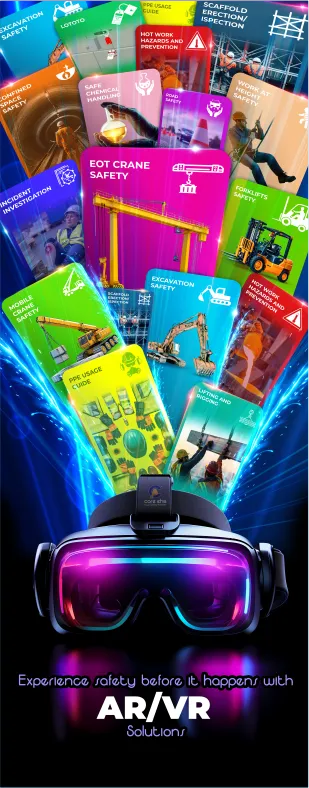
CORE-EHS offers immersive VR and simulation-based safety training solutions that replicate real-life workplace hazards, emergencies, and high-risk scenarios for effective experiential learning.

Yes. CORE-EHS develops customised VR and simulation modules based on industry type, site conditions, hazards, job roles, and client-specific safety requirements.

VR training covers topics such as work at height, confined space, electrical safety, fire safety, process safety, emergency response, and behavioural safety.

Yes. CORE-EHS VR solutions can be integrated with classroom training, eLearning modules, and safety workshops as part of a blended learning approach.

VR training programs are suitable for workmen, supervisors, engineers, safety officers, managers, and leadership teams, depending on learning objectives.

Yes. CORE-EHS provides simulation-based emergency and incident response training, allowing participants to practice decision-making in realistic, risk-free environments.

Yes. Training content is aligned with applicable safety regulations, industry best practices, and organisational procedures, ensuring relevance and compliance.

Yes. CORE-EHS can deliver on-site VR training or deploy portable VR setups, depending on infrastructure and project needs.

Training effectiveness is measured through scenario performance, decision tracking, assessments, feedback, and post-training evaluations.

Organisations can start by requesting a VR training demo or needs assessment, after which a customised training roadmap is proposed.

Organisations can start by requesting a VR training demo or needs assessment, after which a customised training roadmap is proposed.

VR safety training uses virtual reality technology to simulate real-world hazards and work environments, allowing users to learn and practice safely.

VR is used because it provides immersive, hands-on learning without exposing participants to actual risk, improving retention and decision-making.

Simulation-based training recreates realistic work scenarios and emergencies to help employees practice responses, procedures, and risk control measures.

VR training offers experiential learning, while classroom training is knowledge-based. VR allows learners to experience hazards rather than just hear about them.

Yes. VR training helps reduce accidents by improving hazard recognition, response time, and safe behaviour in high-risk situations.

Yes. VR is particularly effective for high-risk and rare scenarios such as confined spaces, working at height, electrical hazards, and emergency situations.

Yes. VR training is highly effective for induction training, contractor onboarding, and refresher programs, regardless of literacy levels.

VR training typically requires VR headsets, controllers, and a compatible system, which can be arranged by the training provider.

Yes. Simulation training can be repeated safely, allowing learners to improve skills and confidence through practice.

Session duration varies based on training objectives and number of scenarios, typically ranging from short modules to full-day programs.

VR safety training is suitable for industries such as manufacturing, construction, oil & gas, power, chemicals, logistics, and infrastructure.

VR engages visual, auditory, and motor senses, helping participants retain safety concepts longer compared to traditional methods.

Yes. VR scenarios can demonstrate unsafe acts, consequences, and correct behaviours, supporting behaviour-based safety initiatives.

Yes. VR training supports audits by demonstrating structured competency development and innovative safety training practices.

Traditional training often lacks realism and engagement, whereas VR provides immersive, risk-free exposure to real hazards.

While initial setup may be higher, VR training is cost-effective in the long term due to reduced accidents, repeatable training, and improved outcomes.

Yes. VR and simulation training can be scaled across multiple sites and locations, ensuring consistent training delivery.

CORE-EHS combines EHS domain expertise with advanced immersive technology to deliver practical, impactful, and future-ready safety training solutions.

CORE-EHS offers immersive VR and simulation-based safety training solutions that replicate real-life workplace hazards, emergencies, and high-risk scenarios for effective experiential learning.

Yes. CORE-EHS develops customised VR and simulation modules based on industry type, site conditions, hazards, job roles, and client-specific safety requirements.

VR training covers topics such as work at height, confined space, electrical safety, fire safety, process safety, emergency response, and behavioural safety.

Yes. CORE-EHS VR solutions can be integrated with classroom training, eLearning modules, and safety workshops as part of a blended learning approach.

VR training programs are suitable for workmen, supervisors, engineers, safety officers, managers, and leadership teams, depending on learning objectives.

Yes. CORE-EHS provides simulation-based emergency and incident response training, allowing participants to practice decision-making in realistic, risk-free environments.

Yes. Training content is aligned with applicable safety regulations, industry best practices, and organisational procedures, ensuring relevance and compliance.

Yes. CORE-EHS can deliver on-site VR training or deploy portable VR setups, depending on infrastructure and project needs.

Training effectiveness is measured through scenario performance, decision tracking, assessments, feedback, and post-training evaluations.

Organisations can start by requesting a VR training demo or needs assessment, after which a customised training roadmap is proposed.

Organisations can start by requesting a VR training demo or needs assessment, after which a customised training roadmap is proposed.

VR safety training uses virtual reality technology to simulate real-world hazards and work environments, allowing users to learn and practice safely.

VR is used because it provides immersive, hands-on learning without exposing participants to actual risk, improving retention and decision-making.

Simulation-based training recreates realistic work scenarios and emergencies to help employees practice responses, procedures, and risk control measures.

VR training offers experiential learning, while classroom training is knowledge-based. VR allows learners to experience hazards rather than just hear about them.

Yes. VR training helps reduce accidents by improving hazard recognition, response time, and safe behaviour in high-risk situations.

Yes. VR is particularly effective for high-risk and rare scenarios such as confined spaces, working at height, electrical hazards, and emergency situations.

Yes. VR training is highly effective for induction training, contractor onboarding, and refresher programs, regardless of literacy levels.

VR training typically requires VR headsets, controllers, and a compatible system, which can be arranged by the training provider.

Yes. Simulation training can be repeated safely, allowing learners to improve skills and confidence through practice.

Session duration varies based on training objectives and number of scenarios, typically ranging from short modules to full-day programs.

VR safety training is suitable for industries such as manufacturing, construction, oil & gas, power, chemicals, logistics, and infrastructure.

VR engages visual, auditory, and motor senses, helping participants retain safety concepts longer compared to traditional methods.

Yes. VR scenarios can demonstrate unsafe acts, consequences, and correct behaviours, supporting behaviour-based safety initiatives.

Yes. VR training supports audits by demonstrating structured competency development and innovative safety training practices.

Traditional training often lacks realism and engagement, whereas VR provides immersive, risk-free exposure to real hazards.

While initial setup may be higher, VR training is cost-effective in the long term due to reduced accidents, repeatable training, and improved outcomes.

Yes. VR and simulation training can be scaled across multiple sites and locations, ensuring consistent training delivery.

CORE-EHS combines EHS domain expertise with advanced immersive technology to deliver practical, impactful, and future-ready safety training solutions.

CORE EHS offers gamified safety learning solutions that use interactive games, challenges, and simulations to improve safety awareness, behaviour, and decision-making at the workplace.

Yes. CORE-EHS designs customised safety games based on industry type, job roles, hazard profiles, learning objectives, and organisational safety culture.

Gamified learning covers topics such as work at height, electrical safety, confined space, fire safety, PPE compliance, hazard identification, and behavioural safety.

Safety games are suitable for workmen, supervisors, engineers, safety officers, managers, and leadership teams, depending on game design and objectives.

Yes. CORE-EHS safety games can be integrated with classroom training, eLearning modules, toolbox talks, and safety campaigns.

Yes. CORE-EHS safety games are scalable and suitable for large groups, making them ideal for plant-wide training and safety events.

Learning outcomes are ensured through clear objectives, scenario-based challenges, scoring systems, debrief sessions, and performance analysis.

Yes. Gamified learning strongly supports behaviour-based safety by reinforcing safe choices, consequences, and positive reinforcement.

Yes. CORE-EHS offers both digital gamified learning solutions and physical safety games, depending on training needs and site conditions.

Organisations can start by requesting a demo or safety game concept, after which a customised gamified learning plan is developed.

Gamified learning uses game mechanics like points, levels, challenges, and rewards to make safety training engaging and effective.

Gamified learning is effective because it increases engagement, improves retention, encourages participation, and reinforces safe behaviour.

Games simulate real-life scenarios, allowing learners to practice decision-making and see consequences, leading to behaviour change.

Yes. Gamified training is suitable for industrial workers, including contract labour, as it simplifies learning and overcomes language and literacy barriers.

Yes. By improving awareness and decision-making, gamified learning helps reduce unsafe acts and accident risks.

Traditional training is instructor-led and passive, while gamified learning is interactive, learner-driven, and experiential.

Yes. Gamified learning is highly effective for refresher training, reinforcing key safety concepts without training fatigue.

Yes. Safety games are ideal for induction and onboarding, helping new joiners understand site rules quickly.

Yes. Gamified learning provides measurable data such as scores, completion rates, participation levels, and knowledge gaps.

Yes. Gamified safety training can be customised for multiple languages and cultural contexts.

Yes. Gamified learning promotes engagement, ownership, and continuous learning, strengthening safety culture.

Yes. Gamified scenarios can be designed to train leadership decision-making and risk ownership.

Yes. Gamified learning can be delivered through web-based platforms, mobile devices, and tablets, depending on design.

Session duration varies based on game complexity and objectives, ranging from short activities to full-day programs.

Yes. Gamified learning supports audits by demonstrating innovative competency development and engagement initiatives.

It addresses low engagement, poor retention, training fatigue, and lack of behaviour change seen in traditional methods.

Yes. Gamified learning can be combined with VR and simulation-based training for enhanced experiential learning.

CORE-EHS combines safety expertise, learning design, and innovation to deliver impactful, scalable, and results-driven gamified safety solutions.

CORE-EHS offers IoT-based safety solutions that use smart sensors, devices, and analytics to monitor risks, prevent incidents, and improve real-time safety visibility across industrial operations.

Yes. CORE-EHS IoT solutions are purpose-built for industrial safety, focusing on people safety, equipment safety, process safety, and compliance—not generic IoT applications.

IoT safety solutions help address unsafe acts, unsafe conditions, permit violations, vehicle risks, fire hazards, electrical risks, lifting hazards, and emergency response gaps.

Yes. IoT solutions are customised based on site layout, hazard profile, operational processes, and industry requirements, ensuring practical on-ground deployment.

Yes. CORE-EHS IoT solutions can integrate with existing EHS software, permit systems, access controls, and dashboards for centralised monitoring and reporting.

Industries such as manufacturing, construction, oil & gas, power plants, refineries, chemicals, logistics, and infrastructure projects benefit from IoT-enabled safety solutions.

Yes. The solutions provide real-time alerts and notifications for unsafe conditions, threshold breaches, equipment anomalies, and high-risk activities.

Yes. CORE-EHS IoT platforms are scalable and suitable for large plants, multiple locations, and distributed operations.

Yes. CORE-EHS provides end-to-end support, including site assessment, installation guidance, user training, and post-deployment support.

Organisations can start by requesting an IoT safety assessment or demo, after which a customised solution roadmap is proposed.

IoT in safety refers to the use of connected sensors, devices, and systems to monitor hazards, track conditions, and improve safety decision-making in real time.

IoT improves safety by detecting risks early, providing real-time visibility, enabling proactive interventions, and reducing reliance on manual monitoring.

IoT safety solutions can monitor movement, location, speed, temperature, gas levels, electrical parameters, equipment status, and worker behaviour indicators.

Yes. IoT helps prevent accidents by identifying unsafe conditions early and triggering timely corrective actions before incidents occur.

Yes. IoT is especially effective for high-risk activities such as confined space entry, lifting operations, vehicle movement, hot work, and electrical work.

Yes. IoT can support permit-to-work compliance, access control, condition monitoring, and safe-to-work verification.

Yes. IoT enables automated monitoring and alerts, reducing dependence on constant manual supervision while improving accuracy.

Yes. IoT solutions help monitor contractor activities, movement, and compliance, improving overall site safety.

IoT provides real-time location, condition monitoring, and alerts, helping emergency teams respond faster and more effectively.

Yes. IoT systems generate digital records, dashboards, and trend data, supporting audits, investigations, and management reviews.

Yes. By preventing incidents and detecting equipment issues early, IoT helps reduce downtime and operational disruptions.

IoT safety solutions can be scaled based on risk and criticality, making them cost-effective compared to accident losses and downtime.

IoT safety systems use secure data transmission, controlled access, and system safeguards to protect sensitive information.

Yes. IoT solutions are modular and scalable, allowing organisations to expand coverage as needs evolve.

IoT promotes safety culture by making risks visible, encouraging accountability, and enabling proactive safety behaviour.

Yes. IoT safety solutions contribute to ESG goals by improving worker safety, reducing incidents, and supporting responsible operations.

Traditional safety relies on manual checks and lagging indicators, while IoT provides real-time, data-driven insights.

CORE-EHS combines deep EHS domain expertise with practical IoT implementation, delivering safety solutions that work reliably on the ground.

CORE-EHS offers drone-based safety supervision services that provide aerial monitoring, inspection, and safety oversight of worksites to identify unsafe acts, unsafe conditions, and high-risk activities.

Drone-based supervision uses aerial drones equipped with cameras and analytics to monitor site activities, capture real-time visuals, and support proactive safety interventions.

Yes. CORE-EHS drone safety supervision is designed specifically for industrial, construction, infrastructure, and large project sites where ground-level visibility is limited.

Drones help identify work-at-height risks, unsafe scaffolding, PPE non-compliance, unsafe access, vehicle movement risks, and restricted-area violations.

Yes. CORE-EHS ensures drone operations are conducted in compliance with applicable aviation regulations, site rules, and safety protocols.

Yes. Drone supervision programs are customised based on project size, site layout, risk profile, and supervision objectives.

Yes. CORE-EHS provides structured reports with observations, visuals, risk insights, and actionable recommendations after each drone supervision exercise.

Yes. Drones can be deployed for periodic or scheduled safety supervision, ensuring continuous safety oversight on large or complex sites.

Yes. Drone-captured insights can be integrated with safety audits, incident management, and corrective action tracking systems.

Organisations can engage CORE-EHS by requesting a site assessment, after which a drone-based safety supervision plan is proposed.

Drone-based safety supervision uses unmanned aerial vehicles to monitor worksites from above, improving visibility and risk identification.

Drones are used because they can reach difficult areas, cover large sites quickly, and capture real-time visuals that are not possible through ground inspections alone.

Drone supervision improves safety by identifying hazards early, enhancing supervision coverage, and enabling proactive corrective actions.

Yes. Drone safety supervision is highly effective for construction and infrastructure projects, especially for height work and large layouts.

No. Drones support and enhance safety supervision but do not replace safety officers. They act as an additional eye in the sky.

Drones can monitor scaffolding conditions, work-at-height activities, lifting operations, traffic movement, housekeeping, and PPE usage.

Yes. When operated by trained professionals and following procedures, drones are safe and non-intrusive.

Yes. Drone visuals provide documented evidence and site overviews that support audits, reviews, and compliance checks.

Frequency depends on site risk level, project phase, and activity intensity, ranging from periodic checks to regular monitoring.

Yes. Drones can be deployed for rapid assessment during emergencies, helping teams understand site conditions quickly.

Yes. Drones significantly reduce blind spots in large, congested, or elevated work areas.

Yes. Drone supervision is cost-effective compared to manual inspections over large or high-risk areas and helps prevent costly incidents.

Yes. Drones can be used in operational plants, subject to site approvals and safety controls.

Drone supervision promotes accountability, visibility, and proactive risk awareness, strengthening overall safety culture.

Traditional supervision is limited by human reach, line-of-sight, and time, which drones help overcome.

Yes. Drone supervision can be combined with IoT safety systems, CCTV analytics, and digital safety platforms.

Yes. Drone-based supervision generates visual data and trends that help organisations improve safety planning and controls.

CORE-EHS combines EHS expertise, project experience, and advanced drone technology to deliver effective, compliant, and actionable safety supervision.

CORE-EHS provides end-to-end scaffolding safety services, including scaffolding design review, inspection, auditing, training, compliance assessment, and safe scaffolding system implementation.

Yes. CORE-EHS scaffolding services are aligned with applicable Indian regulations, international standards, and industry best practices, ensuring safe and compliant scaffolding systems.

Yes. CORE-EHS conducts systematic scaffolding inspections to identify unsafe conditions, structural issues, and non-compliances before work begins and during operations.

Yes. Inspections are carried out by trained and competent scaffolding safety professionals with hands-on industry experience.

Yes. CORE-EHS provides scaffolding safety training for scaffolders, supervisors, engineers, and safety professionals, focusing on safe erection, use, and dismantling practices.

Yes. Scaffolding services are customised based on project type, height, load requirements, work environment, and risk profile.

Industries such as construction, oil & gas, power plants, refineries, manufacturing, infrastructure, and maintenance projects benefit from CORE-EHS scaffolding services.

Yes. CORE-EHS provides post-inspection guidance and corrective action recommendations to improve scaffolding safety and compliance.

Yes. CORE-EHS has experience supporting large-scale, high-risk, and complex scaffolding structures across industrial and project sites.

Organisations can engage CORE-EHS by requesting a scaffolding inspection, audit, or training, after which a customised service plan is proposed.

Scaffolding is a temporary structure used to support workers, tools, and materials while working at height.

Scaffolding safety is critical to prevent falls, collapses, falling objects, and serious injuries, especially during work at height.

Common scaffolding hazards include falls from height, structural collapse, improper erection, overloading, missing guardrails, and unsafe access.

Scaffolding safety is a shared responsibility involving scaffolders, supervisors, engineers, safety officers, and management.

A scaffolding inspection is a systematic check of structure, components, access, stability, and safety features to ensure it is safe for use.

Scaffolding should be inspected before first use, periodically during use, after alterations, and after adverse weather conditions.

A competent person is someone with adequate training, experience, and knowledge to identify scaffolding hazards and take corrective actions.

Common types include supported scaffolds, suspended scaffolds, mobile scaffolds, and system scaffolds, depending on the work requirement.

A safe scaffold should include proper foundations, guardrails, toe boards, safe access ladders, adequate bracing, and load capacity markings.

Yes. Scaffolding training is mandatory for scaffolders and recommended for supervisors and safety staff to ensure safe erection and use.

Training improves hazard awareness, correct erection methods, safe working practices, and emergency response, reducing accident risks.

Inspection focuses on site-specific safety checks, while an audit evaluates the overall scaffolding management system and compliance.

Yes. Proper scaffolding systems and inspections help organisations comply with safety regulations and avoid penalties.

Typical documents include scaffolding design drawings, inspection checklists, training records, permits, and load calculations, where applicable.

Scaffolding provides a stable and protected working platform, reducing reliance on unsafe ladders or makeshift access systems.

Yes. Poorly designed or maintained scaffolding can lead to fatal falls, collapses, and multiple injuries.

Inspection duration depends on scaffold size, height, complexity, and site conditions, ranging from minutes to several hours.

CORE-EHS delivers practical, compliance-focused, and risk-based scaffolding services backed by industry expertise and on-site experience.

Yes, we have product-specific cases studies that you can refer. We would also recommend to explore our EHS blog and resource gallery for whitepapers, videos, buying guide and webinars.

One thing which we can promise you upfront is that all our safety solutions have very high return on investments. The major benefits are listed below:

e-PTW Benefits:

Improved Safety

  • No approval bypasses
  • Comprehensive hazard listing with contextual control suggestions and other safety checks
  • Auto identify SIMOPs and potential work conflicts
  • Robust communication, elevated coordination and control amongst the various involved work groups further strengthens the safety
  • Integrated worker(s) competency checks
  • Utilize past mistakes/lessons learnt to drive your efforts for better safety
  • Ensure safe plant hand-over post work completion
  • Easy sharing of risk assessments

Increased Operational Efficiency

  • Quicker work planning & permit request
  • Early identification of work conflicts & faster approval of work
  • Time-effort savings by elimination of moving paperwork by manpower
  • Efficient isolation management
  • Reuse of risk assessments
  • Improved management of work scope change
  • Reduced administrative overheads
  • Efficient & safe handling of increased work load during plant shutdown resulting in faster plant return to service

Better Compliance Fulfillment

  • Aid in both internal and external audits
  • Avoid lost time incidents & dangerous occurrences/property damage implications

Environmental Benefits

SAFE (EHS Management Software) Benefits:

Improved Safety Management

  • Centralize and Standardize
  • Streamlining EHS Data Collection and Improving Reporting Efficiency
  • Widespread Content Availability
  • Enhanced Compliance Monitoring
  • Robust Task Management
  • Increased Visibility and Rich Insights
  • Monitor Risks and Prevent Incidents

Time-Effort Savings

  • Automation of Manual Work
  • Administration Overhead and System Consolidation

Reduction in Costs

  • Reduction in incidents
  • Reduction in material expenditure
  • Indirect cost reduction due to increase in productivity

Strengthened Safety Culture

    • Boosting accountability
    • Spread Safety Awareness and Engage Employees

Please write us if you wish to obtain detailed information regarding our safety software ROIs.

Well, that’s a simple one! The excel sheets does not communicate back to you whereas our software is interactive and shall serve as your artificial “EAR” in listening important safety chatter within your workplace and across the organization.

E – Escalate critical safety concerns automatically such as a task to correct non-compliance is not completed within the allotted time, no action is taken on a reported incident, a requested breakdown maintenance work permit is not approved within time.

A – Alert and make you aware of the corrective and preventive actions that you need to take, safety trainings you need to undergo, a new hazard is reported, a new work permit request has arrived for work authorization and so much more.

R – Remind you of upcoming audits, soon-to-expire legal permits, closing the safety tasks assigned to you before deadline, renew the work permit so on and so forth.

And that’s not all – instead of spending a lot of time and efforts in switching between spreadsheets to pool and collate EHS data so as to evaluate the safety performance, leverage our software’s intelligence to automatically prepare real-time charts, graph trends and performance scorecard to gain actionable insights into your safety problems.

Furthermore, since all your relevant EHS data (including past years records) across organization are stored at a centralized location within our software unlike the multiple year-wise excel sheets; these records can be accessed at any given point of time with extreme ease.

You can use our mobile applications to carry out your safety-critical activities in such zones using the intrinsically safe smart phones.

We do not manufacture such devices; however, we can provide you vendor listing along with the approximate cost on request basis.

All our safety software is open to be integrated with any third-party software like ERP or HRM system considering vendor allows and provide facility to access the system.

Yes, absolutely. We perfectly understand that there exist such safety-critical activities that requires on-site presence of the personnel like performing risk assessments or carrying out site inspections, to name a few. You can mandate and confirm such on-site presence of the personnel by leveraging our mobile application’s auto Geo-location fetching feature.

The cornerstone of all our safety software is equipping you with complete visibility of all of your critical-to-safety programs – not just within a single work location (site/plant/office), but across all your businesses.

Our Safety Cockpit is equivalent of swiss army knife which empowers you with all the necessary EHS statistics, analytics and trends in real-time so that you have a bird-eye-view to gain foresight. Also, we very well understand that every person is unique, and that his / her responsibilities and area of concern vary accordingly. Our EHS management solution (SAFE) provides you a personalized window to monitor, track and gain insights of the EHS functions that matter the most to an individual. Furthermore, SAFE calculates your organization’s EHS performance (scorecard with lead and lag indicators) and auto-email monthly EHS reports.

And that’s not all – our safety software keeps you informed at all times. Be it any planned activities like overdue site inspections, equipment inspections or upcoming audits or soon going to expire legal permits or what is the status of an ongoing incident investigation or be it a bird-eye-view of all ongoing high-risk activities (PTW) and so much more.

There is availability of mobile application targeted towards throttling employee participation in safety-critical programs through mobile-enabled Hazard Reporting, Safety Observations, Peer-to-Peer Behavior Based Observations.

CORE-EHS’ safety portal is a unique engagement-centric platform that enables sharing of site / plant-specific and enterprise-wide safety newsletters, events, display key KPIs to show the overall safety progress of an organization, promote new safety initiatives and useful trainings, highlight the safe work practices and motivate the employees by running campaigns such as “Safety First Recognition”. Furthermore, our knowledge desk provides a perfect platform for all employees to exchange information and gain awareness about ongoing hazards and safety trends; this in turn can lead into taking corrective actions proactively.

Accident Frequency Rate Calculation:

[(No. of loss time injuries*) x 1000000] / Total man hours worked

Accident Severity Rate Calculation:

[(Man-days lost due to lost time injuries*) x 1000000] / Total man hours worked

*Loss time injury: any work-related injury or illness which prevents that person from doing any work day after the accident.

Note:
The accident calculation is based on “IS 3786 (1983): Methods for computation of frequency and severity rates for industrial injuries and classification of industrial accidents”.

However, our software solution is open to adopt to any other standards for computation of frequency rate, severity rate and other key safety metrics.

SAFE (EHS Management Software):

Based on the various reporting and on-field activities carried out by your team with the CORE-EHS digital tool, the software automatically prepares a safety performance assessment scorecard for your organization. The scorecard empowers you with real-time actionable insights to the various risks such as unsafe work conditions, at-risk workforce behavior, pending or long due employee safety training, safety non-compliance. Also, the scorecard highlights the Near-Misses and incidents that have occurred facilitated by the provision to carry out causal analysis. This enables you to leverage CORE-EHS’s robust task management tool for immediate assignment of corrective and preventive actions and easy tracking of its closure within the targeted deadline to mitigate the risks and prevent future incidents.

e-PTW (Permit to Work Software):

The permit to work comes with in-built Risk Assessment/Job Safety Analysis/Job Hazard Analysis tool. The software ensures that the work cannot commence until and unless the risks associated with the job are assessed and subsequent necessary mitigation/control measures have been put into place. Upon commencement of work, the permit auditing tool facilitates the EHS Team/Work Supervisors to monitor the risk and stop-the-work if found unsafe to continue working. Additional tools such as SIMOPs identifier further adds up to the robust risk planning.

Yes, absolutely. Eliminating the wastage of paper is a great initiative and we at CORE-EHS will be more than happy to extend our support in achieving it by undergoing complete digital transformation of your existing paper-based EHS / PTW activities.

Certainly! All our safety software is Enterprise grade, scalable, modular in design and made to evolve with you as you and your team grow.

Growing Business Needs

Since we follow a modular design approach, we have the flexibility to provide module-wise software delivery addressing to your specific business needs of the hour. Later, we can roll-out other phases of the software based on your growing business needs.

Growing Size of Business

All of CORE-EHS’ safety software are enterprise grade solutions that are scalable from one plant/site to any number of plants/project sites. In fact, some of our clients have more than 100 site locations.

However, with the increase in size of your business, be it the increase in the user-base or spread of the organization’s presence geographically – the infrastructure requirements such as data servers will have to be scaled up. ASK-EHS shall provide all the required assistance and consultation for the same.

As a matter of fact, digitalization is even more crucial and enjoy huge benefits for large plants or when there are large number of projects. We have a history of successful implementation of our safety software for large setups, thanks to our unique phase-wise roll-out implementation strategy with user acceptance checks and top of the line continued client support.

All our safety software come with English as primary language by default. To cater to the needs of international clients we provide multilingual support as a secondary language. So far, we have successfully delivered the software in several widely spoken languages like Spanish, Portuguese, Chinese, French and we are capable of supporting any other client preferred language on request basis.

Yes, absolutely. As a matter of fact, 15000+ active users spread over 4 continents in diverse industrial workplaces rely on our digital EHS & PTW platforms. Our end-to-end customization for tailored solution delivery, experts within national and international regulatory framework and integrated EHS business services have more than 400+ clients globally.

Visit our clients page to know more about the organizations we work with.

All processes mentioned in OHSAS / ISO are covered in SAFE – our EHS management software. However, the forms and reporting format varies from industry-to-industry, country-to-country. In order to meet industry/country-specific needs, we provide facility to customize our base software.

For EHS compliance, CORE-EHS’ SAFE (EHS management software) offers Audit management (both external and internal audits), Register of Regulation for tracking all your legal permits and various other compliance modules to simplify and effectively manage the regulatory compliance by digitizing the processes while providing timely alerts, real-time actionable insights and analytics for improvement and correction.

SAFE Compliance Suite:

    • Audit Management
    • Register of Regulation
    • Environment Parameter Monitoring
    • Occupational Health Management
    • Waste Management
    • EHS Training Management
    • Emergency Preparedness along with Mock Drill
    • Hazardous Substance Register along with Material Data Safety Sheet (MSDS)

Even for Permit to Work, CORE-EHS’s e-PTW software ensures (by means of in-system checks and obligatory restrictions) that all work is carried out in accordance to the regulatory compliance with addition to software maintaining audit-easy records.

CORE-EHS safety software are applicable to nearly every industry, with clients belonging to oil and gas, automotive, construction, telecommunication, chemical, food and beverage, pharmaceuticals, ship building, energy, fast moving consumer goods (FMCG) and more.

All our safety software are web-based applications with responsive design and shall automatically adapt to the user’s device regardless of the screen size. Meaning, the application will also work on web browser of hand-held devices such as tablets and smartphones.

Since your mobile device is your key to unlocking the power of our software wherever you are and not just at your desk. You can also enjoy mobile app-specific benefits by using our Mobile App which is available across mobile platforms, including both tablets and smartphones running on iOS, Android and Windows Mobile.

As safety conscious app users, we would advise you to download free version of our Hazard Reporting App now from Android Play Store / iOS App Store.

Absolutely. All our safety software is built on tried and true best-practices, integrating two decades of industry expertise. However, we do perfectly understand that you might have specific business needs and we will customize our base software to match to your exact needs so that our software adopts to your organization’s EHS and PTW procedures, processes, terminologies and user roles. Thereby, providing you a personalized experience specific to your organization along with the added digitalization benefits.

The answer to your question is “YES”. Our software will adopt to use the exact same nomenclature and terminologies that is currently being used in your organization to maintain the user familiarization. In fact, CORE-EHS’ vast experience in successful implementation of the safety software has revealed that the software adopting to the organization’s terminologies has an increased chance of the users accepting the new digital system with minimal push-back.

CORE-EHS is among the world’s most trusted safety, health and environment software solution providers. 15000+ active users spread over more than 4 continents in diverse industrial workplaces rely on our digital EHS platforms. Our end-to-end customization for tailored solution delivery, experts within national and international regulatory framework and integrated EHS business services have more than 400+ clients globally.

The global service delivery in core and diverse industrial domains have allowed the software solution delivered to address three key areas: adaptability, better user rate for acceptance and proactive compliance management.

At CORE-EHS, the in-house safety experts that are having deep understanding of the EHS activities, plans, procedures and terminologies along with the practical exposure to the challenges faced in industrial safety collaborate with the highly experienced professionals of CORE-EHS’s software division to develop digital EHS solutions targeted to overcome the industry challenges. As an additional benefit of this harmonious collaboration of the software professionals and safety experts, our clients enjoy successful implementation of the safety software while having minimum need of hand-holding and consultation.

Summarizing the CORE-EHS advantage over other safety software vendors:

  • Core competency in the domain of EHS having in-house SMEs and have a technical experience of over 13 years in successfully delivering digitized safety solutions tailored to meet our clients’ unique processes.
  • Our safety software is extremely user friendly and can be adopted by new users with ease.
  • We provide highly effective and bespoke implementation assistance and software trainings.
  • As a part of our “client-happy” moto, we provide excellent post Go Live support.

CORE-EHS’ e-PTW (electronic permit-to-work) software proves to be a very useful and convenient tool to establish Control, Co-ordination and Communication following correct work sequences among the participating agencies through computer/ mobile devices, facilitating:

  • Full view of the entire work scenario to enable the in-charge to take correct and fast decision
  • Facilitates better communication and avoid bypass of defined safety processes
  • Smooth flow of work, saving time, avoiding lengthy paper work
  • Easy to access permit data bank

Accordion Widget for Elementor allows you to present plenty of content in a foldable and concise way.

SAFE is CORE-EHS’ web-based, mobile-compliant integrated solution for holistic EHS management built in consultation and under the guidance of experienced industrial subject matter experts for the EHS professionals.

SAFE accomplishes EHS goals & objectives through robust management and software-enabled intelligence in protecting the employees and the environment from workplace hazards while cutting down on cost & administrative overheads.

SAFE assures improved safety management, increased operational efficiency, enhanced safety culture and better compliance fulfillment.

We mainly follow three licensing models:

Perpetual License – A non-expiring license to use an application. The customer needs to take annual maintenance contract.

Subscription License – A yearly renewable license to use an application which includes software support during the designated period of time.

Software As A Service License – A yearly renewable license to use an application hosted on ASK-EHS provisioned Microsoft Azure/AWS cloud which includes software support during the designated period of time.

Note: We also address to client-specific software use cases, such as client is targeting only a few limited system users for managing large number of projects by providing flexible custom-made licenses.

Yes, our safety software is open to be integrated with any BI tools which supports Microsoft SQL server as data source.

Yes, we would be glad to discuss the various project management activities and practices followed by CORE-EHS such as the team composition, communication channels, project plan and dependencies, phase-wise deliverables, Responsibility Assignment (RACI) Matrix, project risk management, critical success factors, assumptions, constraints and much more. Please write to us and our technical representative will get in touch with you for detailed project management discussion.

All our safety software is built using the “Waterfall Model” approach. The implementation activities under this model are as follows:

*Design and Development stages are followed for development of CORE-EHS Standard Product.
In client projects, these stages are replaced by software customization & configuration.

Yes! We can integrate with most IT systems.

Yes, we can integrate with your Oracle database server on request basis.

No, our safety software will not interfere with other existing software available on the server. Unless there is a client-specific requirement for integration with external systems such as SAP.

Good that you asked. Yes, the software is capable of implementing and hosting on Virtual Environment using Virtual Machine.

Our safety software supports latest versions of all major HTML 5 supported web browsers including Microsoft IE 11 (and above) and Edge, Google Chrome, Mozilla Firefox and Safari.

Also, since all our safety software are responsive in design, it will automatically adapt to the user’s device regardless of the screen size. Meaning, the application will also work on a HTML5 supported web browser of hand-held devices such as tablets and smartphones.

To handle data security and thwart threats, a secure application architecture is designed by following OWAST recommendations.

To know more about security, please write to us and our technical representative will get in touch with you with detailed explanation of our security architecture and measures.

CORE-EHS safety software implementations have successfully passed third party VAPT assessment audits. Upon client request for VAPT, CORE-EHS carries out a third party VAPT certification of the customized solution that has been developed for the client.

The following tools were used during the vulnerability assessment and penetration testing.

  • Burp Suite Pro
  • Dirbuster
  • Qualys SSL Labs
  • Nmap / Zenmap

For data stored on cloud, there can be variable responsibility for data protection and security:

  • Cloud service providers like Microsoft Azure have their own data security certifications. For example: Microsoft Azure is certified for ISO/IEC 27001:2013 Information Security Management Standards
  • Your IT team can also manage the data security.

Note: To know more, kindly visit Microsoft Trust Center

Yes, all our safety software use SSL/TLS protocol for establishing encrypted links between a web server and a browser whenever there is an online interaction. So, your data is completely secure.

Yes, for clients whose business criticality demands a software designed for operation 24 hours a day, 7 days a week throughout its life having a very high fault tolerance and resilience against any single point of failure – we recommend high availability software architecture & infrastructure.

Please write to us and our technical representative will get in touch with you with detailed explanation of our high availability recommendation.

CORE-EHS shall suggest a tailored disaster recovery plan based on consideration of the following factors:

  • Deployment strategy (On-premise, Cloud)
  • Disaster recovery time period
  • Data backup frequency
  • Data backup locations

Please write us to get more details about it.

If you are hosting data on a cloud computing service such as Microsoft Azure, then you can select any of the available data backup plans (back up plans usually depends upon factors like amount of data to be backed, the frequency of backup, backup retention duration, etc.)

However, if you are planning to host data On-Premise, then we shall assist your organization’s IT team in setting up a data backup plan and schedule based on your requirements.

Primarily, the following backups shall be taken:

Application Files Backup:
Whenever we release any update/patch on server, we shall take backup of existing files before we perform any updates. This backup shall be made available on other location than the actual application files location.

Database (Data files) Backup:
Database backups can be scheduled with daily backup having 7 or more days retention of backup files.

User documents/files Backup:
User documents/files can be backup with scheduled backup to other file storage.

Based on the general infrastructure recommendations made by us, the performance SLA is as follows:

  • Page Response time for standard actions in form submit, open, new: 5 to 6 seconds
  • User think time at least 30 seconds between two subsequent page actions within same page/different page

Note: If client is targeting a different performance SLA than the one mentioned above, then we can recommend the architecture and infrastructure accordingly to meet the performance targets.

Of course, you can! Please write to us and our technical representative will get in touch with you with detailed explanation.

Please find below a diagrammatic representation providing an overview of our implementation plan.

For detailed understanding of our client-happy proven implementation strategy, please write to us and our sales or technical representative will get in touch with you.

At CORE-EHS, we firmly believe that scalability is an essential component of any enterprise software. Prioritizing it from the start leads to lower maintenance costs, better user experience, and higher agility. All our safety software is completely scalable to handle an increase in workload in terms of users, storage capacity and the maximum number of transactions handled.

You or your organization own the data. When you want to stop using the software, all data can be easily exported.

The answer to this is “Yes”. This can be done by leveraging Amazon Elastic Compute Cloud (EC2) that forms a central part of Amazon’s cloud-computing platform, Amazon Web Services (AWS), by allowing users to rent virtual computers (which Amazon calls an “Instance”) on which to run their own computer applications.

Microsoft Azure which is one of the CORE-EHS recommended cloud services has data centers in 54 regions worldwide with availability to 140 countries. In India, Microsoft has Azure data centers in Pune, Chennai, and Mumbai, serving Central India, South India, and West India Azure cloud regions respectively.

Our software doesn’t need heavy IT infrastructure, with both the options available for hosting data On-Premise or on Cloud. For On-Premise deployment you need to have Microsoft SQL database server depending on users’ load with express/standard/enterprise edition, Microsoft IIS (Internet Information Service) v 7.5 or above.

We are flexible in our mode of hosting the software based on client’s preference and convenience. The software and its data can be either hosted;

  • On-Premise deployment on your organization data center
  • Cloud deployment on your organization provisioned cloud server
  • Cloud deployment on CORE-EHS provisioned cloud server.

CORE-EHS shall provide full assistance in recommending the infrastructure requirements based on your intended user load and setting up the production environment on either of the client selected hosting modes.

Absolutely. All our safety software is built on tried and true best-practices, integrating two decades of industry expertise. However, we do perfectly understand that you might have specific business needs and we will customize our base software to match to your exact needs so that our software application adopts to your organization’s EHS and PTW procedures, processes, terminologies and user roles. Thereby, providing you a personalized experience specific to your organization along with the added digitalization benefits.

All our safety software are web-based applications with responsive design and shall automatically adapt to the user’s device regardless of the screen size. Meaning, the application will also work on web browser of hand-held devices such as tablets and smartphones.

Since your mobile device is your key to unlocking the power of our software wherever you are and not just at your desk. You can also enjoy mobile app-specific benefits by using our Mobile App which is available across mobile platforms, including both tablets and smartphones running on iOS, Android and Windows Mobile.

As safety conscious app users, we would advise you to download free version of our Hazard Reporting App now from Android Play Store / iOS App Store.

All our software is developed using Microsoft technology stack with responsive design. Since we are certified Microsoft partner, for back-end too we use Microsoft offerings such as Microsoft SQL Server or Microsoft Azure SQL. However, we also support Oracle database.

Technology Stack:

Web & API Development

  • Microsoft Visual Studio
  • Microsoft ASP.NET MVC
  • Microsoft .Net Framework
  • Microsoft Entity Framework
  • Microsoft SQL Server
  • HTML5, CSS3, AngularJS
  • WEB API / Web Service
  • Apache JMeter
  • Fiddler
  • TFS

Integration Mechanism with other System

  • SAP / other ERP: Web API / Web Services
  • BI Tools: Read only access of Database
  • Email: SMTP
  • SSO: LDAP / Azure Graph API
  • Push Notification: Google Firebase

All our safety software is open to be integrated with any third-party software like ERP or HRM system considering vendor allows and provide facility to access the system.

Yes! We can integrate your Active Directory / Azure AD / Office 365 with our software application.

Well yes, we can provide Single Sign-On facility using Active Directory for On-premise deployments and using Azure AD / Office 365 for cloud deployments.

It supports dual mode as well;

    • Single Sign-On for Active Directory / Azure AD / Office 365 user
    • Custom Login for non-active directory users

Please write to us your query and our sales or technical representative will get back to you with detailed information.

Firstly, to clarify that the Annual Maintenance Contract (AMC) is applicable to perpetual license only. To learn about our various licensing models, click here.

Under perpetual license, the client shall receive 3 months free-of-cost hyper care support from CORE-EHS post “Go-Live” of the software. However, post that period, to avail the support services for a duration of 1 year – the client will have to purchase the AMC that costs about 10% of the cost of the software.

The AMC includes:

  • Bug fixes and issue resolution
  • Unlimited support for query clarification
  • Maintaining software compatibility
  • Software Upgrades
  • User Help Documentation Updates

AMC Exclusion:

  • Change Requests (Click here to know more about it)

Under our tried-and-trusted practice for supporting clients, generally two client personnel (one from the functional team and other from the IT team) act as support liaison between CORE-EHS and the client end-users.

The downtime usually is for 2 to 4 hours.

CORE-EHS strategically performs such tasks that require software downtime so as to minimally affect the software availability to its users. An example would be performing maintenance during weekends when client’s employees are on holiday or carrying out maintenance after office work hours.

For the administrator and IT team, CORE-EHS’s trainer will demonstrate the installation, configuration and operational use of software. Client resources will be given opportunities to ask CORE-EHS about all aspects of software installation, configuration and operation, as it pertains to the use of client’s environment.

Moreover, configuration manual is provided as self-help measure to the administrators and IT Team.

Software training can be delivered online using remote meeting tool like CISCO WebEx, MS Teams or else personal visit to client premises can be organized on request basis.

A typical training day consists of both theory session and practical session. In the theory session, the trainers will explain the software work-flow(s), various users and their roles within the system, entry modules and reporting (outcome) of software. During the practical session, participants gets familiar with the proposed software solutions. Trainers personally assist participants to make entries into the software and how to see reports.

Apart from the software training, user help (in form of textual help manuals or videos) shall be made available for the users for self-help.

Based on an excellent track record of delivering effective user trainings, CORE-EHS also strongly advocates & provides – “Train the Trainer” trainings where in client’s chosen representatives are trained to be trainers themselves thus resulting in the client trainer being able to respond to users queries promptly.

We are so glad that you asked this because supporting our esteemed clients in their journey of digital transformation has always been a stronghold of CORE-EHS. Below infographics will help you catch a glimpse of our high commitment towards helping you achieve your goal.

First of all, we would like to inform that with our full-proof User Acceptance Testing (UAT) program with feedback-driven changes to the software has proven to be a success with all our clients in terms of delivering the software solution exactly as per their requirements.

However, post “Go Live” of the software, in the future if the need arises to make changes in the existing functionality or add new functionality; then all such requests shall be regarded as “Change Request” and will be fulfilled under the change management program and shall be chargeable based on the estimated efforts to make the said changes to the software.

Yes. You can recommend the course that you feel is most relevant to your industry. Please send your suggestions on [email protected].

Yes. The existing courses can be customized as per your requirement.

Yes, It is absolutely possible. Please share your requirement on [email protected].

Yes, Client’s signature can be added on the certificates awarded upon course completion.

Once you complete the program successfully, you will be able to view the certificate and download the PDF copy. You will also get the certificate on your registered email ID.

Client’s logo will be displayed on CORE-EHS’ LMS’ homepage & certificates issued on course completion.

Yes, Course validity can be extended as per the requirement. However, the validity extension charges will be applicable.

Yes. Get notified on successful completion or non-completion of the courses assigned. Get reports of number of people who have passed the courses and other insights.

You can select the course/s, mention the number of users through the inquiry form. We shall suggest the best suitable price plan for you. Use this form to send your inquiry.

The duration of each module ranges between 40 to 60 minutes including the final the assessment.

The courses have been developed taking references from global standards (OSHA, OHSAS, ADNOC and others).

Yes. Please send us your requirement on [email protected].

Yes. Your custom courses can be hosted on CORE-EHS’ LMS. Separate user credentials shall be generated for your employees to take the training.

Yes. CORE-EHS shall deliver a SCORM compliant package of the Module that can be uploaded on the Client’s LMS.

Typically, a module of 45 to 60 minutes requires around 30 days for complete development.

Absolutely! The module shall be customized entirely as per the client’s requirement. Right from the content, the layout, the branding guidelines, links to download specific documents or videos. These references can be uploaded at specific sections in the modules or in a resource section in the end.

CORE-EHS is an EHS domain expert that can customize your EHS courses according to your specifications, based on company branding guideline, plant/project specific processes, procedures, standards, industry, characters, backgrounds, incident types among others. You can either host your courses on CORE-EHS’ LMS or host it on your own LMS through a SCORM compliant package that we will provide.

top white arrow